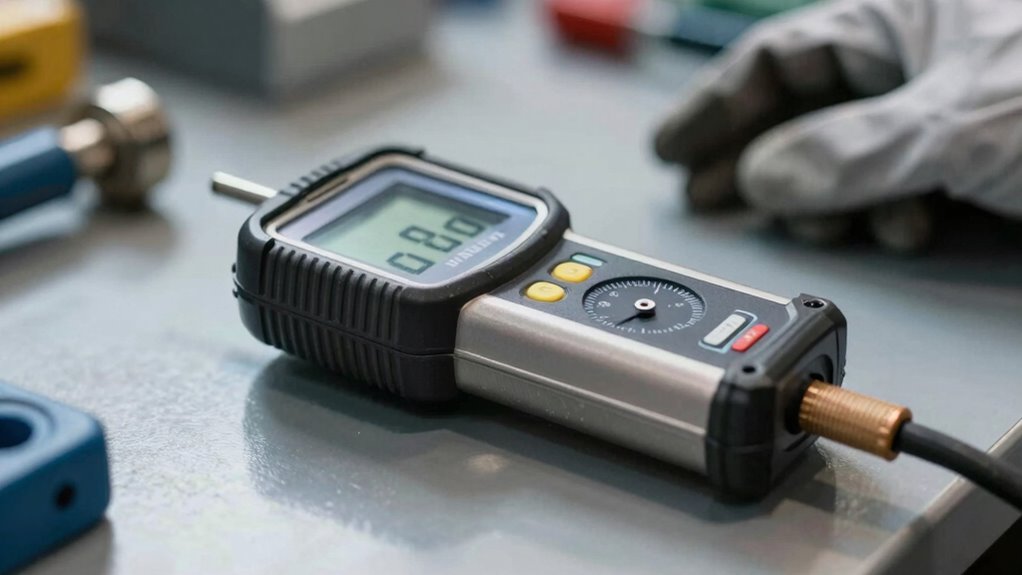
Coating thickness gauges can accurately measure how thick a coating is at specific spots, helping you verify the coating meets standards. However, they can’t assess adhesion quality, chemical composition, or overall uniformity of the entire surface. Proper surface preparation and calibration are essential for reliable results. Keep in mind, these gauges offer valuable data points but don’t replace thorough coating inspections. To make the most of your measurements, learn more about their best practices and limitations.

Get business pricing on tools and workshop supplies
- Business-only prices and quantity discounts
- Tax-exempt purchasing
- Multiple users, one account, clear invoices
Key Takeaways
- Coating thickness gauges accurately measure coating layers’ thickness at specific points but do not assess overall coating uniformity.
- They cannot determine the adhesion quality or chemical composition of the coating.
- Proper surface preparation and calibration are essential for reliable readings.
- Gauges provide data only; they do not replace comprehensive coating inspections or testing.
- They are useful for quality control but should be complemented with other evaluation methods for complete assessment.

Have you ever wondered how professionals guarantee that coatings on surfaces meet quality standards? The answer lies in precise measurement tools like coating thickness gauges, which play a crucial role in ensuring your coating jobs are both effective and durable. But to get accurate readings, you need to understand the importance of proper surface preparation and calibration techniques. Surface preparation is the foundation of any successful coating application. If the surface isn’t clean, smooth, and free of contaminants, the gauge might give false readings, leading to under- or over-coating. Before measurement, you should always clean the surface thoroughly, removing dirt, grease, rust, or old paint layers that could skew the results. This step ensures the coating thickness gauge can make contact with the surface properly, providing a true representation of the coating’s thickness.
Calibration techniques are equally critical. Just as a scale needs calibration to give correct weight readings, a coating thickness gauge requires regular calibration to maintain accuracy. Manufacturers often recommend calibration standards that match the type of surface you’re measuring—be it ferrous or non-ferrous metals. Proper calibration involves using these standards at the beginning of each measurement session or after the gauge has been bumped or dropped. This process ensures that your readings are reliable and consistent across different surfaces and conditions. Without proper calibration, even the most advanced gauges can produce misleading data, which might result in coatings that don’t meet specifications or fail prematurely. Additionally, understanding measurement limitations helps prevent over-reliance on gauge readings alone for assessing coating quality.
When you’re using a coating thickness gauge, keep in mind that it can tell you a lot about the applied coating but not everything. For example, it measures the thickness at specific points, giving you a snapshot of the coating’s uniformity. This allows you to identify areas that may need additional coating or areas where overspray has occurred. However, it can’t assess the adhesion quality or the chemical composition of the coating. Also, the gauge’s accuracy depends heavily on correct surface preparation and calibration; neglecting these steps can lead to erroneous readings. Remember, a well-calibrated gauge and a properly prepared surface are your best tools for making sure your coatings meet the desired standards. They help you catch issues early, avoid costly rework, and ensure the longevity and performance of your coating.
As an affiliate, we earn on qualifying purchases.
Frequently Asked Questions
Can Coating Thickness Gauges Measure Wet or Dry Coatings?
Coating thickness gauges measure dry coating, not wet coating. When you use a gauge, it tells you how thick the coating has dried on the surface. You can’t rely on it to measure wet coating directly because the wet layer’s thickness includes solvents and moisture that evaporate during drying. So, if you need precise dry coating measurements, these gauges are your best tool, but they won’t give accurate wet coating readings.
How Accurate Are Coating Thickness Gauges on Different Materials?
Like a trusty compass in uncharted waters, your coating thickness gauge’s accuracy depends on calibration procedures and your user skill. On different materials, it can be quite precise—if properly calibrated and used correctly. However, unfamiliar surfaces or improper handling can lead to errors. You need to follow manufacturer guidelines carefully and acquire experience to guarantee consistent, reliable readings across diverse substrates.
Do Coating Gauges Work in Extreme Environmental Conditions?
Coating gauges can work in extreme environmental conditions, but you need to take into account environmental limitations like temperature, humidity, and vibration. These factors can affect their readings and reliability. Calibration challenges also arise in harsh environments, so you must regularly calibrate your gauge under those specific conditions to maintain accuracy. Always check the manufacturer’s guidelines for environmental tolerances to ensure your measurements remain trustworthy in challenging settings.
Can Gauges Detect Underlying Corrosion Beneath Coatings?
Like a detective uncovering hidden clues, your coating gauge can sometimes detect underlying corrosion beneath coatings. It provides valuable substrate analysis, revealing areas where corrosion may lurk. However, it’s not foolproof; thick or uneven coatings can obscure corrosion detection. You should combine gauge readings with visual inspections and other methods for a more accurate assessment of underlying corrosion, ensuring you catch issues early and maintain ideal protection.
Are Coating Thickness Gauges Suitable for Non-Metallic Surfaces?
Coating thickness gauges aren’t suitable for non-metallic surfaces because their measurement principles rely on magnetic or eddy current methods, which only work with metals. You’ll find gauge limitations when trying to measure coatings on plastics, wood, or other non-metallic materials. For accurate readings on non-metallic surfaces, you need specialized tools like ultrasonic thickness gauges, which aren’t based on magnetic or eddy current principles.
Conclusion
Coating thickness gauges are essential tools that provide quick, non-destructive measurements, but they have limitations. For instance, they can’t always distinguish between different coating materials or detect underlying flaws. Remarkably, studies show that up to 30% of coatings may be over- or under-applied without proper measurement. So, while these gauges are valuable, always combine them with other inspection methods to ensure your coating quality meets standards.
Halloween Picks
halloween
As an affiliate, we earn on qualifying purchases.