Applying thick coatings can cause priming issues, leading to poor adhesion, air pockets, and trapping solvents or moisture beneath the surface. These problems weaken the bond, causing peeling, blistering, or surface defects over time. It’s best to avoid heavy coats and instead use multiple thin layers for better contact and curing. Continuing to explore these tips will help you understand how to achieve a durable, smooth finish with proper priming techniques.
Key Takeaways
- Thick coatings trap air, solvents, and moisture, impairing proper primer adhesion to the substrate.
- Excessive thickness hampers solvent evaporation and chemical curing, leading to uneven or incomplete adhesion.
- Primers may struggle to bond effectively under thick layers, increasing risk of peeling, blistering, or delamination.
- Applying multiple thin coats promotes better surface contact and stronger primer-to-surface bonding.
- Proper surface prep, environmental conditions, and patience are essential to prevent priming issues with thick coatings.
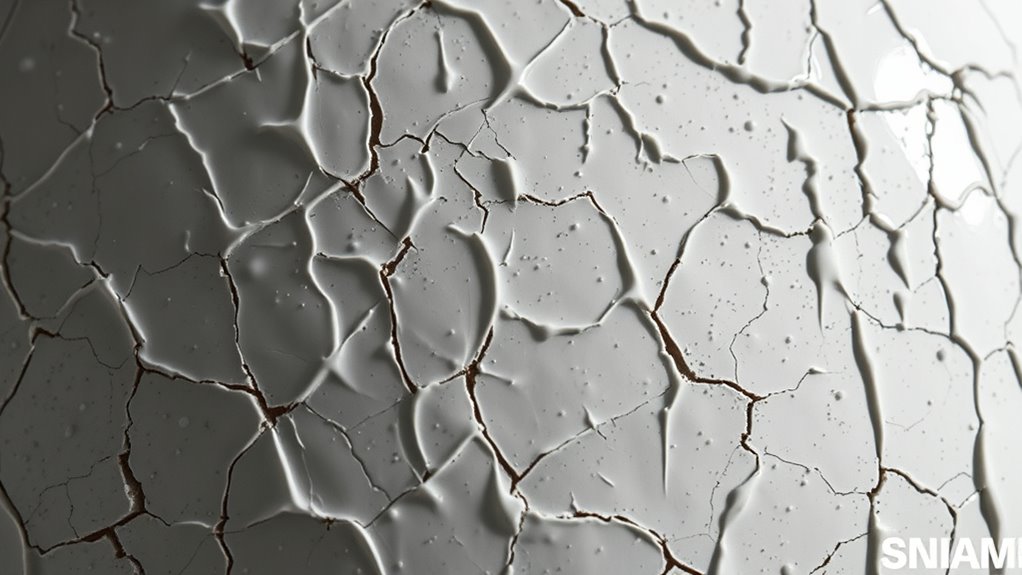
Applying thick coatings can seem straightforward, but it often leads to priming issues that compromise the finish’s durability and appearance. One of the biggest hurdles you’ll face is adhesion challenges. When you apply a coating too thick, the primer beneath might struggle to form a strong bond with the substrate. This is because thick layers can trap air pockets or solvents, preventing proper contact between the primer and surface. As a result, the coating may peel, blister, or delaminate over time, especially in areas subjected to stress or weather changes. To avoid this, you need to guarantee the primer is compatible with your coating and applied in thin, even coats. This allows for better adhesion and a more uniform surface for the top layer.
Applying thick coatings risks trapping air and solvents, leading to poor adhesion and coating failure over time.
Curing problems are another common issue when working with thick coatings. Thick applications hinder the evaporation of solvents and the chemical reactions necessary for proper curing. When the coating doesn’t cure evenly, it can remain sticky or soft in the middle while the outer layers harden. This uneven curing not only affects the appearance, causing sags or runs, but also weakens the coating’s overall integrity. You might notice that the finish becomes prone to scratches or cracks prematurely. To mitigate curing issues, it’s vital to follow manufacturer instructions carefully, applying multiple thin coats rather than one heavy layer. Allow each coat to fully cure before adding the next, which promotes proper solvent evaporation and chemical bonding.
Another challenge related to thick coatings is the increased risk of trapping moisture or solvents beneath the surface. This entrapment can lead to bubbling or blistering as the trapped air expands or the solvents try to escape. Such problems are especially prevalent in humid environments or when the surface isn’t properly prepared. Proper surface prep includes cleaning, sanding, and sometimes priming with compatible products designed for thick applications. Additionally, working in suitable weather conditions—avoiding high humidity or extreme temperatures—helps make certain the coating cures uniformly and adheres properly. Advances in automation technologies have also contributed to more consistent application methods, reducing manual errors that can lead to priming issues.
Ultimately, while it might seem tempting to apply a thick coating all at once to save time, doing so invites significant priming issues. Adhesion challenges and curing problems are common pitfalls that can undermine your project’s success. By understanding these issues and opting for multiple thin coats, you improve adhesion, guarantee proper curing, and achieve a durable, smooth finish that lasts. Patience and proper technique are your best tools for overcoming the inherent difficulties of thick coatings, leading to a professional-looking result that stands the test of time.
Frequently Asked Questions
How Do Temperature Fluctuations Affect Priming With Thick Coatings?
Temperature fluctuations can critically impact your priming process with thick coatings. When temperature stability varies, the primer may not adhere properly, leading to poor coating adhesion and potential peeling or cracking later. You should guarantee a consistent temperature environment to promote uniform drying and bonding. By controlling temperature fluctuations, you help achieve better primer adhesion and a more durable, high-quality finish on your thick coatings.
What Are the Best Primers for Different Surface Types?
Think of priming like choosing the right key for a lock. For metal surfaces, use an oil-based primer to guarantee compatibility and corrosion resistance. For wood, a shellac or latex primer works best for proper surface preparation. For drywall, opt for a water-based primer. Always match your primer to the surface type and check for compatibility, making sure your coating adheres perfectly and lasts longer.
Can Thick Coatings Be Applied Without Primer?
You can apply thick coatings without primer, but it often compromises surface adhesion and coating durability. Primer helps create a uniform surface, guaranteeing the coating bonds well and lasts longer. Without primer, you risk peeling, cracking, or reduced lifespan of your coating. To achieve the best results, especially with thick coatings, using a suitable primer is highly recommended to enhance adhesion and ensure the durability of your finish.
How Long Should I Wait Before Applying a Second Coat?
They say patience is a virtue, and with paint, it’s no different. You should wait at least 24 hours before applying a second coat, allowing the cure time and drying process to complete fully. Rushing it can cause issues like uneven texture or peeling. Check the paint’s instructions for specific drying times, and make certain the first coat feels dry to the touch before adding the next.
What Tools Are Most Effective for Priming Thick Coatings?
You should use a high-quality brush or roller designed for thick coatings to guarantee effective primer adhesion and coating penetration. These tools help you spread primer evenly, reaching deep into textured or uneven surfaces. For best results, consider using a sprayer for smoother application, especially on large areas. Proper tool selection ensures the primer bonds well, preventing issues like peeling or poor adhesion on thick coatings.
Conclusion
Just like trying to paint a wall with too much paint at once, skipping proper priming with thick coatings can lead to uneven results and long-term problems. I once watched a painter struggle because he ignored the priming step—his thick coat cracked and peeled within weeks. Remember, a good primer is like a foundation in a house: it sets the stage for a smooth, lasting finish. Take your time, prime properly, and enjoy a flawless, durable coat.

Franz came aboard the Paint Sprayer Zone team with a background in both journalism and home renovation. His articulate writing style, combined with a passion for DIY projects, makes him an invaluable asset. Franz has a knack for breaking down technical jargon into easy-to-understand content, ensuring that even the most novice of readers can grasp the complexities of paint sprayers.