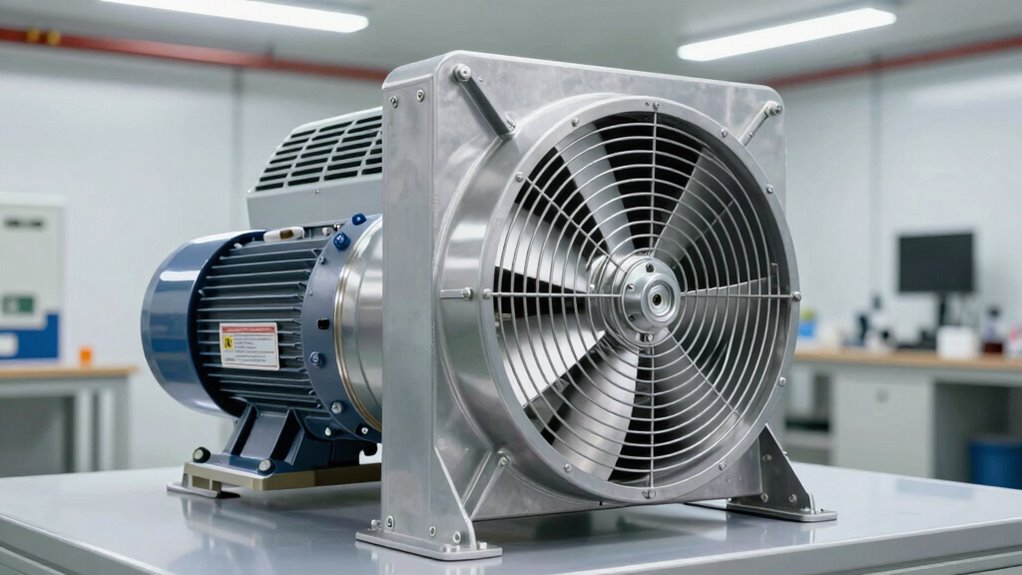

For a paint booth, an explosion-proof fan must match the booth’s hazardous-area requirements as well as its airflow and duct layout. My best overall pick is the VEVOR 16-inch portable fan, which lists the highest stated airflow here at 4,240 CFM, though its no-plug setup calls for electrical planning. The 12-inch utility blower with 25-foot duct suits directed extraction, while the 10-inch portable fan with 32-foot duct favors reach and portability. The main tradeoffs are airflow versus duct pressure, fixed installation versus portability, and ready-to-connect wiring versus a no-plug unit. Read on for the full comparison, selection criteria, and questions to settle before choosing.

Get business pricing on tools and workshop supplies
- Business-only prices and quantity discounts
- Tax-exempt purchasing
- Multiple users, one account, clear invoices
Complete the kit


Key Takeaways
- Stated airflow separates the largest option: VEVOR’s 16-inch fan lists 4,240 CFM, but it has no plug, so buyers must plan the electrical connection.
- Duct length changes the job a fan can do: the 12-inch blower includes 25 feet of duct and the 10-inch portable fan includes 32 feet, giving them a different setup role from axial fans without listed ducting.
- Motor wattage alone does not rank performance: the 550W Dreamdragon and VEVOR 12-inch models, 790W 12-inch utility blower, and lower-wattage axial options list different designs and operating details; compare airflow and pressure data where available.
- Compact ducted options trade capacity for placement flexibility: the 10-inch 32-foot-duct unit can reach farther than a bare axial fan, while the larger 16-inch VEVOR is aimed at moving more air through a suitable installation.
- Product naming is not hazardous-location proof: the listed titles frequently say explosion-proof, but buyers still need model-specific certification, hazardous-area suitability, and installation details before putting any fan in a paint operation.


| explosion proof paint booth fan | Airflow | Motor power |
|---|---|---|
| LIWBYYG Explosion Proof Exhaus | 2,880 m³/h | 250 W |
| 12-Inch Explosion-Proof Utilit | 2,795 CFM (77 m³/min) | 550 W |
| 12-Inch Explosion-Proof Ventil | — | 180 W |
| 10-Inch Portable Explosion-Pro | 1,070 CFM | 195 W |
| 250W Explosion-Proof Axial Ven | — | — |
| Dreamdragon 12-Inch Explosion- | Up to 2720 CFM | — |
| 12 Inch Explosion Proof Portab | Up to 2645 CFM | — |
| DNYSYSJ 12-Inch Explosion-Proo | — | — |
| VEVOR 16-Inch Explosion-Proof | 4240 CFM | 1.1 kW AC |
| 370W Explosion-Proof Axial Duc | — | — |
| 18-Inch Explosion-Proof Axial | 2880 m³/h | 250 W |
| 12" Explosion-Proof Axial Fan | — | — |
| 12-Inch Industrial Axial Exhau | 2650 m³/h | — |
| VEVOR 10-Inch Explosion-Proof | 1942 CFM | 350 W |
| VEVOR 12-Inch Explosion-Proof | — | 550 W |
More Details on Our Top Picks
LIWBYYG Explosion Proof Exhaust Fan, 110V 250W Paint Booth Ventilation Fan, 1450 RPM, 2880 m³/h, for Factories and Warehouses
The LIWBYYG makes the most sense for a paint booth that needs a wall or duct mounted exhaust fan with its airflow and hazardous-atmosphere compatibility clearly specified. Its 2,880 m³/h capacity and 74 Pa wind pressure suit a fixed ventilation setup, while its listed IIA/IIB/IIC Class T1–T4 compatibility gives buyers a more specific atmosphere rating to check against their site requirements. Compared with the 12-Inch Explosion-Proof Utility Blower Fan, it trades portability and a supplied long duct hose for a more compact installation footprint. The tradeoff is 75 dB operating noise, plus indoor-only use and a 110V supply requirement. Buyers should confirm the certification and installation meet their booth’s requirements before use; the product description alone does not establish suitability for every hazardous location.
Pros:- Wall and duct mounting support a fixed booth exhaust layout
- Specified airflow of 2,880 m³/h and wind pressure of 74 Pa
- Lists IIA/IIB/IIC Class T1–T4 atmosphere compatibility
- Metal casing, cast iron motor housing, and aluminum blades
Cons:- Listed noise level reaches 75 dB
- Indoor use only
- Requires a suitable 110V installation
Best for: Paint booth operators planning a fixed indoor wall or duct installation who need stated airflow and atmosphere compatibility details.
Not ideal for: Crews needing a portable blower with a long included hose, or sites without a suitable 110V supply and verified installation conditions.
- Voltage:110 V
- Motor power:250 W
- Speed:1,450 RPM
- Airflow:2,880 m³/h
- Wind pressure:74 Pa
- Noise level:75 dB
- Compatible atmospheres:IIA/IIB/IIC Class T1–T4
- Mounting:Wall mount or duct mount
- Materials:Carbon steel casing, cast iron motor housing, aluminum alloy blades
Our verdict“Choose the LIWBYYG for a fixed indoor booth installation when its stated airflow and atmosphere rating match your site requirements.”
12-Inch Explosion-Proof Utility Blower Fan with 25-Foot Duct Hose
For crews who move extraction between work areas, this blower pairs 2,795 CFM airflow with a 25-foot duct hose, making it more adaptable than the fixed-mount LIWBYYG Explosion Proof Exhaust Fan. Its handle and four rubber feet help with repositioning and stability, while the steel housing, aluminum impeller, and copper-coil motor are suited to industrial ventilation tasks. That portable setup can help route exhaust from a specific work zone without mounting a fan at the booth wall. The tradeoff is a larger, hose-based arrangement that needs room for both the blower and duct run. The listed 66 dB(A) noise level may also be noticeable nearby. For paint booth use, buyers should verify the product’s hazardous-location certification and confirm the airflow arrangement fits their booth design.
Pros:- Supplied 25-foot duct hose supports remote exhaust routing
- Airflow listed at 2,795 CFM
- Portable handle and four rubber feet aid setup and stability
- Steel housing, aluminum impeller, and copper-coil motor
Cons:- The long hose and blower need storage and routing space
- Listed noise level is 66 dB(A)
- Product data provided here does not specify a hazardous-atmosphere class
Best for: Mobile shop or maintenance crews that need to direct exhaust through a supplied long duct hose across changing work areas.
Not ideal for: Operators seeking a compact, permanently mounted booth fan or those without space to route and store a 25-foot hose.
- Fan diameter:12 inches
- Motor power:550 W
- Airflow:2,795 CFM (77 m³/min)
- Noise level:66 dB(A)
- Motor speed:Up to 3,450 RPM
- Duct hose length:25 feet
- Housing and impeller:Steel housing, aluminum impeller
- Motor coil:Copper
- Setup features:Portable handle, four rubber feet, on/off switch
Our verdict“Pick this blower when portable, hose-directed extraction matters more than a compact fixed installation.”
12-Inch Explosion-Proof Ventilation Fan, AC 110V Portable Axial Exhaust Fan, 1450 RPM
This axial fan is aimed at shops that want to move a portable steel-frame unit between ventilation jobs rather than install a permanent exhaust point. Its 180 W pure copper motor runs at 1,450 RPM, and the product lists a 66 dB noise level. An explosion-proof switch is specified, giving it a different stated feature from the LIWBYYG Explosion Proof Exhaust Fan, which instead lists wall and duct mounting plus atmosphere classes. That distinction matters: a switch description alone does not establish a fan’s hazardous-location suitability, so buyers should verify the full certification for paint booth service. The listing’s airflow figure is given as 2,280 m³/min, an unusually high unit that should be confirmed before comparing performance. Its 110V supply and industrial frame also limit where it fits.
Pros:- Portable steel boxed frame supports repositioning
- Pure copper motor is specified
- Explosion-proof switch is listed
- Four-blade axial design with 1,450 RPM speed
Cons:- Listed airflow unit should be confirmed before performance comparisons
- Requires AC 110V power
- The explosion-proof switch description does not provide a full atmosphere class
Best for: Workshop operators who need a portable axial fan for repositioning among industrial ventilation tasks and can verify its ratings before booth use.
Not ideal for: Buyers who need clearly comparable airflow data, a fixed wall or duct installation, or confirmed hazardous-location certification for a paint booth.
- Diameter:12 inches (355 mm)
- Motor power:180 W
- Voltage:AC 110V
- Speed:1,450 RPM
- Airflow capacity:2,280 m³/min (as listed)
- Noise level:66 dB
- Blades:Four thick blades
- Motor coil:Pure copper
- Frame and switch:Portable steel boxed frame; explosion-proof switch
Our verdict“Consider this portable fan for workshop ventilation only after confirming its airflow unit and hazardous-location certification.”
10-Inch Portable Explosion-Proof Exhaust Fan with 32 ft Flexible Duct Hose, Heavy-Duty Industrial Air Mover for Extraction, Ventilation, and Fume Removal
The 10-inch blower stands out for its 32-foot reinforced flexible duct and rotating discharge outlet, a useful combination when exhaust must travel around obstacles or away from a work area. Its 1,070 CFM rating is below the listed 2,795 CFM of the 12-Inch Explosion-Proof Utility Blower Fan, so this is the more targeted option for longer duct routing rather than the lineup’s higher stated airflow. GFCI protection and an IP44 housing add specified electrical and splash protection for damp or exposed locations, but IP44 does not mean submersion protection. The compact, plug-in setup should be easier to move than a wall-mounted LIWBYYG, though it still depends on an AC outlet and a properly planned duct run. Verify its hazardous-location suitability for the intended paint booth.
Pros:- 32-foot steel-wire reinforced PVC duct supports extended routing
- 180° rotating discharge helps direct the outlet
- GFCI protection and IP44 housing are specified
- Handle and non-slip feet support portable setup
Cons:- Listed airflow of 1,070 CFM is lower than the 12-inch utility blower’s stated 2,795 CFM
- Requires access to an AC outlet
- IP44 does not cover submersion or heavy water exposure
Best for: Paint and maintenance crews that need a portable fan with a long flexible duct to route exhaust around a shop or away from a work zone.
Not ideal for: Buyers prioritizing higher listed airflow, cordless operation, heavy water exposure, or a permanent wall-mounted booth fan.
- Fan diameter:10 inches
- Motor power:195 W
- Airflow:1,070 CFM
- Duct hose:32 feet, PVC with steel-wire helix
- Discharge outlet:Rotates 180°
- Electrical protection:GFCI
- Ingress protection:IP44
- Housing:Powder-coated steel
- Power source:AC plug-in
Our verdict“Choose this model when long, flexible duct routing matters more than maximizing the listed airflow.”
250W Explosion-Proof Axial Ventilation Fan, 2880 m³/h
This 250 W axial fan offers a straightforward choice for buyers who need wall or ventilation-duct mounting and a stated 2,880 m³/h air volume. Its carbon steel shell, cast iron motor housing, and aluminum blades resemble the fixed-installation LIWBYYG, which lists the same airflow and 74 Pa wind pressure. The LIWBYYG also specifies IIA/IIB/IIC Class T1–T4 compatibility, so buyers who need atmosphere-class information have more to check in that listing. This model’s product data instead specifies a pure copper motor and ball bearings, useful construction details for a planned stationary setup. At 75 dB and roughly 17.91 × 11.02 inches, it needs a suitable mounting location and noise tolerance. Confirm the hazardous-location rating and booth compatibility before relying on it for paint fume exhaust.
Pros:- Wall or duct installation supports a fixed exhaust layout
- Air volume listed at 2,880 m³/h
- Pure copper motor and ball bearings are specified
- Metal shell, motor housing, and blades
Cons:- Listed noise level is 75 dB
- Mounting dimensions may constrain placement
- Supplied data does not state an atmosphere class
Best for: Facilities teams seeking a metal axial fan for a fixed wall or duct exhaust point and able to verify the required safety rating.
Not ideal for: Buyers who need a portable hose-equipped blower or require a stated atmosphere class in the supplied product data.
- Power:250 W
- Rotation speed:1,450 RPM
- Air volume:2,880 m³/h
- Wind pressure:74 Pa
- Noise level:75 dB
- Dimensions:17.91 × 11.02 inches (D × H)
- Motor:Pure copper
- Mounting:Wall mounted or installed in a ventilation duct
- Materials:Carbon steel shell, cast iron motor housing, aluminum blades
Our verdict“Choose this axial fan for a fixed wall or duct exhaust point if its verified safety rating matches the booth environment.”
Dreamdragon 12-Inch Explosion-Proof Blower Fan, 550W, 3450 RPM, 110V
The Dreamdragon pairs a 12-inch blower with up to 2720 CFM, making it a fit for paint areas where moving fumes through a confined workspace matters more than covering a broad open floor. Its stated explosion-proof construction, sealed wiring, and flame-resistant components are aimed at hazardous-location use; buyers still need to confirm the unit’s suitability for their specific booth and applicable requirements. Compared with the DNYSYSJ 12-Inch Axial Flow Fan, this model runs at a much higher stated speed and offers slightly more airflow, while the DNYSYSJ is lighter on power and quieter by the listed figures. The Dreamdragon adds thermal protection, a carry handle, and non-slip feet for practical handling. Its 69 dB noise level may be intrusive, and the 6.6-foot cord has no plug, so installation needs suitable electrical work.
Pros:- Listed airflow reaches 2720 CFM
- Explosion-proof construction with sealed wiring and flame-resistant components
- Thermal protection, carry handle, and non-slip feet
- IP44 splash rating
Cons:- 6.6-foot power cord has no plug and requires wiring
- Listed 69 dB noise level may be disruptive
- Airflow and hazardous-location suitability should be checked against the booth’s requirements
Best for: Paint-shop operators needing a portable 12-inch blower for an enclosed work area and able to arrange hardwiring.
Not ideal for: Buyers seeking a quiet fan, a plug-in setup, or airflow documentation matched to a specific booth design.
- Fan size:12 inches
- Power:550 W
- Voltage and frequency:110 V / 60 Hz
- Speed:3450 rpm
- Airflow:Up to 2720 CFM
- Noise level:69 dB
- Power cord:6.6 ft, no plug
- Mounting:Wall or floor
Our verdict“Choose the Dreamdragon for a portable, higher-speed 12-inch blower when its wiring requirements and noise level suit the workspace.”
12 Inch Explosion Proof Portable Utility Blower Fan, 790W Industrial Ventilator Extractor
This 790W utility blower is the higher-power portable choice among the 12-inch options here, with steel housing and NSK bearings specified alongside its explosion-proof construction. Its listed 2645 CFM is slightly below the Dreamdragon 12-Inch Blower Fan’s 2720 CFM, so the larger motor rating does not translate into the highest stated airflow in this group. Buyers should weigh the sturdy build and portable handle against that distinction rather than treating wattage as a direct measure of extraction performance. Rubber feet help stabilize it during placement, but this remains a heavy-duty unit that may be awkward to move often. The 7A draw calls for a suitable electrical supply, and the listing provides no cord or plug details here, so installation planning matters for a paint booth.
Pros:- Listed airflow up to 2645 CFM
- Steel housing with NSK bearings
- Explosion-proof construction and wiring are specified
- Carry handle and rubber feet support portable placement
Cons:- Draws 7A, requiring a suitable supply
- Heavy-duty build may be bulky to reposition
- No plug or power-cord details are provided in the product data
Best for: Workshop owners who need a portable 12-inch blower with specified steel construction and can accommodate its 7A electrical draw.
Not ideal for: Buyers prioritizing the highest listed airflow, low power demand, or a clearly specified plug-and-play connection.
- Diameter:12 inches
- Power:790 W
- Current:7 A
- Airflow:Up to 2645 CFM
- Speed:3420 RPM
- Housing:Steel
- Bearings:NSK
- Insulation:F-grade enameled wire
Our verdict“Pick this model for a sturdily built portable blower when its power draw matters less than its industrial construction.”
DNYSYSJ 12-Inch Explosion-Proof Axial Flow Fan, 110V, 180W
The DNYSYSJ is the lower-power axial option, rated at 180 W while listing 2280 m³/h of airflow and a 62 dB noise level. Its metal guards on both sides and support for vertical or horizontal installation make it better suited to a planned mounting position than the portable blower designs. Compared with the Dreamdragon 12-Inch Blower Fan, it has a lower listed power draw and noise level, but also lower airflow when the figures are converted to the same units. The Ex d II BT4 Gb marking is a specific designation in the product data; buyers need to verify that it matches the atmosphere and requirements of their paint-booth installation. No plug is included, so wiring is part of the setup, and the stated 60 wind pressure lacks a unit in the supplied specs.
Pros:- 180 W motor with listed airflow of 2280 m³/h
- Metal protective mesh on both sides
- Supports vertical or horizontal installation
- Listed 62 dB noise level
Cons:- Plug is not included and customer wiring is required
- Lower listed airflow than the Dreamdragon 12-Inch Blower Fan
- Specified for particular explosive gas or vapor environments that must match the installation
Best for: Facility operators planning a fixed 12-inch axial fan installation who want a lower-power unit with a stated explosion-proof marking.
Not ideal for: Users who need a ready-to-use portable blower, a plug-in connection, or airflow data stated in CFM.
- Model:CBF-300
- Voltage:AC 110 V
- Power:180 W
- Impeller diameter:300 mm
- Product dimensions:355 mm diameter × 277 mm height
- Air volume:2280 m³/h
- Spindle speed:1450 RPM
- Noise level and weight:62 dB; 10 kg
- Explosion-proof marking:Ex d II BT4 Gb
Our verdict“Choose the DNYSYSJ for a lower-power, guarded axial fan when fixed mounting and customer wiring fit the project.”
VEVOR 16-Inch Explosion-Proof Portable Ventilation Fan, 4240 CFM, No Plug
With 4240 CFM listed airflow, this VEVOR is the clear high-volume choice in this batch, well above the 12-inch Dreamdragon and DNYSYSJ models. Its 16-inch axial fan, steel structure, four wheels, and two carry handles suit larger work areas where moving substantial air and repositioning a heavy unit are priorities. The wheels make it more mobile than a fixed axial fan, though its dimensions—over 27 inches long—make storage and tight booth access harder. ETL and ATEX certifications are listed, but a buyer still needs to confirm the exact fan and installation meet the relevant paint-booth requirements. IP44 water resistance and overheating protection add practical safeguards. The 1.1 kW motor and cord without a plug mean electrical planning is required before it can be put to work.
Pros:- Listed airflow of 4240 CFM
- Four wheels and two carry handles aid repositioning
- ETL and ATEX certifications are listed
- Includes overheating protection and IP44 water resistance
Cons:- Large dimensions can limit access and storage
- Power cord has no plug
- 1.1 kW motor requires suitable electrical provision
Best for: Operators ventilating a larger workshop or booth who need high stated airflow and have room to maneuver a wheeled fan.
Not ideal for: Small paint areas, cramped storage spaces, or buyers who need a fan supplied with a plug.
- Fan diameter:16 inches
- Motor power:1.1 kW AC
- Airflow:4240 CFM
- Dimensions:27.36 × 18.90 × 23.23 inches
- Power cord:16.4 ft, no plug
- Certifications:ETL and ATEX
- Construction:Steel structure with corrosion-resistant coating
- Portability:Four wheels and two carry handles
Our verdict“Choose this VEVOR when a larger workspace needs substantially more stated airflow and can accommodate its size and wiring.”
370W Explosion-Proof Axial Duct Exhaust Fan
This axial duct fan makes the most sense when the installation details lead the decision: the listing specifies a base, protective metal mesh, cast aluminum blades, and a copper-coil motor. Those material and mounting details help buyers plan how the fan may fit into a workshop or factory ventilation setup. However, unlike the VEVOR 16-Inch Portable Ventilation Fan, this model has no airflow capacity or dimensions provided, leaving two key paint-booth sizing questions unanswered. Its 370 W motor and 1450 RPM speed do not by themselves establish extraction performance. The listing describes an explosion-proof motor design, but provides no certification marking here, so buyers should verify suitability for their hazardous location before specifying it. This is a weaker choice for anyone comparing booth airflow directly; its value is in the installation and component information that is available.
Pros:- Copper-coil motor
- Cast aluminum fan blades
- Protective metal mesh guard
- Base included for installation
Cons:- Airflow capacity is not specified
- Dimensions are not provided
- No explosion-proof certification marking is included in the supplied product data
Best for: Ventilation contractors or workshop operators who already have system sizing data and need a base-mounted axial fan with specified materials.
Not ideal for: Paint-booth buyers who need documented airflow, physical dimensions, or a listed explosion-proof certification before selection.
- Power:370 W
- Motor speed:1450 RPM
- Motor coil:Pure copper
- Fan blade material:Cast aluminum
- Motor housing material:Cast iron
- Protection:Metal mesh guard
- Mounting:Base included
Our verdict“Consider this fan only when its mounting and material details fit a project whose airflow and hazardous-location requirements are verified separately.”
18-Inch Explosion-Proof Axial Exhaust Fan
The 2880 m³/h airflow and 18-inch format make this a strong fit for a fixed booth exhaust setup where moving a large volume of air matters more than portability. Its iron-and-aluminum construction and protective grilles suit wall or duct installation, while the 1450 rpm speed is lower than the 2800 rpm listed for the 12-Inch Industrial Axial Exhaust Fan. That makes the two better suited to different installation needs: this model prioritizes a larger impeller, while the 12-inch option offers a one-way valve and a lighter listed weight. I’d shortlist this fan for a sheltered indoor installation, but its wired connection and missing plug call for a compatible electrical setup. Its stated environmental limits also rule out exposed locations.
Pros:- Listed airflow of 2880 m³/h for substantial ventilation demand
- Supports wall mounting or internal duct installation
- Metal construction with protective mesh grilles
- 1450 rpm motor speed suits a fixed ventilation role
Cons:- Requires wired installation because no plug is included
- Indoor use is limited to locations protected from liquids
- Specified operating range is limited to -4°F to 104°F
Best for: Shops planning a sheltered, fixed wall or duct exhaust installation that needs the listed 2880 m³/h airflow.
Not ideal for: Buyers needing a portable fan, plug-in setup, or installation exposed to rain, snow, or temperatures outside its stated range.
- Motor power:250 W
- Voltage:110 V
- Airflow:2880 m³/h
- Impeller diameter:400 mm (15.75 in)
- Spindle speed:1450 rpm
- Wind pressure:74 Pa
- Noise level:65 dB
- Explosion-proof mark:Exdll BT4Gb
- Mounting:Wall mount or internal duct installation
Our verdict“Choose this for high-volume, sheltered booth ventilation when a fixed wired installation is already planned.”
12″ Explosion-Proof Axial Fan for Cylinder Pipe, Spray Booth & Paint Fume Exhaust
This 12-inch fan is positioned specifically for spray-booth fume exhaust, with a stated 2280 m³/h air volume and a pure-copper motor. Compared with the larger 18-Inch Explosion-Proof Axial Exhaust Fan, it has a smaller footprint and lower 120 W power rating, which may suit a compact wall or duct opening; the 18-inch model lists higher airflow at 2880 m³/h. Both need a planned installation rather than a simple portable setup, and this model’s metal housing and meshes on both ends are practical for ducted use. The tradeoff is that the product data gives no weight or noise figure, so I can’t compare those factors reliably. Buyers should also account for the wall or duct setup needed to use it.
Pros:- Product description specifically identifies spray-booth paint-fume exhaust
- Listed air volume of 2280 m³/h
- Pure-copper motor and all-metal housing
- Protective mesh on both ends and wall or duct mounting options
Cons:- Requires a prepared wall or duct installation
- Metal construction may be heavier to handle than a plastic fan
- Product data does not state noise level or net weight
Best for: Paint-shop operators fitting a 12-inch wall opening or ventilation duct who want a fan described for booth fume removal.
Not ideal for: Buyers who need a portable unit, documented noise and weight figures, or the higher stated airflow of the 18-inch model.
- Fan diameter:12 inches
- Power:120 W
- Air volume:2280 m³/h
- Speed:1450 rpm
- Air pressure:60 Pa
- Motor:Pure copper wire core
- Housing:All-metal with protective mesh on both ends
- Mounting:Wall or ventilation duct
Our verdict“Pick this for a compact, fixed paint-fume duct setup when the installation can accommodate its 12-inch format.”
12-Inch Industrial Axial Exhaust Fan, 125W, 2800 RPM
The standout here is its one-way exhaust valve, which helps limit reverse airflow through the opening when the fan is off. That gives it a distinct role beside the 12″ Explosion-Proof Axial Fan for Cylinder Pipe, Spray Booth & Paint Fume Exhaust: both are 12-inch axial models, but this one lists a higher 2800 rpm speed and a valve, while the other is described specifically for spray-booth fume extraction and lists a pure-copper motor. The seven stainless-steel blades and iron housing offer a durable construction profile, and the stated 2650 m³/h airflow is substantial for its size. Installation needs careful orientation and wall-gap sealing. The product data does not provide an explosion-proof certification or mark, so buyers should verify suitability for their hazardous-area requirements before treating it as an explosion-proof booth fan.
Pros:- One-way valve helps prevent reverse airflow
- Listed airflow of 2650 m³/h
- Seven 201 stainless-steel blades
- Copper motor with stated speed of 2800 rpm
Cons:- Product data does not state an explosion-proof certification or mark
- Valve must face outward and wall gaps need sealing
- Noise is listed at up to 65 dB(A)
Best for: Installers needing a 12-inch outward exhaust with a one-way valve for a properly assessed, non-hazardous or verified-suitable application.
Not ideal for: Buyers who require documented explosion-proof certification for a hazardous paint booth or need a portable fan.
- Fan size:12 inches
- Power:125 W
- Airflow:2650 m³/h
- Voltage:110 V
- Speed:2800 rpm
- Blades:7, 201 stainless steel
- Exhaust method:One-way
- Hole diameter:30 cm (11.8 in)
- Net weight:4.5 kg (9.92 lb)
Our verdict“Consider it for one-way wall exhaust only after confirming that its hazardous-area suitability meets your booth requirements.”
VEVOR 10-Inch Explosion-Proof Industrial Portable Fan, 350W, 1942 CFM, 9.8 ft Power Cord, No Plug
Among these options, the VEVOR 10-inch fan is the clearest choice when portability and stated certifications matter: it has a handle, rubber feet, a 9.8-foot cord, and listed ETL and ATEX certifications. Its 1942 CFM figure is expressed in different units from the m³/h figures on the fixed axial models, so I wouldn’t compare those numbers without conversion and matching conditions. Compared with the VEVOR 12-Inch Explosion-Proof Industrial Ventilation Fan, this model adds a stated IP44 rating and thermal protection, while the 12-inch option lists a larger 550 W motor and 3450 rpm. The 10-inch fan’s no-plug cord still requires electrical work, and IP44 splash resistance does not make it suitable for submersion or unrestricted outdoor exposure.
Pros:- Product data lists ETL and ATEX certifications
- Portable handle and non-slip rubber feet
- 9.8-foot power cord
- Thermal protection and stated IP44 rating
Cons:- No plug is included, so electrical setup is required
- IP44 indicates splash resistance, not full waterproofing
- 10-inch format may not match larger fixed booth openings
Best for: Industrial users who need a movable 10-inch fan with stated ATEX and ETL certifications and can arrange its electrical connection.
Not ideal for: Buyers who need a plug-in unit, fully waterproof protection, or a fixed wall fan sized for a booth opening.
- Fan size:10 in
- Motor power:350 W
- Airflow:1942 CFM
- Motor type:AC motor
- Power cord length:9.8 ft
- Plug:Not included
- Construction:Steel
- Certifications:ETL, ATEX
- Features:Portable handle, non-slip feet, thermal protection
Our verdict“Choose this for movable industrial ventilation where its stated certifications fit the application and a no-plug connection is acceptable.”
VEVOR 12-Inch Explosion-Proof Industrial Ventilation Fan, 550W
This VEVOR’s listed 550 W motor and 3450 rpm speed set it apart from the fixed 12-inch models in this group, which list 120 W at 1450 rpm and 125 W at 2800 rpm. That makes it the higher-powered option on paper for buyers seeking a 12-inch axial fan, though the product data gives no airflow figure, so I can’t rank its actual air-moving capacity against them. It is described for industrial and potentially explosive environments, but unlike the VEVOR 10-Inch Explosion-Proof Industrial Portable Fan, the supplied details do not list ATEX or ETL certifications, a handle, or thermal protection. Its 9.8-foot cord has no plug, so the electrical connection needs planning. I’d choose it for a compatible fixed or jobsite ventilation setup where the motor specification matters more than published airflow data.
Pros:- 550 W motor is the highest stated power among these five products
- Listed motor speed of 3450 rpm
- 12-inch axial-flow format
- 9.8-foot cord provides some placement flexibility
Cons:- No plug included, requiring electrical setup
- Product data does not provide an airflow figure
- No ATEX or ETL certification is listed in the supplied details
Best for: Industrial buyers selecting a 12-inch axial fan based on its stated motor power and speed who can verify application suitability and arrange wiring.
Not ideal for: Paint-booth operators who need a published airflow figure or documented ATEX/ETL certification in the available product data.
- Fan diameter:12 inches (300 mm)
- Motor power:550 W
- Motor speed:3450 rpm
- Voltage:110 V
- Frequency:60 Hz
- Fan type:Axial flow
- Cord length:9.8 ft
- Plug:Not included
- Switch:Explosion-proof
Our verdict“Choose it when a 12-inch format and high stated motor power are priorities, after verifying airflow and hazardous-area suitability for your setup.”

How We Picked
I compared the 15 listings by the details a paint-booth buyer can act on: stated airflow, fan style, size, motor and speed data, included ducting, portability, power connection, and intended installation. I gave more weight to models with concrete, decision-useful specifications and a clear fit for a defined job. That puts the 16-inch VEVOR first for its stated 4,240 CFM, while its no-plug design keeps it from being a simple drop-in choice. Ducted utility blowers rank well for extraction layouts that need a hose run; compact axial fans make more sense where size and a direct airflow path matter.
I treated missing or inconsistent specifications as a limitation rather than filling gaps with assumptions. Several products share similar titles or figures, so the list distinguishes them by the details supplied, not by presumed performance differences. Before ranking any of these as suitable for hazardous paint-vapor service, a buyer should verify the exact unit’s certification, motor and electrical configuration, and compatibility with the booth and applicable requirements. The ordering reflects the available listing information and practical fit, not independent performance or safety testing.
Factors to Consider When Choosing Explosion Proof Paint Booth Fan
Choosing a fan for a paint booth starts with the booth and the process, not the biggest number in a product title. I would settle the airflow path, hazardous-area requirements, and connection plan before comparing motor wattage or fan diameter. These factors help separate a fan that can move air in a simple setup from one that is suitable for the actual installation.
Verify hazardous-area suitability
The words “explosion-proof” in a listing title do not identify which hazardous locations the unit is approved for. Ask for the exact model’s certification documents and confirm the ratings cover the paint, solvent vapors, and location where the fan will operate. Check whether the motor, switches, wiring, and any supplied controls are included in that approval. A fan with strong airflow is still the wrong choice if its electrical equipment does not match the site classification. Have the responsible safety or electrical professional review the full installation before purchase.
Match airflow to the booth and duct route
Airflow figures are useful only when they describe conditions close to your intended setup. Duct length, bends, filters, grilles, and the booth opening can reduce delivered airflow, so a free-air rating may not represent what reaches the work area. Ask for a fan curve or static-pressure data if the manufacturer provides it, then compare that with the planned duct system. A larger fan is not automatically the better fit if the duct route creates resistance or the booth needs a controlled, even flow. Size the system around the booth design and applicable ventilation requirements.
Choose axial or utility blower around the air path
Axial fans move air along the fan’s axis and are often suited to a more direct intake or exhaust path. Utility blowers with ducting can direct air into or out of harder-to-reach spaces, but the hose and its route affect installation and airflow. Before choosing, sketch the intake, fan position, duct run, and discharge point rather than relying on the product name. A long hose can solve a placement problem while adding bends and resistance that a short, direct setup avoids. The right format depends on where the air must travel and how the booth is arranged.
Plan the electrical connection before ordering
Listings that specify 110V still may not provide a plug, and some products explicitly say “no plug.” Confirm voltage, current, phase, wiring method, cord length, and any required disconnect or control equipment with the supplier. Do not assume a no-plug model can be connected like a household fan or that a cord supplied with another listing will fit your site. Include the installed electrical components in the hazardous-area review, since the connection affects the safety of the whole system. This check can rule out a seemingly convenient option before it arrives.
Read airflow and power figures together
Wattage and RPM describe parts of a motor and fan setup, but neither figure alone tells you how much air the unit will deliver through your ductwork. Compare stated airflow, pressure information, fan diameter, and motor data as a group. If an important number is missing, request it rather than treating a higher wattage as proof of better extraction. Also check whether figures use comparable units and test conditions before comparing listings. This is especially useful here, where the products range from 125W and 180W axial models to higher-wattage blowers and larger fans.
Account for maintenance and replacement access
Paint work can leave filters, ducts, and nearby surfaces coated with residue, so consider how each part can be inspected and cleaned under the maker’s instructions. Check whether the fan can be accessed without dismantling the booth, how duct sections attach, and whether replacement components are available. A portable fan may be easier to reposition but still needs a stable location and a safe way to manage its hose and cable. Avoid assuming that a “heavy-duty” label tells you how the unit will hold up to a particular coating process. A maintainable layout can matter more over time than a small difference in listed motor power.
Frequently Asked Questions
Can I use any fan labeled explosion-proof in a paint booth?
No. The label in a product title is not enough to confirm that a particular model is certified for the booth’s hazardous location and the vapors involved. Request the model-specific certificate and installation instructions, then have the responsible safety or electrical professional check them against site requirements. Confirm the full electrical setup, including switches and connections, not only the fan housing or motor. If the seller cannot provide the relevant documentation, do not treat the listing wording as proof of suitability.
Is the 16-inch VEVOR a better choice than a 12-inch fan?
It may suit a job that needs its stated 4,240 CFM, but fan diameter alone does not settle the choice. The 16-inch listing says it has no plug, which adds connection planning, and delivered airflow can differ once ducting and other resistance are part of the setup. A 12-inch ducted blower may fit better when the task depends on directing air through a hose. Compare pressure and installed airflow information, then match the option to the booth layout and electrical plan.
Should I choose a fan that includes duct hose?
Included duct hose is helpful when the fan must sit away from the booth opening or direct air to a specific discharge point. In this roundup, the 12-inch utility blower lists 25 feet of hose and the 10-inch portable unit lists 32 feet, but longer duct routes can add resistance and complicate placement. Check the hose diameter, material, connection method, and permitted use for the paint environment. If your layout allows a short, straight run, a fan without an included hose may be simpler to integrate.
What information should I request when a listing omits airflow or pressure data?
Ask for rated airflow with its test conditions, static pressure or a fan curve, electrical current, and the exact model number. Also request hazardous-location certification documents and installation limits for the intended environment. These details let you compare units more meaningfully than motor wattage or RPM by itself. If the supplier cannot provide basic performance and approval information, you will have little basis for confirming fit. Keep the seller’s answers with the product documentation for the installer’s review.
Can a portable ventilation fan serve as a permanent paint-booth exhaust fan?
Portability describes how a fan can be moved; it does not confirm that the fan is suitable for permanent booth service. A permanent system may need a specific airflow capacity, duct arrangement, electrical installation, and approvals that the portable listing does not establish. Check the manufacturer’s permitted duty and installation method, and verify requirements for the booth and process. A fixed axial fan may be easier to integrate into a designed exhaust path, while a portable blower can suit temporary or directed ventilation when allowed. Get the system reviewed before using it with paint vapors.
Conclusion
For the broadest stated airflow, I would start with the VEVOR 16-inch portable fan as the best overall candidate, provided its no-plug connection and model-specific hazardous-area documents fit the installation. The 250W, 2,880 m³/h axial options are the value-minded picks when a direct airflow path suits the job and their documentation checks out. Beginners should favor a clearly documented unit with a straightforward installation plan, rather than selecting by wattage or the “explosion-proof” label alone. For a premium, higher-capacity direction, compare the 16-inch VEVOR with the 18-inch axial exhaust fan after obtaining comparable airflow and pressure data. If your main need is reaching a distant extraction point, consider the 12-inch blower with 25-foot duct or the 10-inch fan with 32-foot duct. In every case, make certification, delivered airflow, and electrical suitability the final filters.
Fall yard work Picks
leaf blowers
As an affiliate, we earn on qualifying purchases.