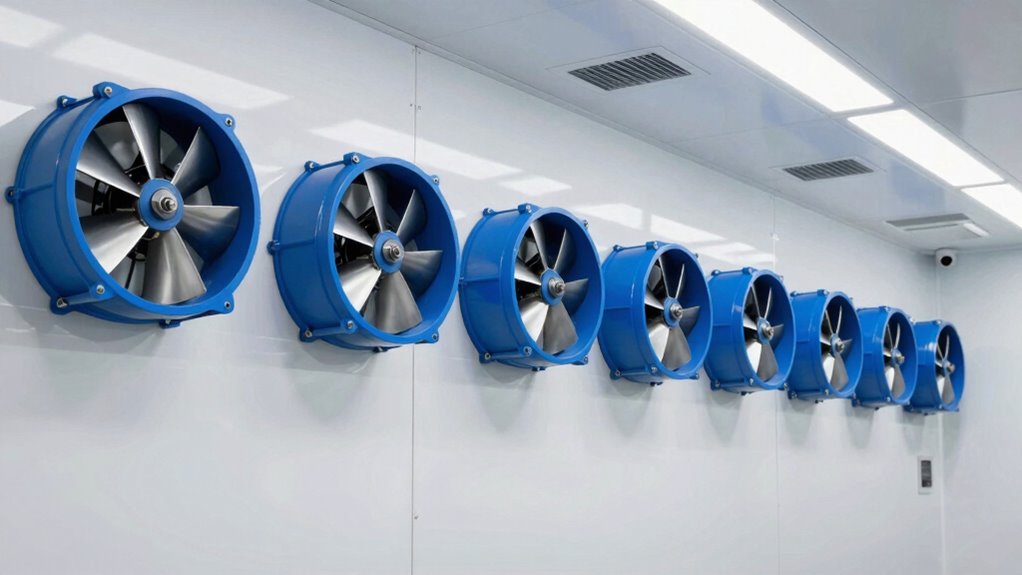

Choosing the right axial fan for paint booth ventilation comes down to one central tradeoff: raw airflow versus safety certification, with budget sitting somewhere in between. Non-explosion-proof blowers like the 16-Inch Portable Axial Exhaust Fan (4238 CFM) move serious air for the money, but solvent-laden fumes demand an explosion-proof motor housing — which is why the 16″ Explosion-Proof Axial Fan with 550W Cylinder Pipe Exhaust takes my best overall spot for dedicated spray booths. For high-volume professional shops, the TECHTONGDA 24-Inch Blower at nearly 11,000 CFM is the airflow king, while the YIPONYT 12-Inch Inline Duct Fan wins on value for smaller booths. Read on for the full breakdown, including which fans belong in the booth and which are better kept for general shop ventilation.

Get business pricing on tools and workshop supplies
- Business-only prices and quantity discounts
- Tax-exempt purchasing
- Multiple users, one account, clear invoices
Complete the kit


Key Takeaways
- Explosion-proof certification is the single biggest dividing line in this lineup: seven of the thirteen fans carry it, and only those should exhaust flammable solvent fumes from an active spray zone.
- The 16-inch fan class emerged as the sweet spot for typical two-car-size booths, balancing CFM, duct compatibility, and manageable single-person handling — which is why the 550W explosion-proof 16″ model ranks best overall.
- CFM claims varied wildly against wattage: the 24-inch TECHTONGDA genuinely delivers industrial-scale airflow, while some 250W units claim CFM figures their motor class can barely support — match expectations to power draw, not marketing numbers.
- Ducting is the hidden cost: fans bundled with flexible duct (the MOUNTO 12-inch with 25-foot hose and the 16-inch portable with 5 m duct) save a separate purchase that often runs high, while bare units assume you already own compatible hose.
- Sub-12-inch utility blowers are fine for drying, cooling, or non-flammable dust, but none of them belong inside or directly exhausting a paint booth — a common and dangerous mistake this comparison makes easy to avoid.


| axial fan for paint booth ventilation | Power | Speed | Noise Level | Airflow |
|---|---|---|---|---|
| 16-Inch Portable Axial Exhaust | 1100 W at 110 V | — | — | 4238 CFM (120 m³/min) |
| 10-Inch Explosion-Proof Axial | 250 W at 110 V | 1420 rpm | — | — |
| 15.75in Explosion Proof Axial | 250 W at 110 V | 1450 rpm | 65 dB | — |
| 16" Explosion Proof Axial Fan | 550 W | 1420 rpm | 71 dB | — |
| MOUNTO 12-Inch Heavy-Duty Axia | 550 W, 120 V single-speed motor | 3,300 RPM | 78 dB | 2,900 CFM |
| 12-Inch Explosion-Proof Axial | — | 1450 rpm | — | 2280 m³/h |
| 16" Explosion-Proof Axial Fan | — | 1420 rpm | 71dB | — |
| 16" Explosion Proof Axial Fan | 370W, 110V 60Hz | 1420 RPM | 70–71 dB | — |
| 16-Inch Explosion-Proof Axial | — | 1,420 rpm | 71 dB | 2,675–5,400 m³/h |
| TECHTONGDA 24-Inch Axial Blowe | — | — | — | 10,982 CFM |
| YIPONYT 12-Inch Inline Duct Ve | 180 W, AC | — | 62 dB | 2280 m³/h |
| 250W Explosion-Proof Axial Ven | 250 W | — | 75 dB | 2880 m³/h |
| 12-Inch Utility Blower Fan wit | — | — | — | — |
More Details on Our Top Picks
16-Inch Portable Axial Exhaust Fan with 5 m Flexible Duct, 110 V, 1100 W, 4238 CFM
This option stands out for sheer airflow — at 4238 CFM, it moves more air than everything else in this batch except the much larger 24-inch TECHTONGDA blower, and it does so while staying plug-and-play portable. The bundled 5-meter flexible duct is what makes it my top pick for paint booth work: you can position the fan outside the spray zone and pull fumes through the duct, which keeps the motor away from overspray and solvent vapor. Compared with the MOUNTO 12-inch, you get roughly 45% more airflow plus a duct nearly twice as long. The tradeoff is power draw — 1100 W is double most rivals here — and there’s no published noise figure, so expect it to be loud at full pressure.
Pros:- Highest airflow in this batch at 4238 CFM
- 5 m flexible duct lets you remote-mount the fan from fumes
- Pure copper motor rated for continuous 2800 rpm duty
- Portable handle and rubber feet make repositioning easy
Cons:- 1100 W power draw is heavy for residential circuits
- No published noise level, likely loud at full pressure
Best for: Paint booth operators who need serious fume extraction with the flexibility to place the fan away from the spray zone
Not ideal for: Small home workshops on shared circuits — the 1100 W draw plus other equipment can trip breakers
- Fan Diameter:16 in (41 cm)
- Airflow:4238 CFM (120 m³/min)
- Power:1100 W at 110 V
- Motor Speed:2800 rpm
- Full Pressure:700 Pa
- Duct Length:5 m flexible
- Motor:Pure copper
- Portability:Handle and four rubber feet
Our verdict“If you want maximum plug-in fume extraction with ducted placement flexibility, this is the most capable all-rounder here.”
10-Inch Explosion-Proof Axial Pipe Fan, 250W
Where the 16-inch portable units are about raw volume, this 10-inch pipe fan is about fitting into existing ductwork. Its cylindrical body slots directly into a 10-inch duct run, making it a fit-and-forget solution for a permanent booth exhaust line rather than a movable blower. Airflow of 1000–2000 m³/h is modest next to the 16-inch 550W cylinder fan’s 2675–5400 m³/h, but for a small booth or touch-up station that volume is often enough, and the explosion-proof copper motor with stainless blades addresses the safety concern that the MOUNTO — a general-utility fan with no explosion-proof rating — simply doesn’t. Note it arrives without a plug, so budget for wiring.
Pros:- Explosion-proof all-copper motor for solvent-laden air
- Compact cylindrical body installs directly in 10-inch duct
- Stainless steel blades resist corrosion from paint fumes
- Light 5.3 kg weight simplifies mounting
Cons:- Ships without a plug — needs hardwiring or an electrician
- Air volume is the lowest of the fixed-install options here
Best for: Owners of small spray booths who want a permanently ducted, explosion-proof exhaust fan rather than a portable unit
Not ideal for: Full-size booths or high-output shops — the airflow ceiling is too low for heavy spraying
- Diameter:10 in inner / 12 in outer
- Power:250 W at 110 V
- Air Volume:1000–2000 m³/h
- Air Pressure:73–42 Pa
- Speed:1420 rpm
- Noise:63 dB
- Weight:5.3 kg
- Blades:Stainless steel
Our verdict“A sensible small-booth duct fan if your priority is a permanent, fume-rated installation over portability and raw power.”
15.75in Explosion Proof Axial Exhaust Fan, 250W 110V Paint Booth Ventilation Blower
This model earns its place by balancing performance with operating noise of just 65 dB — noticeably quieter than the 71 dB 16-inch 550W cylinder fan and far quieter than the MOUNTO’s 78 dB. For a booth inside a shared building or attached garage, that difference matters. The 2880 m³/h output is respectable for its 250 W draw, and the electrostatic-coated iron/aluminum blades add rust and heat resistance that plain steel fans lack. Installation is flexible — wall-mounted or in-duct — but like the 550W unit it needs a 110 V wired setup with no plug in the box, so this isn’t an unbox-and-go option the way the portable 16-inch ducted fan is.
Pros:- Quietest fixed option at 65 dB
- Versatile wall-mount or in-duct installation
- Corrosion-resistant electrostatic blade coating
- Handles fumes, dust, moisture, and heat in one unit
Cons:- Requires professional 110 V wiring — no plug included
- 15.75-inch footprint is too large for tight residential spaces
Best for: Workshops in noise-sensitive buildings that need continuous booth ventilation without a loud blower running
Not ideal for: Buyers wanting a portable, plug-in solution — the wired installation makes it a fixed fixture
- Diameter:15.75 in
- Power:250 W at 110 V
- Air Volume:2880 m³/h
- Speed:1450 rpm
- Air Pressure:74 Pa
- Noise Level:65 dB
- Motor:Pure copper wire core
- Installation:Wall-mounted or in-duct
Our verdict“The pick when noise is the deciding factor and you’re willing to hardwire a permanent exhaust solution.”
16″ Explosion Proof Axial Fan – 110V 550W Cylinder Pipe Exhaust Blower for Spray Booth Paint Fume Extraction
For a permanent booth exhaust line that runs all day, this is the strongest fixed-installation choice in the batch. The cast iron explosion-proof housing and large-angle stainless blades are built specifically for solvent-heavy spray environments — a step up in durability from the coated blades on the 15.75-inch 250W unit. Its 2675–5400 m³/h output range comfortably outflows that quieter rival, putting it closer to the portable 1100 W unit’s territory without needing a duct dragged across the floor. The costs are real, though: it’s hardwired with no plug, demanding professional installation, and at 71 dB it’s loud enough that hearing protection near the booth is wise.
Pros:- Explosion-proof motor in cast iron housing for solvent environments
- Highest airflow of any fixed unit here at up to 5400 m³/h
- Stainless steel large-angle blades resist corrosion and wear
- Efficient all-copper motor suited to continuous duty
Cons:- Hardwired 110 V connection with no plug — electrician required
- 71 dB noise level is loud for enclosed spaces
Best for: Professional spray booths needing a permanent, corrosion-resistant exhaust fan running long shifts
Not ideal for: DIYers or hobby booths — hardwiring requirements and cast iron weight make it overkill for occasional use
- Diameter:16 inches
- Power:550 W
- Voltage:110 V, 60 Hz (hardwired)
- Air Volume:2675–5400 m³/h
- Air Pressure:98–150 Pa
- Speed:1420 rpm
- Noise Level:71 dB
- Housing:Cast iron
- Blades:Stainless steel
Our verdict“The right call for a dedicated professional booth where durability and airflow outrank noise and installation convenience.”
MOUNTO 12-Inch Heavy-Duty Axial Fan with 25-Foot Vinyl Hose
Of the portable ducted options, the MOUNTO is the approachable one — a 25-foot vinyl hose that’s longer than anything else here, a coated steel housing, and 2900 CFM of directional airflow for shops that don’t need the 1100 W unit’s full 4238 CFM. That hose reach is its killer feature: you can push fresh air into a far corner or pull fumes from a booth across a room, something the fixed cylinder fans can’t touch. The honest tradeoff is that it’s a general-utility fan with no explosion-proof rating, so for heavy solvent spraying the 550W explosion-proof unit is the safer choice. It’s also the loudest here at 78 dB, and single-speed operation means no dialing airflow down.
Pros:- 25-foot hose is the longest duct reach in this lineup
- Solid 2900 CFM output in a compact 12-inch frame
- Coated steel housing rated for indoor and outdoor use
- Free-standing design needs no mounting hardware
Cons:- 78 dB noise level is the loudest in the batch
- Single-speed motor offers no airflow adjustment
Best for: Budget-minded DIYers and contractors who want a versatile ventilator for booths, crawl spaces, and job sites
Not ideal for: Professional solvent spray work — no explosion-proof motor rating for flammable vapor environments
- Fan Diameter:12 inches
- Airflow:2,900 CFM
- Hose Length:25 feet vinyl
- Power:550 W, 120 V single-speed motor
- Speed:3,300 RPM
- Noise Level:78 dB
- Blades:6
- Housing:Coated steel, free-standing
Our verdict“Great value for multi-purpose ventilation jobs, but serious paint spraying warrants an explosion-proof alternative.”
12-Inch Explosion-Proof Axial Fan for Ventilation Ducts
For smaller paint booths or booths where wall space is at a premium, this 12-inch axial fan keeps the footprint small while still moving a respectable 2,280 m³/h. The pure copper motor and all-metal housing put it a step above generic utility blowers like the MOUNTO 12-Inch Heavy-Duty Axial Fan, which trades permanent installation for portability. Mesh guards on both ends matter here — in a paint booth, airborne debris and dried paint flakes are a real hazard for exposed blades. The tradeoff is raw power: compared with the 16-inch explosion-proof models in this guide, this fan’s 120W motor and 60 Pa pressure rating mean it will struggle in longer duct runs or larger booths. Buyers get a clean, wipeable housing that resists paint buildup, which is a genuine maintenance win.
Pros:- Compact 12-inch size fits tight wall or duct installations
- Pure copper motor windings for durability under continuous duty
- Mesh guards on both ends keep paint debris away from the blades
- Smooth all-metal housing wipes clean easily after painting sessions
Cons:- No published noise level, so sound output is a gamble before purchase
- 60 Pa air pressure limits performance in longer or restrictive duct runs
- Only 120W of power — the weakest mover in this batch
Best for: Hobbyists and small shops ventilating a compact spray booth through a short duct run
Not ideal for: Owners of full-size paint booths or long ductwork — the 120W motor and low static pressure won’t keep up
- Fan Type:Axial
- Diameter:12 in
- Motor Power:120 W
- Airflow:2280 m³/h
- Speed:1450 rpm
- Air Pressure:60 Pa
- Motor Core:Pure copper
- Installation:Wall or ventilation duct
Our verdict“A sensible pick for small-booth owners who need a permanent, low-profile exhaust solution without industrial-grade airflow demands.”
16″ Explosion-Proof Axial Fan – Paint Booth Exhaust Fan
This is the pick that best balances airflow, materials, and booth-specific suitability for a typical paint booth setup. The stainless steel blades resist the solvent exposure that corrodes cheaper fans over time, and the 300W copper motor delivers 2,675–5,400 m³/h — enough capacity for most mid-size booths, and more headroom than the smaller 12-Inch Explosion-Proof Axial Fan. At 71 dB, it’s not silent, but the vibration-reducing triangular mount keeps it from rattling a shop wall. Compared with the 370W 110V model from the same size class, this fan’s advantage is cleaner, more consistent published specifications — its rival has conflicting RPM and CFM figures across listings. The catch: explosion-proof wiring standards mean most buyers will need a professional electrician to keep the rating valid.
Pros:- Stainless steel blades resist solvent and paint-fume corrosion
- Wide 2,675–5,400 m³/h airflow range covers most mid-size booth requirements
- 71 dB operation with vibration-reducing triangular mechanical fixation
- Versatile enough for workshops, labs, and kitchen exhaust if the booth outgrows it
Cons:- 71 dB is audible enough to notice in a quiet residential garage
- Professional installation required to maintain the explosion-proof rating
- 300W motor is outclassed by 370W rivals in the same 16-inch class
Best for: Serious hobbyists and small commercial shops running a mid-size paint booth that needs reliable daily-duty exhaust
Not ideal for: Buyers wanting a plug-and-play solution — the explosion-proof rating is only valid with professional hardwired installation
- Fan Diameter:16 inches
- Motor Power:300W
- Air Volume:2675-5400 m³/H
- Speed:1420 rpm
- Air Pressure:98-150 Pa
- Noise Level:71dB
- Shell Material:Carbon steel
- Blade Material:Stainless steel
Our verdict“The most well-rounded 16-inch choice for a dedicated paint booth, provided you’re set up for proper hardwired installation.”
16″ Explosion Proof Axial Fan, 370W 110V Exhaust Fan with Pure Copper Motor, 3000 CFM
This model earns its spot by pairing the strongest motor in the 16-inch class with standard 110V power — no rewiring to 220V like the TECHTONGDA 24-inch blower demands. At up to 3,200 CFM, it out-moves the 16″ Explosion-Proof Paint Booth Exhaust Fan from the same category, and the UL certification plus IP55 rating give buyers documented protection against dust and water jets, something several rivals here can’t claim. Sealed ball bearings keep noise near 70 dB, and at 14 lbs it’s genuinely manageable for one person during mounting. The honest drawback: no plug is included, so it must be hardwired, and the listed RPM and CFM figures vary between listings — worth confirming with the seller before sizing your booth’s air changes around it.
Pros:- 3,200 CFM maximum airflow — top of the 16-inch class here
- UL certified with IP55 dust and water-jet protection
- Runs on standard 110V household power
- Lightweight 14 lb build with wall-mount or in-duct flexibility
Cons:- No plug included — hardwiring is mandatory
- Published RPM and CFM figures are inconsistent across listings
- Max working temperature of 140°F may limit placement near heat sources
Best for: Booth owners on standard household 110V power who want maximum exhaust capacity without upgrading their electrical service
Not ideal for: DIYers expecting to unbox and plug in — hardwiring is required, and spec inconsistencies make careful verification necessary
- Power:370W, 110V 60Hz
- Speed:1420 RPM
- Air Volume:1,500–3,200 CFM
- Air Pressure:98–150 Pa
- Noise Level:70–71 dB
- Housing:Carbon steel, UL certified, IP55
- Blades:4 stainless steel
- Dimensions:16 x 16 x 11.8 inches, 14 lbs
Our verdict“The highest-output option that runs on ordinary 110V power, best for buyers comfortable with an electrician’s visit.”
16-Inch Explosion-Proof Axial Ventilation Fan
Spec-for-spec, this fan mirrors the 16″ Explosion-Proof Paint Booth Exhaust Fan almost exactly — same 2,675–5,400 m³/h airflow, same 1420 rpm speed, same carbon steel shell and stainless blades — which makes it the value play if it comes in lower at checkout. It also claims ATEX certification in its title, a European explosion-proof standard that most rivals in this roundup don’t reference at all. The dual protective covers are practical for booth work, blocking overspray clumps and stray debris from the blade path. The real weakness is documentation quality: the title says 1.5 HP while the description says 300W — those figures can’t both be right, and the discrepancy means buyers should confirm details with the seller before committing. Compared with the 370W 110V model, you’re accepting fuzzier specs in exchange for a likely lower price.
Pros:- Matches the airflow and build specs of higher-priced 16-inch rivals
- ATEX certification referenced for explosion-proof compliance
- Protective covers on both ends guard against debris and overspray
- Corrosion- and heat-resistant materials suited to solvent-heavy environments
Cons:- Conflicting power specs — 1.5 HP in the title versus 300W in the description
- 71 dB noise output is comparable to louder rivals with no improvement
- Less documentation clarity than the UL-certified 370W alternative
Best for: Budget-conscious booth builders who want mainstream 16-inch performance and are willing to verify specs before buying
Not ideal for: Buyers who need trustworthy published specifications for code compliance or booth engineering calculations
- Fan Size:16 in
- Airflow:2,675–5,400 m³/h
- Speed:1,420 rpm
- Air Pressure:98–150 Pa
- Noise Level:71 dB
- Housing Material:Carbon steel
- Blade Material:Stainless steel
- Mounting:Wall or ventilation duct
Our verdict“A smart value buy for buyers who do their homework — the specs are competitive, but verify the motor rating before purchase.”
TECHTONGDA 24-Inch Axial Blower Exhaust Fan, 10982 CFM, 220V
Nothing else in this roundup comes close to the 10,982 CFM this 24-inch blower produces — more than triple the output of the 370W 110V 16-inch fan. For large commercial spray booths or high-volume industrial spaces where air changes per minute are the priority, that capacity is the whole story. Unlike the wall-mounted 16-inch models, this unit is built to move around the shop: nylon casters, rubber feet, and an adjustable-angle stand let you position airflow exactly where finishing work happens. The cast aluminum impeller and titanium steel body are built for abuse. But this is a specialist tool — the 220V requirement rules out standard residential outlets, the size overwhelms a home garage booth, and positioning it as a portable blower means it isn’t a sealed, permanent duct exhaust like its smaller explosion-proof rivals.
Pros:- 10,982 CFM airflow dwarfs every other fan in this roundup
- Cast aluminum impeller and titanium steel body built for industrial duty
- Casters, rubber feet, and adjustable-angle stand for flexible positioning
- Copper motor with heat sinks handles sustained high-volume operation
Cons:- 220V power requirement excludes standard residential outlets
- Large 24-inch footprint is bulky in compact workshops
- Portable blower design rather than a permanent sealed duct installation
Best for: Commercial shops and large spray booth operators who need massive air movement and the flexibility to reposition the fan
Not ideal for: Home garage painters — it needs 220V power, takes up serious floor space, and its output is overkill for small booths
- Diameter:24 inches
- Airflow:10,982 CFM
- Full Pressure:300 Pa
- Voltage:220V
- Motor:Pure copper with heat sinks
- Impeller:Cast aluminum alloy
- Body Material:Titanium steel, sprayed coating
- Mobility:2 nylon casters, 2 rubber feet, adjustable stand
Our verdict“The clear choice for large-scale commercial booth ventilation — overkill for anything smaller, and it demands 220V power to run.”
YIPONYT 12-Inch Inline Duct Ventilation Fan, Explosion-Proof Axial Exhaust Blower
Most axial fans in this roundup are designed to sit on the floor or bolt to a wall, but this YIPONYT model is built specifically as an inline duct fan, which changes where it fits in a paint booth system. Its explosion-proof cast-iron motor with a pure copper coil addresses the core safety concern of solvent-laden air, and the detachable duct ends make cleaning out paint residue far less painful than with sealed units like the 16-inch cylinder blowers elsewhere in this guide. Airflow of 2280 m³/h is respectable for a 12-inch unit, though it falls short of the 250W Explosion-Proof Axial Ventilation Fan’s 2880 m³/h if raw extraction volume is the priority. The tradeoffs are real: plastic blades are a durability and spark concern compared to all-aluminum alternatives, and a single power level means no way to dial airflow down for smaller jobs or slower-drying finishes.
Pros:- Explosion-proof cast-iron motor with pure copper coil suits solvent fume extraction
- Inline design with detachable duct ends simplifies installation and paint-residue cleaning
- 2280 m³/h airflow is strong for a compact 12-inch unit
- Mounting brackets included for permanent wall or duct installation
Cons:- Plastic blades are less durable and less spark-resistant than aluminum alternatives
- Single power level provides no airflow adjustment
- Indoor use only, limiting flexibility for outdoor prep or finishing work
Best for: Spray booth operators who already have ducting in place and want a permanently installed inline extraction fan with explosion-proof motor protection
Not ideal for: Anyone needing adjustable airflow or portability — it has one speed, requires fixed mounting, and cannot be moved between workspaces like a blower with a carry handle
- Fan Size:12 inches
- Airflow:2280 m³/h
- Fan Speed:1450 RPM
- Power:180 W, AC
- Motor:Explosion-proof, cast iron housing
- Installation:Inline duct, wall mount brackets included
- Noise Level:62 dB
- Blade Material:Plastic
Our verdict“This pick makes the most sense for booth builders who want a permanently ducted, explosion-proof fan and can live without speed control.”
250W Explosion-Proof Axial Ventilation Fan
Of the three fans in this batch, this is the one explicitly engineered for paint booths and factory ducts, and its spec sheet reflects that intent. The aluminum blades are the standout difference versus the YIPONYT inline fan — aluminum is the standard choice in spray environments where a plastic blade could fatigue or pose a spark risk. At 2880 m³/h with 74 Pa of wind pressure, it out-moves the YIPONYT by roughly 25%, meaning faster air changes in a sealed booth. Installation flexibility is decent: it works either wall-mounted or inside a ventilation duct. The compromises are noise and bulk. At 75 dB it is the loudest of this trio, and its 17.91-inch depth demands real wall or duct space — tighter than a portable unit like the 12-inch Utility Blower that simply rolls wherever it’s needed. There’s also no speed control, so it runs flat-out whenever it’s on.
Pros:- 2880 m³/h airflow with 74 Pa wind pressure for rapid booth air changes
- Aluminum blades are spark-resistant and better suited to solvent environments than plastic
- Pure copper motor with ball bearings supports stable continuous operation
- Installs either on a wall or inside a ventilation duct
Cons:- 75 dB noise level is loud for prolonged exposure without hearing protection
- 17.91-inch depth may not fit smaller booths or tight duct runs
- No speed control or portability — it is a fixed-installation unit
Best for: Serious spray booth owners who prioritize maximum fume extraction with spark-resistant aluminum blades in a fixed installation
Not ideal for: Small home workshops or shared spaces — the 75 dB noise level and nearly 18-inch depth make it intrusive and hard to fit in cramped booths
- Power:250 W
- Airflow:2880 m³/h
- Wind Pressure:74 Pa
- Rotation Speed:1450 RPM
- Noise Level:75 dB
- Dimensions:17.91 × 11.02 in (D × H)
- Blade Material:Aluminum
- Housing Material:Carbon steel
Our verdict“This is the pick for buyers who want a dedicated, hard-mounted booth exhaust fan with aluminum blades and are willing to accept the noise.”
12-Inch Utility Blower Fan with 16-Foot Duct Hose
Where the two explosion-proof units above assume a permanent booth, this utility blower takes the opposite approach: it’s a portable 550W workhorse you can point at any job. The stepless speed control is its biggest practical advantage over both fixed fans in this batch — you can run gentle airflow while a clear coat flashes, then crank to full output for heavy overspray removal, something neither the YIPONYT nor the 250W duct fan can do. At 3243 CFM through a 3300 RPM motor, its peak extraction is strong for its class, and the 16-foot flexible PVC duct with D-rings lets you route fumes out a window or doorway without moving the whole unit. The tradeoff is safety certification: there’s no explosion-proof rating here, so in a booth dense with solvent vapor it’s a weaker choice than the aluminum-bladed 250W model. At 16.5 pounds with a handle, though, nothing else in this trio travels as easily between workspaces.
Pros:- Stepless speed control lets you match airflow to the finishing stage
- 3243 CFM output from a 550W motor handles serious fume removal
- 16-foot flexible duct with D-rings routes exhaust through windows or doorways
- Carry handle, steel frame, and anti-slip feet make it genuinely portable and stable
Cons:- No explosion-proof rating, a meaningful gap for solvent-heavy spray work
- Requires a nearby 120 V outlet, limiting truly remote use
- Plastic-bladed fan body is built for utility, not continuous industrial duty
Best for: Mobile painters and hobbyists who ventilate different spaces — basements, garages, temporary spray areas — and want adjustable airflow
Not ideal for: Permanent professional paint booths with heavy solvent vapor loads, since it lacks an explosion-proof motor and aluminum spark-resistant blades
- Fan Diameter:12 inches
- Motor Power:550 W
- Max Airflow:3243 CFM
- Motor Speed:3300 RPM
- Duct Length:16 feet flexible PVC
- Voltage:120 V / 60 Hz, US 3-prong plug
- Weight:16.53 lb
Our verdict“Choose this if flexibility and speed control matter more than explosion-proof certification; skip it for a dedicated solvent spray booth.”

How We Picked
I ranked these fans through the lens of paint booth work specifically, not general ventilation. The first filter was safety classification: any fan exhausting solvent or paint fumes needed an explosion-proof motor and housing, which immediately separated the lineup into booth-safe units and general-purpose blowers. From there I weighed realistic airflow against booth size — a 12-inch fan struggles in a two-car booth, while a 24-inch blower is overkill (and over-budget) for a hobby cabinet.
Secondary criteria included power draw and voltage compatibility (110V versus 220V matters for shop wiring), ducting compatibility and included hose, build quality indicators like pure copper motors and sealed housings, portability features such as casters and handles, and overall value relative to the competition. Fans were ranked by how well their combination of these factors matches real paint booth scenarios, from small home booths to production spray environments.
Factors to Consider When Choosing Axial Fan For Paint Booth Ventilation
Before clicking buy on any fan in this roundup, step back and match the fan to your booth, your electrical service, and the materials you spray. These are the factors that most often make or break a paint booth ventilation setup.Explosion-Proof Rating: Non-Negotiable for Solvent Work
If you spray anything solvent-based — lacquers, enamels, two-part urethanes — an explosion-proof fan isn’t optional; it’s the difference between ventilation and an ignition source. Standard fan motors produce small sparks during normal operation and their housings aren’t designed to contain a flash. The most common mistake I see is buyers saving money on a high-CFM utility blower and mounting it in the exhaust stream of a booth spraying flammable products. Explosion-proof units cost more per CFM because of sealed motor housings and certified construction, and that premium buys genuine risk reduction. Water-based sprayers have more latitude, but even then, solvents used for cleanup and gun flushing argue for the safer rating. Treat this as the first gate, not a feature to weigh against others.
Airflow: Match CFM to Booth Volume, Not Marketing Claims
Paint booths generally need enough air exchange to hold overspray and fumes moving toward the exhaust — commonly cited as roughly one full air change every few minutes in a hobby setting, faster for professional finishing. Measure your booth’s cubic footage before shopping, because a 12-inch fan that’s generous in a 4×6 cabinet will feel weak in a two-car garage booth, while a 24-inch blower near 11,000 CFM can pull so hard it disturbs the spray pattern in a small enclosure. Be skeptical of CFM numbers that seem high for the wattage; motor power sets a physical ceiling on realistic output. Also account for static pressure loss: every foot of flex duct and every bend cuts effective airflow, sometimes dramatically. Buy for your booth with ducting attached, not the free-air rating on the box.
Voltage and Wiring: Check Before You Order
Several high-output fans in this class run on 220V power, which is useless if your shop only has standard 110V outlets — or worse, if you discover it after unboxing. Meanwhile, 110V fans drawing 1000W or more can trip standard 15-amp circuits when paired with lights, compressors, or heaters on the same line. Map your electrical panel first: know what circuits serve your booth area and what else shares them. A dedicated circuit for your booth fan is the clean solution and worth planning for if you’re building or upgrading a space. Also consider where the switch lives — a fan you have to walk behind the booth to toggle won’t get used consistently, and inconsistent ventilation is where fume problems start.
Ducting: The Cost Nobody Budgets For
The fan is only half the system; the duct moves the air to where you actually want it, and compatible flex duct is not cheap. Buyers routinely price a bare fan, order it, then discover hose and clamps add a meaningful chunk to the total. Bundled options — like a 12-inch fan with a 25-foot vinyl hose or a 16-inch unit shipped with 5 m of duct — change the value math considerably. Beyond cost, think about duct diameter matching, hose durability (vinyl wears differently than coated polyester), and how far fumes need to travel before exhausting outside rather than into an adjacent room. Undersized or kinked duct chokes a good fan, so treat ducting as part of the ventilation design, not an accessory.
Motor Quality and Duty Cycle
Paint booth fans often run for hours during and after spraying sessions, and that separates real workhorses from occasional-use units. Pure copper windings, sealed bearings, and thermally protected motors handle sustained duty far better than cheaper alternatives that overheat and cut out mid-session. A fan that thermally shuts down while your freshly cleared coat off-gasses leaves fumes accumulating exactly when ventilation matters most. Weight and build give honest clues here — heavier housings and solid mounts usually signal components sized for continuous operation. Check the stated duty cycle or runtime expectations, and when in doubt, favor a slightly larger fan running comfortably over a smaller one running at its limit.
Portability Versus Permanence
Decide early whether your fan lives in one booth forever or moves between spaces, because that dictates the right form factor. Cylinder pipe fans mount cleanly into fixed duct runs and stay put; blower-box designs with handles, casters, and rubber feet travel between booths, jobsites, or vehicles. Mobile units trade some airflow efficiency for flexibility, and their attached duct typically sacrifices a bit of CFM to friction. If you’re a hobbyist sharing a garage booth with parking duty, portability wins. If you’re building a dedicated finishing space, a permanently mounted explosion-proof cylinder fan with hard ducting outperforms any portable setup and simplifies your air balance. Buying the wrong format is a frustrating and avoidable mismatch.
Frequently Asked Questions
Can I use a regular utility blower instead of an explosion-proof fan in my paint booth?
Not if you’re spraying solvent-based products. Standard blower motors can generate small sparks internally during normal operation, and paint solvent vapors are flammable well before you can smell them at hazardous concentrations. An explosion-proof fan is built so its motor and housing either prevent ignition or contain it, which is the entire point of the certification. Utility blowers like the 12-inch unit in this lineup are excellent for drying, cooling, or dust control in non-hazardous settings — that’s exactly what they’re designed for. If you exclusively spray water-based materials, you have more flexibility, but most shops eventually use solvents for cleanup or primers, so I’d build the system for the worst case, not the best one.
How much CFM does my paint booth actually need?
Start by calculating your booth’s volume in cubic feet — length times width times height — and target a complete air exchange every one to three minutes depending on how aggressive your spraying is. A small hobby cabinet might need only a few hundred CFM, a one-car booth typically lands in the 1,000–2,000 CFM range, and a two-car or production booth justifies 3,000 CFM and up, which is where the 16-inch and 24-inch fans in this roundup shine. Then subtract real-world losses: flex duct, bends, and filters can cut delivered airflow by 20–40 percent versus free-air ratings. The practical takeaway is to buy one size class above your paper calculation. An over-delivering fan can be throttled with a damper; an under-delivering one can’t be upgraded by wishful thinking.
Is the 220V TECHTONGDA 24-inch blower worth it if my shop only has 110V outlets?
Only if you’re prepared to have a 220V circuit installed, and for a serious finishing operation that investment often makes sense. The 24-inch class delivers roughly triple the airflow of a good 16-inch fan, and high CFM on 110V usually means drawing enough amperage to strain standard household circuits anyway. If you’re running a dedicated booth regularly and your panel has capacity, an electrician adding a 220V circuit is a one-time cost that unlocks the entire high-output fan category. For occasional use or a shared garage space, a 110V 16-inch explosion-proof model delivers enough air for most two-car booths without the wiring project. Decide based on how often you spray and how long you’ll stay in the space, not on the CFM number alone.
Do I need a fan with an included duct hose, or should I buy duct separately?
Included hose simplifies setup and usually improves the total-cost picture, since compatible flex duct purchased separately adds up fast — especially in 16-inch diameters. The bundled MOUNTO 12-inch with its 25-foot hose and the 16-inch portable with 5 m of duct are good examples of packages that work out of the box. The tradeoff is that bundled vinyl hose is often lighter-duty than the coated polyester duct you’d choose for permanent installs or abrasive environments. If you’re building a fixed booth with a planned exhaust path, buying a bare fan and quality duct matched to that run usually gives a better long-term result. If you want ventilation working this weekend with zero extra orders, buy the bundle.
Where should the fan sit — pushing air in or pulling fumes out?
For paint booths, the standard approach is exhaust-side extraction: the fan pulls contaminated air out of the booth and pushes it through duct to the outside, keeping the booth under slight negative pressure so fumes don’t leak into adjacent spaces. That’s why every booth-rated fan in this roundup is configured as an exhaust blower. Pushing fresh air in instead pressurizes the booth, which forces solvent vapors out through every gap and seam — including into areas you don’t want them. Some serious setups use both: filtered intake on one end and powered exhaust on the other, which gives the smoothest crossflow for finish quality. For most home and small-shop booths, a single properly sized exhaust fan with make-up air entering through a filtered intake panel is the proven, simple design.
Conclusion
The right choice here depends almost entirely on what you spray and how big your booth is. For the best overall pick, the 16″ Explosion-Proof Axial Fan with the 550W cylinder pipe design hits the ideal balance of certified safety, serious airflow, and clean duct integration for a typical two-car booth. The YIPONYT 12-Inch Inline Duct Fan is my best value for small booths and hobby cabinets where explosion-proofing still matters but mega-CFM doesn’t. On the premium end, the TECHTONGDA 24-Inch Blower is the move for production shops with 220V power and booths that swallow smaller fans. Beginners setting up a first ventilation system should grab the 16-inch portable with included 5 m duct for water-based work, or the bundled MOUNTO 12-inch if they want everything in one box. And for general shop duty — drying, dust, cooling — the non-explosion-proof utility blowers do that job well, just keep them out of the solvent exhaust path. Match the fan to the hazard, size it to the booth, and budget for the ducting: get those three right and everything else is preference.
Halloween Picks
halloween
As an affiliate, we earn on qualifying purchases.