TL;DR

Get business pricing on tools and workshop supplies
- Business-only prices and quantity discounts
- Tax-exempt purchasing
- Multiple users, one account, clear invoices
A Hunker report identifies oriented strand board (OSB) as a lower-cost alternative to plywood for a custom backyard shed. It cites a price estimate of 15% to 30% less than plywood, while warning that OSB can swell permanently when it gets wet, particularly at the edges.
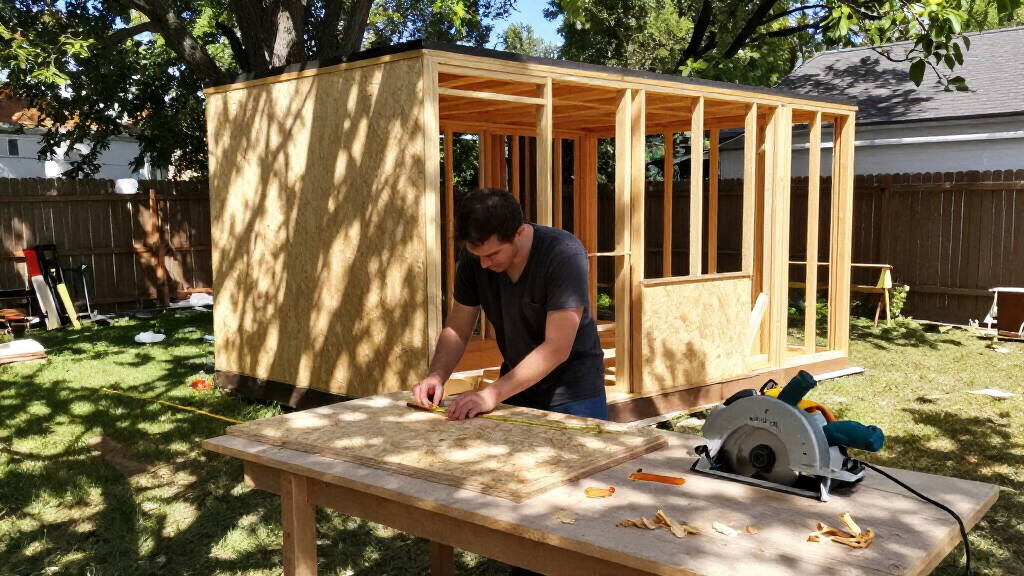
Oriented strand board (OSB) may lower material costs for a custom backyard shed compared with plywood, according to a Hunker report, but its susceptibility to moisture can make proper weather protection a key part of the project. The report says OSB is structurally suitable for shed floors, walls and roofs, while warning that wet panels can swell permanently.
OSB and plywood are both wood-based panel products, but they are made differently. Plywood uses cross-laminated sheets of wood veneer; OSB is formed from layers of rectangular wood strands arranged in different directions and bonded with adhesives. Hunker describes OSB as a solid, heavy board that can be used in shed construction.
The report cites United Built Homes as estimating that OSB costs 15% to 30% less than plywood. It also gives a retail comparison from Home Depot: at the time of writing, a 4-by-8-foot OSB sheathing sheet cost just under $13, compared with about $30 for a plywood sheet of the same size. Those are the report’s dated examples, not a current price check; actual costs can vary by location, product grade and market conditions.
Hunker says OSB is in the same structural category as plywood and can provide rigidity for a shed. It also notes that OSB is available in larger panels, with some sheets measuring up to 8 by 24 feet, which could reduce the number of panels needed. The report does not identify a specific product grade or establish that every OSB panel is suitable for every shed application.
The Cost Depends on Weatherproofing
For people building a shed on a limited budget, the cited price gap could make OSB worth comparing with plywood. Lower panel prices may help reduce the initial materials bill, and larger panel formats could mean fewer pieces to install. The savings, however, are not a full project-cost estimate: the source does not compare installation costs, protective finishes, or the lifespan of complete sheds built with each material.
The main trade-off is exposure to water. Hunker warns that when OSB gets wet, especially along its edges, it can swell and remain permanently swollen. That can push up or distort materials installed over it, including flooring and roof shingles. The report’s bottom line is conditional: OSB can be a lower-cost, sturdy choice if the shed is kept watertight. This makes site drainage, roof detailing and protection from rain relevant to the material decision, rather than treating the price per sheet as the only consideration.
Products Worth Considering

TCL QM64L 85-Inch QD-Mini LED 4K Smart Fire TV

TCL T7 Series 85-Inch 4K 144Hz QLED Smart Google TV

Sony BRAVIA 5 85-Inch Mini LED 4K HDR Smart TV (K-85XR50)
As an affiliate, we earn on qualifying purchases.
How OSB Differs From Plywood
The source attributes OSB’s lower cost in part to how its wood is sourced and processed. Plywood veneer is made from larger sheets of wood, while OSB can use strands from smaller trees. Hunker says this allows OSB to be manufactured faster and notes that poplars are among the trees farmed for its production. These points are the report’s explanation; the supplied material does not provide independent environmental-impact data or a lifecycle comparison.
Both products are commonly considered for panel sheathing, but their construction and response to moisture differ. The article focuses on the choice for a custom shed, where a builder may be choosing material for the floor, roof and walls. Its examples show why the decision involves more than comparing two panels in a store: the intended use and the shed’s ability to keep water out matter too.
“OSB costs between 15% and 30% less than plywood.”
— Hunker, citing United Built Homes
Prices and Product Grades Vary
The supplied report gives no publication date, and its Home Depot prices are explicitly framed as current only when the article was written. It is not clear what those sheets cost now or whether the comparison used products with matching grades and specifications. Buyers would need to check local prices and product labels before treating the figures as a project estimate.
The source also does not specify a shed design, local climate, installation method, or the moisture-protection details required for a particular build. It provides no comparative lifespan data or cost calculation that includes labor and protective materials. Its claims about OSB’s affordability and suitability should therefore be understood as general guidance from the cited report, not a guarantee for every project.
Check Local Prices and Shed Plans
Anyone considering OSB should compare current prices for the specific panel grades intended for the shed and confirm that those products meet the project’s requirements. The next practical step is to plan how the roof, walls, floor and edges will be protected from rain and other moisture, while following the panel maker’s installation guidance and applicable local requirements.
The report does not announce a new product, policy or follow-up study; it offers a material comparison for homeowners weighing shed costs. The decision remains with the builder: OSB may reduce upfront panel spending, but its value depends on the design, exposure and effectiveness of the shed’s water protection.
Key Questions
What is OSB?
Oriented strand board is a wood panel made from layers of rectangular wood strands arranged in different directions and bonded with adhesives. Plywood is made from cross-laminated sheets of veneer.
How much cheaper does the report say OSB is?
Hunker cites United Built Homes as estimating OSB costs 15% to 30% less than plywood. The report also gives a Home Depot example of just under $13 for a 4-by-8-foot OSB sheet versus about $30 for a same-size plywood sheet at the time it was written. Those prices may no longer apply.
Can OSB be used for a shed roof or floor?
The report says OSB can be used for a shed’s floor, roof and walls and describes it as structurally suitable for providing rigidity. It does not specify a product grade, so builders should check that the panel is appropriate for the intended use and follow its installation instructions.
What is the main drawback of OSB for a shed?
Hunker identifies moisture exposure as OSB’s main weakness. It says wet panels, particularly at the edges, can swell permanently and may lift or distort materials placed over them.
Does the report show OSB is always the better choice?
No. It presents OSB as a potentially lower-cost option, but says the material needs to be kept watertight. The supplied information does not compare full project costs or lifespans, so the best choice depends on current local prices, product specifications and the shed design.
Source: hunker.com