
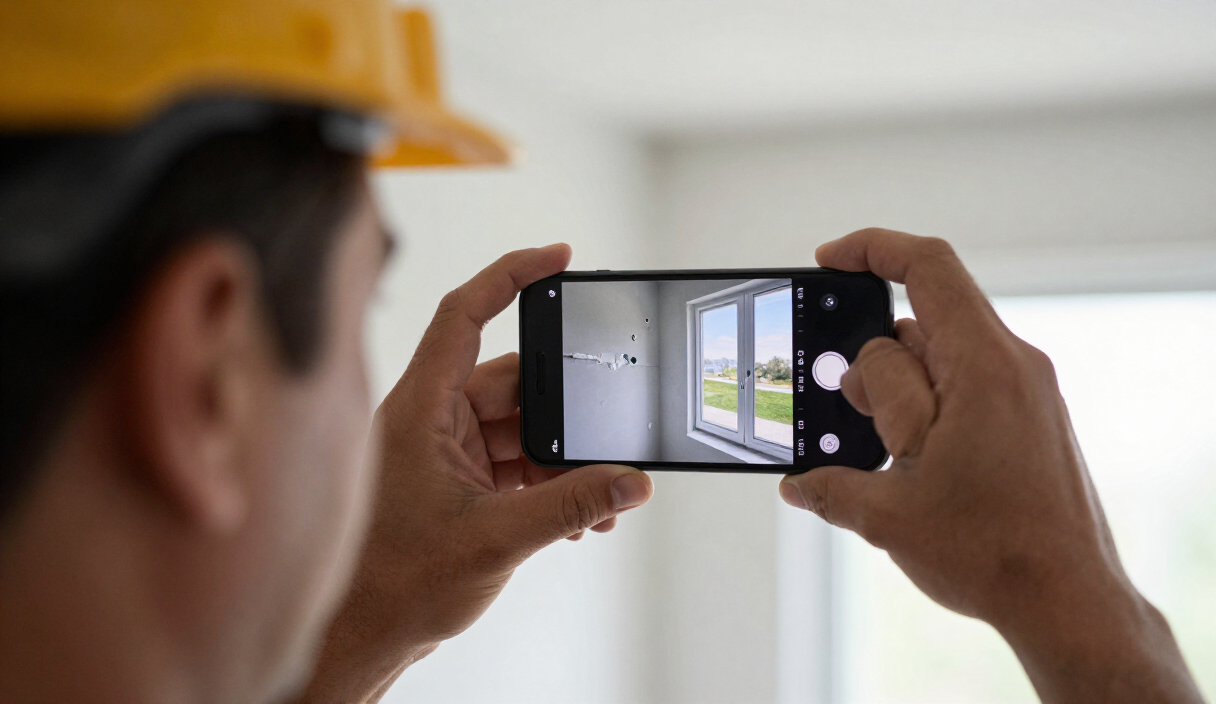
A photograph taken on a job site is not automatically evidence you can use. It may show the right defect from the right angle, yet still disappear into a camera roll with no trade, deadline, responsible person, or reliable connection to the work. The same thing happens with verbal instructions. Everybody hears them, several people act on them, and nobody records exactly what was agreed. Then there is the daywork report assembled three weeks later from messages, photographs, and memory.
DIY & Bau · Site documentation
The evidence goes missing between the work and the record.
A photograph, spoken instruction or daywork detail may exist—and still lack the context that makes it usable. Gewerkton Field is built to capture that context while it is still present.
What the site produces
- Defect photograph
- Verbal instruction
- Daywork details
What the record may lose
- Trade and deadline
- Responsible person and original audio
- Context displaced by messages and memory
The speakable daywork report
Dictation moves reporting closer to the event, before the next problem replaces the surrounding details.
Content languages
Cross-border teams can work on the same project in their own languages while the evidence original remains unambiguous.
Product lines, one branded house
Field centres the voice-first site workflow: dictation to evidence, defects, daywork reports, takt and a portal.
Public beta planned
Gewerkton is in beta now. Its scope is ambitious, but its workflows should be evaluated as a platform still being built—not as a finished product.
From a site-manager’s perspective, these are not separate administrative annoyances. They are versions of the same problem: something happened on site, but the structured record did not keep pace. By the time somebody tries to reconstruct it, the original context has already started to fade.
Gewerkton is being built around that gap. It is a voice-first construction documentation and defect management platform for global markets, born in the German market and organised as one branded house with three product lines: Field, Studio, and Cloud. The central idea is straightforward enough to say aloud: “On site, what counts is what’s proven.”
The product is in beta now, with a public beta planned for fall 2026. That status matters. This is not a finished product being presented as though every workflow is already settled. It is a beta platform with an ambitious scope, and it should be evaluated accordingly.
construction site photo evidence camera
As an affiliate, we earn on qualifying purchases.
As an affiliate, we earn on qualifying purchases.
The loss happens between the work and the record
A busy site does not naturally produce neat documentation. It produces movement: crews changing areas, trades working in parallel, deadlines approaching, questions arriving, defects being discovered, and instructions being given where the work is actually happening. The formal record often comes later because the person who understands the event is also the person dealing with everything around it.
That delay is where information gets stripped away. A defect photograph without a deadline does not say when correction is expected. A note without a responsible person leaves ownership open. A verbal instruction without its original audio is easier to separate from the circumstances in which it was given. A daywork report written long after the event asks memory to perform a job that capture should have handled at the time.
The common response is to be more disciplined: take better notes, name photographs immediately, and complete reports before leaving site. That advice is sensible, but it ignores the practical reason documentation falls behind. Traditional input can demand too much attention at precisely the moment when attention belongs on the work. If recording the event feels like a separate desk task, the desk task is likely to be postponed.
Voice changes that relationship. Speaking is already part of site management. The relevant question is whether those spoken facts can become structured evidence rather than remaining an informal exchange or an isolated recording.
The speakable daywork report
The daywork report is where the voice-first approach becomes easiest to understand. Instead of reconstructing the day several weeks later, the site manager can dictate on site while the details are still present. The resulting evidence is structured around the trade, deadline, and responsible person. At handover, the report can be signed on the device.
This is the centre of Gewerkton Field, the voice-first construction site app. Field covers dictation to evidence, defects, daywork reports, takt, and a portal. Its value proposition is not that speech itself is novel. Site teams already speak all day. The useful shift is from speech that disappears to speech that contributes to a structured record.
Consider the difference in the workflow. In a delayed reporting process, the site manager first observes the work, perhaps takes photographs, moves on to another issue, and later tries to connect those fragments. The daywork report becomes an act of recovery. With on-site dictation, capture happens closer to the event. The report can carry the facts that make it actionable, and signature on the available device closes the handover without requiring a return to a separate paper process.
This does not remove the need for judgement. A structured report is only as useful as the information captured. The site manager still has to identify the relevant trade, set the deadline where one applies, and establish responsibility. Voice-first input is valuable because it gives that discipline a form suited to the site rather than reserving it for later office work.
Why timing matters more than typing speed
The strongest argument for dictation is not that it saves keystrokes. It is that it shortens the distance between an event and its record. A report dictated where the work occurred can be created before the surrounding details are replaced by the next problem. That is particularly important when several trades are operating in parallel or when crews rotate across distributed locations.
Housing and building construction offer the most familiar examples: a defect recorded with a photograph and deadline, a dictated daywork report, and signature on the device at handover. But the underlying problem is not confined to conventional building sites. Wind farms and renewable-energy projects involve distributed sites, rotating crews, field acceptance, and capture in dead zones. Data centres and industrial plants may have many trades working in parallel under tight deadlines, with meeting decisions becoming trade-sorted task lists.
Infrastructure and tunnel projects add long durations and many change orders. In that setting, instructions backed by original audio preserve a direct connection to what was said. Across all these fields, the principle remains the same: the record should be created close enough to the work that the original evidence does not have to be reinvented later.
A defect photograph needs a destination
Photographs are easy to take and surprisingly easy to lose in practice. The image file may remain on the device, but its meaning becomes harder to retrieve once it is detached from the relevant defect, trade, person, and deadline. The problem is not always deletion. Often it is a failure of connection.
A voice-first construction documentation and defect management workflow treats the photograph as part of an evidence package rather than as the entire record. The image shows the condition. The dictated information supplies context. Structured fields establish what must happen next and who is responsible. The photograph can then serve its actual purpose rather than becoming another item that someone must interpret later.
This is also why a general camera roll is a poor substitute for a site record. Chronology alone does not provide project meaning. Two photographs taken minutes apart may concern different trades, areas, deadlines, and responsibilities. If those distinctions are not captured while they are clear, searching by date merely narrows the pile.
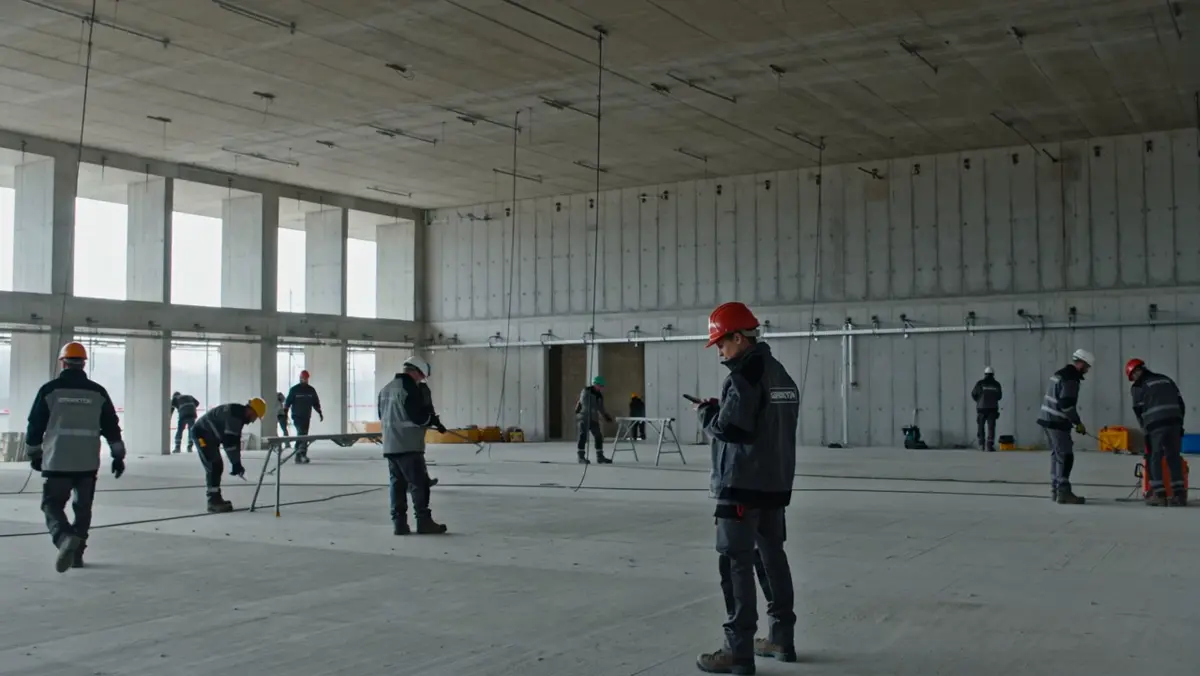
For a site manager, findability is part of evidence quality. A record that technically exists but cannot be located when needed has lost much of its practical value. Field’s dictation-to-evidence approach is aimed at keeping observation and classification together.
Verbal instructions should not evaporate
Site work depends on spoken communication. Instructions are given because decisions need to reach people quickly. The weakness appears when the spoken exchange remains the only record. Later, the team may remember the direction but not the precise wording, the responsible trade, or the circumstances around it.
Gewerkton’s infrastructure and tunnel use case explicitly keeps instructions backed by original audio. That creates a clearer path from the structured item to the source material. The structured record supports sorting and follow-up; the original audio preserves what was actually captured.
For data centres and industrial plants, meeting decisions can become trade-sorted task lists. This addresses another familiar point of loss: the meeting where the right people make the right decisions, followed by a fragmented transfer into separate notes and individual memories. Sorting decisions by trade gives each instruction somewhere to go.
None of this turns communication into an automatic process. Teams still need to make sound decisions and communicate them clearly. The benefit lies in reducing the number of manual transitions between what was said, what was recorded, and what must be done.
One site, several languages
Multilingual work adds another layer. Gewerkton supports 27 content languages and is designed for global markets. Cross-border teams in the EU, US, and APAC can work on the same project, each in their own language, while the evidence original remains unambiguous.
For projects in Asia, the stated use case includes Chinese, Korean, and Vietnamese crews, with multilingual handling from capture to report and data residency by choice. The platform also offers regional AI-provider selection across the EU, US, and Asia, including mainland China.
This is not merely a matter of translating an interface. The site record has to move from capture to report without losing its relationship to the original evidence. When different crews contribute in their own languages, retaining that relationship becomes essential.
Gewerkton’s bring-your-own-AI model covers 13 AI providers. Users can bring their own keys and select a region, including EU, US, and Asian providers, with mainland China included. The stated aim is to avoid vendor lock-in. Data can reside in an EU cloud or on the user’s own infrastructure.
Where Field meets plans, models, and operations
Field carries the site story, but it is one part of the branded house. Gewerkton Studio is the browser workspace for plans and models. Where no model exists, the site team can create one in the browser.
That matters because site evidence becomes more useful when it can be coordinated with the project’s spatial and technical information. Not every project arrives with a complete model, and the ability to create one in the browser addresses that absence without introducing another named product line.
Gewerkton Cloud handles operations and model or data coordination between Field, Studio, and third parties. In practical terms, Field is where site capture happens, Studio is where plans and models are handled, and Cloud coordinates the movement of operational and model data among those environments and external parties.
The German commercial integration is the platform’s deepest regional integration, covering GAEB, REB, XRechnung, and DATEV. Gewerkton was born in the German market, but its product and provider choices are framed for international projects rather than a single regional market.

What the beta status means
Gewerkton is in beta now. The public beta is planned for fall 2026. Buyers and site teams should keep that fact alongside every discussion of the platform’s scope. Beta software is being tested and developed; it is not sensible to describe it as though field adoption and workflows no longer need evaluation.
The development model is unusual. A solo founder directs a fleet of coding agents using Codex and Claude. In one night, that fleet shipped 21 software packages, verified with negative controls and mutation tests. That demonstrates a specific development event and testing approach, but it does not remove the relevance of the current beta label.
The public-facing infrastructure also reflects deliberate technical choices. The marketing site is available in 27 languages, uses zero trackers, has no cookie banner, and runs on a fully egress-free architecture. A media bank contains more than 51 self-produced clips and posters.
Those facts help explain the project’s breadth, but the site manager’s evaluation remains practical. Can the team capture information where the work occurs? Can it attach the necessary context? Can the report be found, handed over, and signed? Does the chosen AI and data-residency arrangement fit the project? A beta should be judged through those real workflows.
The tiny self-build has the same information problem
A tinyhouse43-style self-builder works on a smaller scale, but scale does not eliminate the need for disciplined records. A self-builder may have fewer trades, fewer formal meetings, and a shorter list of defects, yet the same types of information can still disappear: a photograph with no clear label, an instruction that remains verbal, or extra work recorded long after it happened.
The sensible small-project lesson is not to imitate the bureaucracy of a major industrial build. It is to preserve the useful discipline. Record the issue when it is visible. Connect the photograph to the task. Identify the trade, deadline, and responsible person. Capture daywork while the details are current. Obtain the signature on the device at handover where that workflow applies.
On a small build, it can be tempting to rely on familiarity. Everyone knows what the photograph shows today, so adding context feels unnecessary. But projects move forward, areas are covered, and the meaning that seemed obvious at capture becomes less obvious later. The smaller team may also have fewer people available to reconstruct missing information.
Voice-first input is well suited to this kind of discipline because it does not require the self-builder to turn each observation into a long writing session. The point is not to create more paperwork. It is to keep the few facts that make the record useful.
The real test is retrieval, not capture
Construction teams rarely suffer from a complete lack of information. They suffer from information stored in the wrong form, with the wrong person, or without enough context to act on it. The photograph exists, but nobody can find it. The instruction was heard, but nobody wrote it down. The extra work was completed, but the daywork report has to be rebuilt weeks later.
Gewerkton Field addresses that problem by making speech the starting point for evidence, defects, daywork reports, takt, and portal workflows. Its most persuasive use case is the speakable daywork report: dictate on site, structure the evidence around trade, deadline, and responsible person, then sign on the device at handover.
Studio and Cloud extend that record into browser-based plans and models, operations, and coordination with third parties. The wider platform adds multilingual content, provider and region choice, and a choice between EU-cloud residency and the user’s own infrastructure.
The concept is broad, while the current status remains simple: Gewerkton is in beta, and its public beta is planned for fall 2026. For site managers and self-builders alike, the case for trying such a workflow rests on one question. When the work is finished and the details are no longer fresh, will the evidence still be structured, connected, and easy to find?