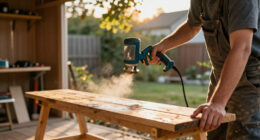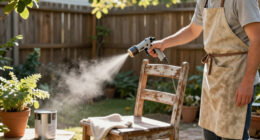
Choosing an electric paint sprayer usually comes down to a tradeoff: finish broad surfaces quickly or apply paint with more control. Airless electric sprayers pump paint at high pressure and suit walls, fences, and other large areas. HVLP (high-volume, low-pressure) sprayers use a high volume of air at lower pressure, making them a better match for furniture, cabinets, and detailed work.

Get business pricing on tools and workshop supplies
- Business-only prices and quantity discounts
- Tax-exempt purchasing
- Multiple users, one account, clear invoices

VONFORN Paint Sprayer, 700W Spray Paint Gun with 4 Nozzles & 3 Patterns
- ✔ Motor: 700W
- ✔ Container capacity: 1,200 ml
- ✔ Nozzles: Four: 1.0 mm, 1.5 mm, 2.0 mm, 3.0 mm
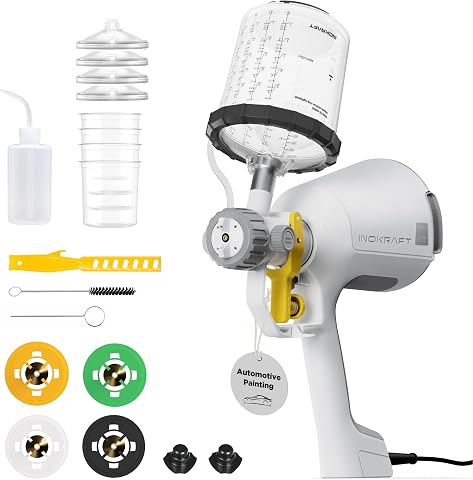
InoKraft Drizzle X Electric Spray Paint Gun for Automotive Spot Refinishing
- ✔ Motor: 800W
- ✔ Container capacity: 650 ml / 22 oz
- ✔ Nozzles: 1.0 mm, 1.3 mm, 1.5 mm, 1.8 mm

Paint Grids 1000W High Power Paint Sprayer Corded HVLP Paint Sprayer
- ✔ Motor: 1,000W
- ✔ Container capacity: 1,400 ml
- ✔ Nozzles: Four copper nozzles; diameters not specified
The difference matters in practice: an airless model can save substantial time on a whole room or exterior project, but it can use more paint and requires careful masking. An HVLP model is slower across a wall, yet easier to direct on smaller pieces where a smooth, controlled coat matters. Choose based on the size and shape of the work you do most often, along with the coatings the specific model supports.
At a Glance
| Criteria | Airless electric paint sprayers | HVLP electric paint sprayers | Winner |
|---|---|---|---|
| Best project scale | Walls, fences, siding, and other broad surfaces | Furniture, cabinets, trim, and smaller projects | Depends |
| Application speed | Fast on large, open areas | Slower on broad surfaces; efficient for detail work | A |
| Control and finish | Productive for coverage; technique still matters | More control and a fine finish on suitable materials | B |
| Overspray and masking | Can produce substantial overspray; mask carefully | Generally easier to direct, though masking is still needed | B |
| Paint compatibility | Often supports a range of coatings, depending on model and paint preparation | May require thinning or be limited by viscosity and model specifications | Depends |
| Setup and cleanup | Requires flushing the pump, hose, and gun | Usually less equipment to clean, but paint passages still need thorough washing | B |
| Typical value | Strong value when frequent large jobs justify the cost and setup | Strong value for occasional, detailed work and smaller batches | Depends |
VONFORN Paint Sprayer, 700W Spray Paint Gun with 4 Nozzles & 3 Patterns
For a buyer who wants one electric sprayer for a mix of home projects, VONFORN makes the most balanced case in this group. Its four nozzle sizes, from 1.0 mm to 3.0 mm, give us more stated options for adapting to different project materials than the automotive-focused InoKraft’s 1.0–1.8 mm set. Three patterns—horizontal, vertical, and circular—also make it easier to choose a pass shape for a panel, edge, or smaller object, though buyers still need to practice on scrap and follow coating guidance.The 1,200 ml container is larger than InoKraft’s 650 ml cup, reducing how often we may need to stop and refill during a household task. Its 700W motor is below Paint Grids’ stated 1,000W, so we would not choose it simply on a power comparison. Instead, VONFORN stands out for the combination of broad nozzle choice and setup support: a dust-blowing joint can clear loose debris before spraying, while a faucet connector, brush, and needle support cleanup afterward. The flow knob adds a way to moderate output for different surfaces.That flexibility does not make this a professional finishing system. The body is plastic, the tank still needs regular refilling on larger jobs, and the supplied details do not specify supported coating viscosities or coverage rates. Compared with Paint Grids, its capacity is smaller; compared with InoKraft, it is aimed at a broader range of home surfaces rather than automotive repair. We see it as the most adaptable pick for furniture, doors, garden chairs, and similar DIY work, provided we are willing to prepare surfaces and clean carefully after each use.
Pros:
- Four nozzle sizes span 1.0 mm to 3.0 mm.
- Three patterns and an adjustable flow knob support varied application approaches.
- The 1,200 ml tank is larger than InoKraft’s 650 ml cup.
- Includes dust-clearing and paint-flushing connections plus a cleaning brush and needle.
Cons:
- The 1,200 ml capacity may still mean refills on extended projects.
- Plastic construction and unspecified coating compatibility limit what we can infer about durability and materials.
- At 700W, its stated motor rating is lower than Paint Grids’ 1,000W.
Best for: DIY homeowners moving between furniture, doors, fences, and other small-to-medium household projects who want several nozzle and pattern choices.
Not ideal for: Buyers focused on automotive refinishing, large uninterrupted painting jobs, or professional-grade finish specifications.
Bottom line: VONFORN is our strongest general household pick because it combines varied nozzle and pattern choices with unusually useful cleaning accessories.
“VONFORN is our strongest general household pick because it combines varied nozzle and pattern choices with unusually useful cleaning accessories.”
InoKraft Drizzle X Electric Spray Paint Gun for Automotive Spot Refinishing
InoKraft earns a distinct place by targeting work the other two are not specifically described for: small automotive refinishing projects. The maker identifies bumper repainting, wheels, trim, body panels, and motorcycle parts, and supplies 1.0 mm, 1.3 mm, 1.5 mm, and 1.8 mm nozzles for primer, base coat, and clear coat applications. That narrower range contrasts with VONFORN’s larger 3.0 mm option and its general household positioning. For a garage hobbyist working on a repair area, the automotive-specific setup is the more relevant starting point.The 800W electric HVLP design is described as compressor-free, so we can avoid setting up a separate air compressor and long air hose. A gravity-feed system and boost control are presented as ways to support steady airflow and atomization; the listed adjustable pattern reaches about 250 mm. Its 16.4 ft power cord gives more reach than the supplied details for the other models establish, while the 650 ml cup is the smallest stated capacity here. That smaller cup may be manageable for spot repairs, but it means more interruptions if we move to larger panels or broader coverage.Compared with VONFORN and Paint Grids, this is less compelling as a general-purpose home sprayer: it offers no three-pattern household modes in the description and has less capacity than either. Nor do the provided details establish that it can match dedicated professional automotive spray equipment. We should check paint maker guidance, nozzle suitability, and required preparation before relying on it for a finish-sensitive repair. Its best role is a focused electric option for small automotive jobs, where avoiding a compressor setup matters more than maximizing container size.
Pros:
- Specifically described for automotive spot refinishing.
- Four nozzle sizes are identified for primer, base coat, and clear coat work.
- Compressor-free electric setup avoids a separate air compressor.
- Includes a 16.4 ft power cord and five disposable inner cups.
Cons:
- The 650 ml cup is the smallest of these three models.
- Its automotive focus makes it less versatile for general household painting.
- The supplied details do not establish professional finish capability or broad coating compatibility.
Best for: Garage hobbyists and DIY automotive painters handling small repairs on bumpers, wheels, trim, motorcycle parts, or limited body-panel areas.
Not ideal for: Buyers who mainly paint household furniture and fences, need a large paint cup, or expect a full-size professional automotive system.
Bottom line: Choose the Drizzle X when small automotive repairs define the job and a compressor-free setup matters more than capacity or household versatility.
“Choose the Drizzle X when small automotive repairs define the job and a compressor-free setup matters more than capacity or household versatility.”
Paint Grids 1000W High Power Paint Sprayer Corded HVLP Paint Sprayer
Paint Grids is the capacity-minded choice. Its 1,400 ml container is the largest listed here, giving it an advantage over VONFORN’s 1,200 ml tank and InoKraft’s 650 ml cup when a project calls for repeated passes across furniture, cabinets, or a fence section. The stated 1,000W motor is also the highest of the three. Those numbers may appeal to buyers looking for a higher-powered household unit, but they do not by themselves tell us how fast it covers a surface or how smooth the finish will be.The kit includes four copper nozzles, three spray patterns—vertical, horizontal, and circular—and a flow-control knob. That makes it more comparable to VONFORN than to the automotive-centered InoKraft. Both are presented for varied home surfaces, but Paint Grids edges ahead on listed container capacity and motor wattage, while VONFORN provides a dust-blowing joint and faucet cleaning connector that make preparation and flushing more explicit. Paint Grids instead lists gloves, filter funnels, and a 1.8 m hose. These are different kinds of convenience: more paint between refills versus more dedicated cleaning and surface-prep aids.We would consider it for DIY furniture, cabinets, doors, fences, and other projects where its larger container is useful. The description does not provide nozzle diameters, detailed viscosity limits, or coverage figures, and the oddly repeated references to “pait grids” do not clarify any specialized application. As with the other handheld units, careful masking, test spraying, and immediate cleaning remain part of the work. Compared with VONFORN, Paint Grids prioritizes capacity and stated wattage; buyers who value more clearly specified nozzle sizes and cleaning connections may prefer VONFORN instead.
Pros:
- Largest stated container in this comparison at 1,400 ml.
- Highest stated motor rating here at 1,000W.
- Three patterns and an adjustable flow-control knob.
- Includes copper nozzles, gloves, filter funnels, and cleaning tools.
Cons:
- Nozzle diameters are not specified in the supplied details.
- The listing does not provide coverage rates or detailed coating compatibility.
- It lacks VONFORN’s described dust-blowing and faucet-flushing connections.
Best for: DIY users painting household items or sections of a fence who value a larger listed container and higher stated motor wattage.
Not ideal for: Automotive refinishing buyers, users who need clearly specified nozzle diameters, or shoppers seeking documented coverage and coating compatibility.
Bottom line: Paint Grids makes the most sense when we want the largest stated tank and highest motor rating among these three, with the caveat that performance details are limited.
“Paint Grids makes the most sense when we want the largest stated tank and highest motor rating among these three, with the caveat that performance details are limited.”
As an Amazon Associate we earn from qualifying purchases.
Key Differences
The most consequential difference is how quickly each type covers an area. Airless sprayers are built for volume: their high-pressure pump pushes paint through a small tip, making them effective on broad surfaces. That speed is valuable when painting a room, fence, or siding. It comes with a need for steady technique and careful masking, since the spray can travel beyond the target.
HVLP sprayers trade that pace for control. Their lower-pressure pattern can make it easier to apply a measured coat to furniture parts, cabinet doors, and trim. They are not automatically better for every fine finish; preparation, paint choice, nozzle selection, and practice still matter. Their practical advantage is managing smaller, shaped work without setting up a high-volume system.
Cost and compatibility depend on the individual model, not just the label. Airless equipment can be a better investment for repeated large jobs, while an HVLP unit can cost less to operate for occasional small projects. Check the manual for supported coatings, tip or nozzle options, thinning requirements, and cleaning instructions before buying.
Detailed Comparison
Project scale (major difference)
Airless is the stronger fit for walls, fences, and siding, where covering a large continuous area matters. HVLP is easier to justify for furniture, cabinet doors, and trim, where each piece is smaller and has edges or details to manage. The gap is major: choosing for the wrong scale can make a job needlessly slow or awkward. Pick according to the projects you do most often.
Speed (Airless electric paint sprayers wins — major)
Airless wins on large, open surfaces because its high-volume application can cover ground quickly. HVLP can feel efficient on a chair or cabinet door, but it is slower for an entire room. The difference is major for a broad job and minor for a few small pieces. Faster application does not remove the time needed for masking, preparation, or cleanup.
Control and finish (HVLP electric paint sprayers wins — moderate)
HVLP generally gives the operator more control over a smaller spray pattern, making it the better starting point for furniture and detailed components. Airless excels at laying paint across broad areas, but controlling it around edges takes practice. The advantage is moderate: either type can produce a poor result without proper preparation and technique, and the coating and surface influence the finish.
Overspray and masking (HVLP electric paint sprayers wins — moderate)
HVLP usually produces a more contained pattern, which helps when working near edges or on a smaller object. Airless overspray can spread beyond the target, particularly outdoors or in a breezy area, so nearby surfaces need protection. HVLP wins by a moderate margin, though it does not eliminate masking. Always follow the manual and use appropriate ventilation and protective equipment.
Paint compatibility (major difference)
Neither category has a universal advantage. Airless models may handle some coatings without thinning, while HVLP units can have tighter viscosity limits; actual capability varies by model, tip, and paint. The difference can be major if your chosen coating is unsupported. Check manufacturer specifications and paint instructions before purchase, and do not thin a product unless its directions allow it.
Setup and cleanup (HVLP electric paint sprayers wins — moderate)
HVLP usually has a simpler paint path and is less cumbersome to prepare for a small job. An airless system’s pump, hose, and gun need thorough flushing, so cleanup can be a meaningful part of the work. HVLP wins moderately for short sessions; on a large job, airless speed may outweigh the extra cleanup. Factor washing and storage into the time you have available.
Value (moderate difference)
Airless provides better value when it replaces many hours of brushing or rolling across large surfaces, especially for repeat projects. HVLP is often the more sensible purchase for occasional furniture or trim work, where paying for high-volume capacity brings little benefit. There is no universal price winner because features and included accessories vary. Pay extra for capacity or controls you will use regularly.
Airless electric paint sprayers: Pros and Cons
Pros:
- Covers large surfaces quickly
- Well suited to walls, fences, and siding
- Can make repeated broad-area projects less labor intensive
Cons:
- Overspray calls for careful masking
- Setup and flushing can take time
- Requires practice to control edges and avoid uneven coverage
HVLP electric paint sprayers: Pros and Cons
Pros:
- Offers more control for furniture and detailed work
- Generally easier to direct on smaller surfaces
- Often simpler to prepare and clean for short sessions
Cons:
- Slow for walls and other large areas
- Some models require paint thinning or restrict viscosity
- Small capacity can mean refills during longer jobs
Who Should Choose What
Choose Airless electric paint sprayers if:
- You regularly paint rooms, fences, siding, or other broad surfaces.
- Reducing application time on large jobs matters more than quick cleanup.
- You can mask surrounding areas and follow the model’s setup and flushing steps.
Choose HVLP electric paint sprayers if:
- Your main projects are furniture, cabinet doors, trim, or decorative pieces.
- Control over a smaller spray pattern matters more than covering ground quickly.
- You paint in shorter sessions and want a system suited to small batches.
Skip both if: You have one small touch-up or a tiny repair; a brush or roller may cost less and take less preparation. Also skip a sprayer if you cannot provide the ventilation and masking the paint and equipment require.
Value for Money
Pay more for an airless sprayer when you will use its speed on large surfaces often enough to offset masking, setup, and cleanup. For a homeowner painting a single room once, renting or using a roller may be better value than buying a capable system. For frequent room or exterior projects, the time saved can justify the higher investment.
HVLP is the better value when detailed, smaller projects make up most of your work. Paying extra for an airless unit will not improve value if its capacity goes unused. Compare the full model specifications, included nozzles, replacement parts, and cleaning demands; the category name alone does not determine cost or performance.
Final Verdict
Choose an airless electric sprayer for frequent large-area painting. Its speed is the deciding advantage, and it can make a substantial difference across walls, fences, and siding. Choose HVLP for furniture, cabinets, trim, and other smaller work where direction and finish control matter more than coverage rate. For most occasional DIY users, the project itself should decide the purchase: HVLP fits smaller tasks, while renting an airless unit can make sense for a one-time room or exterior job. Check coating compatibility and cleaning requirements before committing.
Frequently Asked Questions
Which electric paint sprayer is better for painting a room?
An airless sprayer is generally better for covering room walls quickly. Mask floors, fixtures, and adjacent surfaces carefully, and check whether the coating and tip are approved for the model. For a small room or a one-time job, compare the preparation and cleanup time with a roller or rental.
Is HVLP better for furniture?
HVLP is usually the better fit because its lower-pressure spray is easier to direct across smaller parts and details. The result still depends on surface preparation, the coating, and practice. Confirm that the sprayer supports the paint’s viscosity and follow the product directions.
Do electric paint sprayers need paint thinning?
It depends on the sprayer and coating. Some HVLP units need certain paints thinned to work properly, while other models handle them as sold. Airless systems also have coating limits. Follow both the sprayer manual and paint label; do not assume that thinning is needed or permitted.
Is an airless sprayer worth the higher cost?
It can be worth paying more if you regularly paint broad surfaces and the saved application time outweighs setup and cleanup. For occasional furniture or trim, HVLP is usually a better match for the money. For a single large job, renting can be more economical than buying.