
TL;DR

Get business pricing on tools and workshop supplies
- Business-only prices and quantity discounts
- Tax-exempt purchasing
- Multiple users, one account, clear invoices
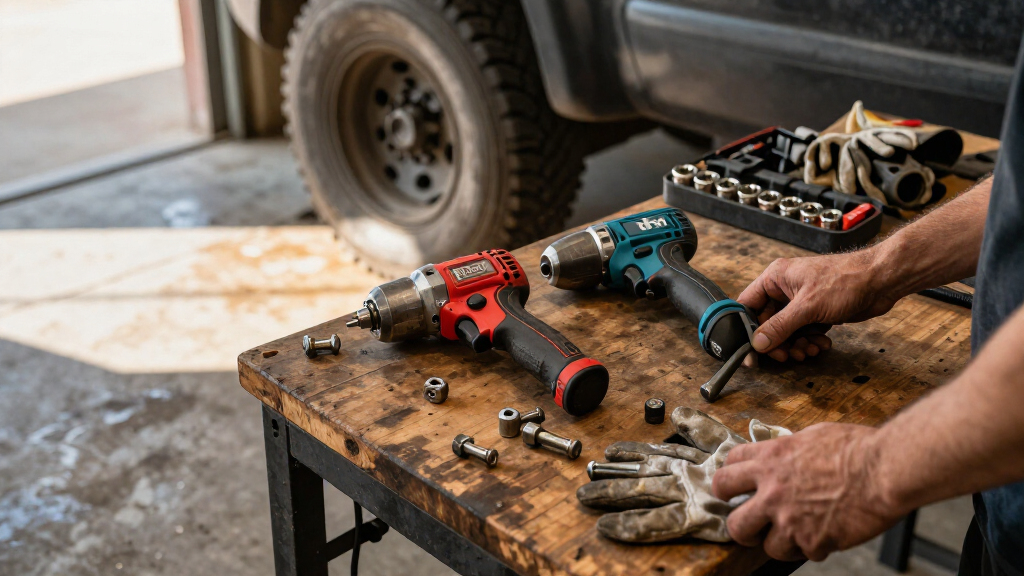
Pro Tool Reviews ran hands-on tests comparing the Ryobi HP Brushless P262 and Ridgid 18V Brushless R86012 impact wrenches. Ridgid won two of three tests, but margins were slim, and the reviewer concluded Ryobi’s prosumer performance now blurs the line with pro-grade tools.
Pro Tool Reviews has published a head-to-head test of two mid-torque impact wrenches sold at Home Depot — the Ryobi HP Brushless P262 and the Ridgid 18V Brushless R86012 — and found the Ridgid model narrowly ahead in two of three performance tests. The reviewer’s broader conclusion: Ryobi’s prosumer line is now close enough to its Pro-focused sibling that the choice largely comes down to battery platform and warranty preference rather than a clear performance gap.
Both tools sit at the top of their respective lineups and are part of the same parent company, TTI. On paper, the Ridgid R86012 holds a spec advantage: 650 ft-lbs of breakaway torque and 500 ft-lbs of fastening torque, versus 600 ft-lbs breakaway and 450 ft-lbs fastening for the Ryobi P262. The Ridgid also posts a higher maximum impact rate of 3,800 IPM compared with Ryobi’s 3,200 IPM, while both tools share a 2,800 RPM top no-load speed and an identical 3.69-lb bare weight. The Ridgid is slightly shorter at 6.75 inches versus 7.19 inches for the Ryobi.
In the outlet’s testing, results were tight. In the bolt break test — removing eight lug nuts torqued to 500 ft-lbs — the Ryobi finished in 33.27 seconds (4.16 seconds per nut) against Ridgid’s 33.68 seconds (4.21 seconds per nut), a rare win for the Ryobi. In the lag bolt fastening test, the Ridgid drove the bolt slightly deeper, leaving 0.31 inches above the surface versus 0.36 inches for the Ryobi. The widest gap came in the inertia torque test, where the Ridgid recorded 283.4 ft-lbs versus Ryobi’s 236.6 ft-lbs.
The reviewer attributed the inertia torque gap primarily to impact rate, noting Ridgid’s anvil strikes roughly 18.75% faster than Ryobi’s. Pricing is nearly identical: the Ryobi P262 sells as a bare tool at $179 and the Ridgid R86012 at $189, with neither offered as a kit. The Ryobi carries a 3-year warranty; Ridgid includes its Lifetime Service Agreement. Both tools feature brushless motors, three speed modes with Assist Mode, and die-cast gearboxes, though the Ridgid is available with either a friction ring or pin detent anvil while the Ryobi uses a friction ring only.
Why the Prosumer Gap Matters for Buyers
The results matter because they suggest the traditional split between Pro-focused Ridgid and DIY-focused Ryobi is narrowing at the mid-torque level. According to the review, the tests showed Ryobi’s One+ HP Brushless performance is “starting to blur the line between Pro and Prosumer.” For buyers already invested in either battery platform, the practical performance difference may be small enough that switching platforms offers little benefit.
The comparison also carries warranty and cost implications. At nearly identical bare-tool prices, the deciding factors become the Ridgid Lifetime Service Agreement versus Ryobi’s broader One+ ecosystem, and whether the extra measured torque output justifies one purchase over the other for demanding fastening work.
“Ridgid’s anvil is hitting at 18.75% higher speed than Ryobi’s, and that extra 600 IPM is really putting in the extra effort for the R86012.”
— Pro Tool Reviews (review author)
What Remains Unclear
The testing reflects one outlet’s methodology with a small number of tests and single-sample results; other testing protocols or individual unit variation could produce different outcomes. The inertia torque figures differ from manufacturer-rated torque specs, which use their own rating methods, so the measured numbers should not be read as contradicting the printed specs directly. The review did not evaluate long-term durability, runtime across battery capacities, or performance under sustained jobsite use.
It is also unclear whether Ryobi plans further HP Brushless updates that would close the torque gap, or whether either model will be offered in kit form with batteries and charger.
What Buyers Should Watch For
Shoppers deciding between the two can compare the $179 Ryobi P262 and $189 Ridgid R86012 as bare tools at Home Depot, factoring in which battery platform they already own. Those who prioritize maximum torque output and the Ridgid Lifetime Service Agreement may favor the R86012, while buyers in the Ryobi One+ ecosystem get near-equivalent performance per this testing. Future model refreshes from either brand — particularly any Ryobi increase in impact rate — could shift the comparison, and additional independent testing would help confirm how consistent these results are across units.
Key Questions
Which impact wrench won the head-to-head test?
The Ridgid R86012 won overall, taking two of three tests (lag bolt fastening and inertia torque). The Ryobi P262 won the bolt break test by a slim margin of about 0.4 seconds total.
How big was the performance gap between the two tools?
Very small in two of three tests. The largest difference was in the inertia torque test, where Ridgid measured 283.4 ft-lbs versus Ryobi’s 236.6 ft-lbs, which the reviewer attributed to Ridgid’s higher impact rate of 3,800 IPM.
How much do the Ryobi P262 and Ridgid R86012 cost?
Both are sold as bare tools without batteries or chargers: the Ryobi P262 at $179 and the Ridgid R86012 at $189, according to the review.
What warranty do these impact wrenches carry?
The Ryobi P262 has a 3-year limited warranty. The Ridgid R86012 includes Ridgid’s Lifetime Service Agreement when registered.
Are Ryobi and Ridgid made by the same company?
Both brands are part of the TTI family and sold primarily through Home Depot. Ridgid has traditionally targeted professionals, while Ryobi has focused on DIY and homeowner users, though both power these particular models on their own 18V battery platforms.
Source: rss
Fall yard work Picks
leaf blowers
As an affiliate, we earn on qualifying purchases.