TL;DR

Get business pricing on tools and workshop supplies
- Business-only prices and quantity discounts
- Tax-exempt purchasing
- Multiple users, one account, clear invoices
YouTube user Greens and Machines built a garden trellis from PVC pipe and jute twine, using the frame and diagonal string supports to guide climbing plants. Hunker reported the project as a budget-conscious DIY option, but did not provide a cost breakdown or independent test of its strength and durability.
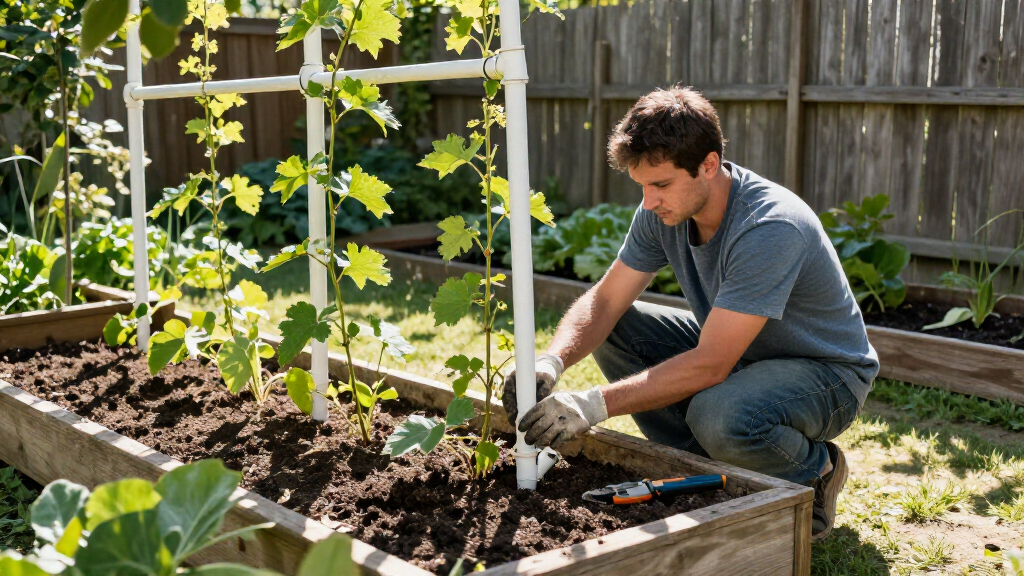
YouTube user Greens and Machines built a garden trellis from PVC pipe and jute twine, creating a frame for climbing fruit and vegetable plants, according to a report by Hunker. The design uses stakes driven into the ground, upright pipes and a top rail, with twine arranged diagonally to give vines places to climb.
The reported design uses ¾-inch Schedule 200 PVC pipe for its main frame and ½-inch Schedule 40 pipe for ground stakes. Hunker says the thinner-walled Schedule 200 pipe is lighter than Schedule 40 pipe of the same outer dimension, while leaving more interior clearance for the stakes. The report describes the materials as inexpensive, but gives no total project cost.
In the example, four vertical frame posts stand six feet tall and four feet apart, joined by an upper rail spanning roughly 12 feet. The builder used elbow connectors at the end posts and T-connectors at the middle posts. The pieces can be adjusted to suit a garden’s layout; Hunker notes that pipe lengths and quantities will change with the desired height and spacing.
After setting the stakes and sliding the upright pipes over them, the builder adds jute twine every 12 to 18 inches. Each strand runs from an anchor on one side, over the upper rail and down to an anchor on the other, making a triangular or X-like support pattern. For raised beds, the report suggests securing the twine to the bed; at ground level, garden staples can anchor it near the row.
A Trellis Built Around Basic Materials
The project offers gardeners a way to create vertical support for climbing plants without buying a prebuilt trellis or constructing one from lumber. A pipe frame can be sized to a particular row, while twine provides the surfaces vines can grip as they grow. That flexibility may be useful where a standard trellis does not fit the bed or planting area.
The approach also keeps the construction relatively simple: cut the pipes, position the stakes, assemble the frame and attach the twine. However, the report does not establish how much the materials cost in a particular location, how long the setup lasts outdoors or how well it handles heavy crops or strong winds. Gardeners would need to assess those factors for their own conditions rather than treating the example as a tested product.
Products Worth Considering

TCL T7 Series 85-Inch 4K 144Hz QLED Smart Google TV

Samsung 85-Inch QN70H Neo QLED 4K Smart TV (2026)

TCL QM64L 85-Inch QD-Mini LED 4K Smart Fire TV
As an affiliate, we earn on qualifying purchases.
How the Example Frame Is Sized
Hunker’s account describes a frame planned around common pipe lengths. Greens and Machines used 10-foot pipes, with cuts planned to produce six-foot uprights and four-foot sections for the top rail. The report says some stores also sell five-foot lengths, which could suit smaller versions, though the frame dimensions would need to change.
The pipe cutter, connectors and twine are all part of the described materials list. The report names a specific cutter and gives its listed online price, but that price is not a complete project estimate and may change. The number of stakes and connectors depends on the number of posts, and the twine anchors depend on whether the garden is in a raised bed or directly in soil.
Cost and Durability Are Unreported
Hunker does not provide a total materials cost, measurements for every variation or results from testing the trellis under different weather and crop loads. The article describes one creator’s setup and offers construction guidance; it does not establish that the same design will suit every garden.
The report also does not say what plants Greens and Machines grew on the structure, how much weight the frame supported or how it performed over time. Those details would affect whether a gardener should use the same pipe size, post spacing and anchoring method.
Adapt the Plan to Your Garden
The report describes no follow-up test or later update to the project. Anyone copying the design would need to measure the planting row, choose post spacing and height for the intended plants, and calculate the required pipe, connectors and twine. Anchors and stake depth may also need to reflect the bed design and local soil conditions.
Hunker’s account leaves the project’s long-term performance open. Further information about crop weight, weather exposure and maintenance would help clarify how well the arrangement holds up across a growing season.
Key Questions
What materials does the reported trellis use?
The frame uses ¾-inch Schedule 200 PVC pipe, with ½-inch Schedule 40 PVC pipe for ground stakes. Elbow and T-connectors join the frame, and jute twine forms the plant supports.
How large was the example trellis?
Greens and Machines used four six-foot vertical posts spaced four feet apart, with an upper rail spanning roughly 12 feet, according to Hunker. The dimensions can be changed to fit a garden.
How is the twine arranged?
The twine runs from an anchor on one side, over and around the top rail, and down to an anchor on the other side. Repeating this pattern every 12 to 18 inches creates supports for climbing vines.
Does the report say how much the project costs?
No. Hunker describes the materials as inexpensive but does not give a total project cost. Prices and the amount of material needed will vary with the frame’s size and local availability.
Source: hunker.com