For most videographers using a mirrorless camera, I’d start with the DJI RS 4 Mini for its camera-focused design in a more manageable size than the full RS 4. Phone creators should compare the DJI Osmo Mobile 8 for a broader feature set with the simpler Osmo Mobile 7 as a more straightforward alternative. The main choice is between a gimbal built for your camera type, portability, and the tracking or accessory features you’ll actually use. A phone gimbal cannot replace a camera gimbal’s payload support, while a larger camera rig can be cumbersome for casual shoots. Read on for the full breakdown of all 14 gimbal stabilizers for videography and how I’d match each to a different filming setup.

Get business pricing on tools and workshop supplies
- Business-only prices and quantity discounts
- Tax-exempt purchasing
- Multiple users, one account, clear invoices
Complete the kit


Key Takeaways
- Camera and phone gimbals serve different jobs: the DJI RS models and FeiyuTech SCORP Mini-3-Pro address camera or mixed-device setups, while most of the lineup is designed for smartphones.
- The DJI RS 4 Mini is the camera-focused middle ground: it suits creators who need more camera support than a phone gimbal without starting with the full-size RS 4.
- Phone-gimbal choice is shaped by workflow, not just stabilization: tracking, controls, folding design, and bundled accessories separate the Osmo Mobile, hohem, AOCHUAN, and COMITOK options.
- The lineup has distinct portability and specialization tradeoffs: compact smartphone models are easier to carry, while the hohem iSteady Pro 4 targets action-camera users with splash resistance.
- Buying for future gear can lead to the wrong fit: a versatile-looking option still needs to support the buyer’s actual camera, lens, phone, and accessories.
| FeiyuTech SCORP Mini-3-Pro Gimbal Stabilizer for Camera, Smartphone, and Action Cameras | 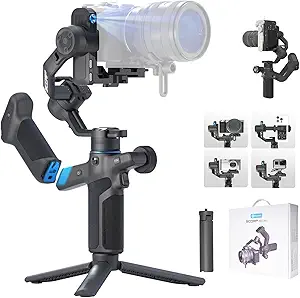 | Best Cross-Device Flexibility | Payload capacity: 4.4 lb (2 kg) | Supported devices: Mirrorless cameras, compact cameras, smartphones, and action cameras | Tracking distance: 18 m | VIEW ON AMAZON | See Our Full Breakdown |
| hohem iSteady V3 Ultra 3-Axis Smartphone Gimbal Stabilizer |  | Best for Solo Smartphone Creators | Stabilization: 3-axis, iSteady 9.0 | Tracking: AI tracking for faces, pets, and objects | Remote: Detachable 1.22-inch touchscreen; range up to 33 ft | VIEW ON AMAZON | See Our Full Breakdown |
| DJI Osmo Mobile 7P 3-Axis Smartphone Gimbal Stabilizer |  | Best Smartphone Video Toolkit | Stabilization: 3-axis | Compatibility: iPhone and Android smartphones | Operating time: Up to 10 hours | VIEW ON AMAZON | See Our Full Breakdown |
| DJI Osmo Mobile 8 Standard Combo Phone Gimbal Stabilizer |  | Best for Wide Panning and Phone Charging | Stabilization: 3-axis | Pan rotation: 360° horizontal | Battery life: Up to 10 hours | VIEW ON AMAZON | See Our Full Breakdown |
| DJI RS 3 Mini Camera Gimbal Stabilizer |  | Best Compact Mirrorless Gimbal | Payload capacity: 0.4–2 kg (0.8–4.4 lb) | Weight: 795 g (1.75 lb) in portrait mode; 850 g (1.8 lb) with horizontal arm | Stabilization: 3rd-generation RS stabilization algorithm | VIEW ON AMAZON | See Our Full Breakdown |
| AOCHUAN Smart XE 3-Axis Foldable Gimbal Stabilizer for Smartphones |  | Best for Hands-Free Smartphone Tracking | Axes: 3 | Compatibility: iPhone and most Android smartphones | Maximum load: 280 g | VIEW ON AMAZON | See Our Full Breakdown |
| DJI Osmo Mobile 7 3-Axis Gimbal Stabilizer for iPhone and Android |  | Best for Reliable Subject Tracking | Stabilization: 3-axis | Tracking: ActiveTrack 7.0 | Weight: 300 g | VIEW ON AMAZON | See Our Full Breakdown |
| DJI RS 4 Mini Gimbal Stabilizer for Camera, Compatible with Canon, Sony, Nikon, Fujifilm |  | Best for Compact Camera Rigs | Payload capacity: 2 kg / 4.4 lb | Supported devices: Cameras and smartphones | Vertical shooting: Supported | VIEW ON AMAZON | See Our Full Breakdown |
| DJI Osmo Mobile 7P + Mic Mini TX (Infinity Black), Gimbal Stabilizer |  | Best Bundled Creator Kit | Stabilization: 3-axis | Tracking: Intelligent tracking | Battery life: Up to 10 hours | VIEW ON AMAZON | See Our Full Breakdown |
| Hohem iSteady X3 SE 3-Axis Gimbal Stabilizer for iPhone and Android, Black |  | Best for Remote-Controlled Solo Filming | Stabilization: 3-axis, iSteady 8.0 | Weight: 0.79 lb | Payload capacity: 0.66 lb | VIEW ON AMAZON | See Our Full Breakdown |
| Hohem iSteady Pro 4 3-Axis Splashproof Action Camera Gimbal |  | Best for Action Cameras | Stabilization: 3-axis | Anti-shake technology: iSteady 5.0 | Water resistance: IPX4 splashproof | VIEW ON AMAZON | See Our Full Breakdown |
| DJI Osmo Mobile 8 3-Axis Phone Gimbal Stabilizer |  | Best for All-in-One Phone Filming | Stabilization: 3-axis | Pan rotation: 360° horizontal | Battery life: Up to 10 hours | VIEW ON AMAZON | See Our Full Breakdown |
| COMITOK L7C Pro 3-Axis Smartphone Gimbal Stabilizer with AI Tracking |  | Best Compact Pick for Solo Creators | Stabilization: 3-axis | Tracking: Face and object tracking | Phone compatibility: Smartphones under 7 inches and up to 0.62 lb | VIEW ON AMAZON | See Our Full Breakdown |
| DJI RS 4 Gimbal Stabilizer for Camera |  | Best for Professional Mirrorless Rigs | Payload capacity: 3 kg (6.6 lb) | Extended tilt axis: Extended by 8.5 mm | Battery runtime: Up to 29.5 hours with optional BG70 grip | VIEW ON AMAZON | See Our Full Breakdown |
| gimbal stabilizers for videography | Stabilization | Weight |
|---|---|---|
| FeiyuTech SCORP Mini-3-Pro Gim | — | 4.4 lb |
| hohem iSteady V3 Ultra 3-Axis | 3-axis, iSteady 9.0 | 15.1 oz |
| DJI Osmo Mobile 7P 3-Axis Smar | 3-axis | — |
| DJI Osmo Mobile 8 Standard Com | 3-axis | — |
| DJI RS 3 Mini Camera Gimbal St | 3rd-generation RS stabilization algorithm | 795 g (1.75 lb) in portrait mode; 850 g (1.8 lb) with horizontal arm |
| AOCHUAN Smart XE 3-Axis Foldab | — | 0.78 lb |
| DJI Osmo Mobile 7 3-Axis Gimba | 3-axis | 300 g |
| DJI RS 4 Mini Gimbal Stabilize | — | — |
| DJI Osmo Mobile 7P + Mic Mini | 3-axis | — |
| Hohem iSteady X3 SE 3-Axis Gim | 3-axis, iSteady 8.0 | 0.79 lb |
| Hohem iSteady Pro 4 3-Axis Spl | 3-axis | — |
| DJI Osmo Mobile 8 3-Axis Phone | 3-axis | — |
| COMITOK L7C Pro 3-Axis Smartph | 3-axis | 0.8 lb |
| DJI RS 4 Gimbal Stabilizer for | — | — |
More Details on Our Top Picks
FeiyuTech SCORP Mini-3-Pro Gimbal Stabilizer for Camera, Smartphone, and Action Cameras
The SCORP Mini-3-Pro is the lineup’s most adaptable choice: its 4.4 lb payload and support for mirrorless, compact, smartphone, and action cameras let one gimbal serve different filming kits. That makes it a stronger fit for creators who switch formats than the DJI RS 3 Mini, which is built for mirrorless cameras, or phone-only models such as the DJI Osmo Mobile 7P. AI tracking and the detachable remote handle add options for solo shoots, including framing yourself from farther away. The tradeoff is weight: at 4.4 lb before accounting for a camera, it is less appealing for long handheld sessions than a dedicated smartphone gimbal. Its broader setup flexibility also brings a steeper learning curve, so casual phone filming may not justify the added complexity.
Pros:- Supports mirrorless, compact, smartphone, and action cameras
- 4.4 lb payload accommodates more substantial camera setups
- AI tracking supports hands-free subject following
- Detachable remote handle gives more flexible control
Cons:- 4.4 lb weight can tire arms during extended handheld filming
- Multi-device setup adds a learning curve compared with phone-only gimbals
- May be more equipment than casual smartphone users need
Best for: Hybrid creators who alternate between a mirrorless camera, phone, compact camera, and action camera and want one stabilizer for several setups.
Not ideal for: Phone-only vloggers or travelers prioritizing a light carry; the 4.4 lb gimbal is heavier and more involved than a dedicated smartphone stabilizer.
- Payload capacity:4.4 lb (2 kg)
- Supported devices:Mirrorless cameras, compact cameras, smartphones, and action cameras
- Tracking distance:18 m
- Response time:0.003 seconds
- Weight:4.4 lb
- Charging:USB-C
- Warranty:1 year
Our verdict“Choose the SCORP Mini-3-Pro if you want one stabilizer for varied camera types and can accept its weight and setup demands.”
hohem iSteady V3 Ultra 3-Axis Smartphone Gimbal Stabilizer
The iSteady V3 Ultra is aimed at phone videographers who want to frame and light a shot without an extra person. Its detachable touchscreen remote, AI tracking for faces, pets, and objects, and included fill light make it more self-contained for solo filming than the DJI Osmo Mobile 8 Standard Combo, whose multifunction module is sold separately. The built-in tripod and 8-inch extension rod also help with static talking-head clips and wider framing. At 15.1 oz folded to 6.3 inches, it is a portable kit, though its 14.11 oz phone-load limit calls for checking a phone and accessory combination before buying. The up-to-9-hour battery life is useful for shoots, but falls short of the DJI Osmo Mobile 7P’s stated 10 hours.
Pros:- AI tracking follows faces, pets, and objects
- Detachable touchscreen remote works up to 33 ft away
- Built-in tripod, fill light, and 8-inch extension rod expand shooting options
- Folds to 6.3 inches and weighs 15.1 oz
Cons:- Maximum phone load of 14.11 oz limits heavier phone-and-accessory setups
- Up to 9 hours of battery life is shorter than the DJI Osmo Mobile 7P’s stated runtime
Best for: Solo smartphone videographers who film themselves, pets, or moving subjects and want remote framing, a fill light, and a built-in tripod.
Not ideal for: Creators using unusually heavy phone rigs or planning long shoots away from charging; the phone-load limit is 14.11 oz and runtime is up to 9 hours.
- Stabilization:3-axis, iSteady 9.0
- Tracking:AI tracking for faces, pets, and objects
- Remote:Detachable 1.22-inch touchscreen; range up to 33 ft
- Maximum phone load:14.11 oz
- Battery life:Up to 9 hours
- Extension rod:8 inches
- Folded length:6.3 inches
- Weight:15.1 oz
Our verdict“Pick the iSteady V3 Ultra for self-directed phone filming where remote control and included lighting matter more than maximum payload or battery life.”
DJI Osmo Mobile 7P 3-Axis Smartphone Gimbal Stabilizer
The Osmo Mobile 7P brings several useful filming tools into a smartphone-first package: 3-axis stabilization, subject tracking, a built-in extension rod and tripod, plus a multifunctional module for lighting and compatible DJI microphone reception. Compared with the Osmo Mobile 8 Standard Combo, the 7P’s included module gives it a more ready-to-film feature set; the 8 Standard Combo requires a separate module for that tracking, audio, and light functionality. Up to 10 hours of operating time supports a long day of phone shooting, while quick launch helps reduce setup between clips. The main snag is for Android owners: the DJI Mimo app is not available on Google Play, so it must be downloaded from DJI’s website. Buyers who want a simpler app setup may prefer a different route.
Pros:- 3-axis stabilization and subject tracking support smooth, hands-free phone filming
- Multifunctional module adds lighting and compatible DJI microphone reception
- Built-in extension rod and tripod support varied framing
- Up to 10 hours of operating time
Cons:- Android users must download DJI Mimo outside Google Play
- Designed for smartphones rather than interchangeable-lens camera setups
Best for: Smartphone filmmakers who want stabilization, tracking, lighting, and compatible DJI microphone reception in one ready-to-shoot kit.
Not ideal for: Android users who only install apps through Google Play, or videographers who prefer a camera gimbal with a higher payload capacity.
- Stabilization:3-axis
- Compatibility:iPhone and Android smartphones
- Operating time:Up to 10 hours
- Built-in features:Extension rod, tripod, and quick launch
- Included module:Multifunctional Module for lighting and compatible DJI microphone reception
- Phone mounting:Magnetic phone clamp
- Included accessories:USB-C cables and storage pouch
Our verdict“Choose the Osmo Mobile 7P if you want a feature-rich smartphone filming kit and are comfortable with DJI’s app installation process.”
DJI Osmo Mobile 8 Standard Combo Phone Gimbal Stabilizer
The Osmo Mobile 8 Standard Combo suits phone videographers who want broad horizontal movement and a built-in way to extend framing. Its 360° horizontal rotation supports continuous pans that a conventional limited pan range cannot match, while the integrated tripod and extension rod make it easier to capture solo clips. Another practical difference from the Osmo Mobile 7P is that the 8 can charge a connected phone while filming, though the 7P includes a multifunctional module that adds lighting and compatible DJI microphone reception. Here, that module is sold separately, so the Standard Combo is less complete for creators who want tracking, audio, and fill-light tools from the outset. Up to 10 hours of battery life is useful, but Android buyers also need to account for the stated DJI Mimo app download requirement.
Pros:- 360° horizontal rotation supports continuous pans
- Built-in extension rod and tripod help with solo and varied-angle filming
- Can charge a connected phone while filming
- Up to 10 hours of battery life
Cons:- Multifunctional Module for tracking, audio, and fill light is sold separately
- DJI Mimo is unavailable on Google Play according to the listing
Best for: Smartphone videographers who prioritize full horizontal pans, a built-in extension rod and tripod, and the option to charge their phone during filming.
Not ideal for: Creators who want included tracking, audio, and fill-light features; the Multifunctional Module is not part of this Standard Combo.
- Stabilization:3-axis
- Pan rotation:360° horizontal
- Battery life:Up to 10 hours
- Built-in features:Extension rod and tripod
- Phone charging:Can charge a connected phone while filming
- Phone mounting:Magnetic phone clamp
- Multifunctional Module:Sold separately; not included
- Included cables:USB-C to USB-C phone charging/audio cable (15 cm) and USB-C to USB-C power cable (50 cm)
Our verdict“Pick the Osmo Mobile 8 Standard Combo for 360° panning and phone charging, but choose the Osmo Mobile 7P if included module features matter more.”
DJI RS 3 Mini Camera Gimbal Stabilizer
For videographers moving beyond a phone, the DJI RS 3 Mini offers a compact camera-focused option with a 2 kg (4.4 lb) payload and native vertical shooting. At 1.75 lb in portrait mode, it is easier to carry than a larger camera stabilizer, while its touchscreen and Bluetooth shutter control keep common adjustments and recording control close at hand. Compared with the FeiyuTech SCORP Mini-3-Pro, the RS 3 Mini is more clearly tailored to mirrorless-camera work rather than switching among phones, action cameras, and compact cameras. That focus means compatibility depends on DJI’s supported camera list, so a camera-and-lens combination needs checking before purchase. The Ronin app also requires a download from DJI’s website for activation and full functionality, adding setup friction for users expecting an app-store installation.
Pros:- Payload supports camera setups up to 2 kg (4.4 lb)
- Lightweight 1.75 lb build in portrait mode
- Native vertical shooting avoids relying on a separate orientation workaround
- Touchscreen and Bluetooth shutter control keep key controls accessible
Cons:- Camera and lens compatibility depends on DJI’s supported camera list
- Ronin app must be downloaded from DJI’s website for activation and full functionality
- Less versatile across device types than the FeiyuTech SCORP Mini-3-Pro
Best for: Mirrorless-camera videographers who want a lighter stabilizer for travel, vertical social video, and camera-and-lens combinations within the supported payload and compatibility list.
Not ideal for: Creators needing one gimbal for phones and action cameras, or anyone whose camera setup is not on DJI’s supported list.
- Payload capacity:0.4–2 kg (0.8–4.4 lb)
- Weight:795 g (1.75 lb) in portrait mode; 850 g (1.8 lb) with horizontal arm
- Stabilization:3rd-generation RS stabilization algorithm
- Display:1.4-inch full-color touchscreen
- Connectivity:Bluetooth shutter control
- Shooting orientation:Native vertical shooting
- Included accessories:Quick-release plate, tripod, USB-C charging cable, multi-camera control cable, and mounting screws
Our verdict“Choose the RS 3 Mini if your priority is a travel-friendly mirrorless gimbal with native vertical shooting and your camera setup is supported.”
AOCHUAN Smart XE 3-Axis Foldable Gimbal Stabilizer for Smartphones
The AOCHUAN Smart XE suits smartphone videographers who want tracking and control features without moving up to a camera-focused rig. Its face tracking and gesture control can help solo creators keep themselves in frame, while the focus wheel and zoom slider offer more direct adjustments than a basic stabilizer. It also switches between horizontal and vertical shooting, which is useful when making both conventional video and phone-first social clips. Compared with the Hohem iSteady X3 SE, the Smart XE offers a focus wheel and a slightly lower listed weight, while Hohem specifies a detachable remote and longer battery life. The AOCHUAN folds for transport and is rated for up to 10 hours, but Android compatibility may vary, and the phone is not included. Its 280 g capacity also keeps it firmly in smartphone territory.
Pros:- Face tracking and gesture control support hands-free recording
- Focus wheel and zoom slider give more direct shot adjustments
- Folds for easier transport and supports both landscape and portrait shooting
- Battery is rated for up to 10 hours
Cons:- Android compatibility may vary by phone
- The 280 g maximum load rules out camera setups beyond smartphones
- A smartphone is not included
Best for: Solo smartphone creators who want face tracking, gesture control, and hands-on focus adjustments in a foldable gimbal.
Not ideal for: Videographers using heavier camera rigs or Android phones that are not confirmed to work with the AOCHUAN app and controls.
- Axes:3
- Compatibility:iPhone and most Android smartphones
- Maximum load:280 g
- Weight:0.78 lb
- Battery capacity:2600 mAh
- Design:Foldable; horizontal and vertical shooting
- Included items:Tripod, USB-C charging cable, user manual
Our verdict“Choose the Smart XE for a foldable phone gimbal with useful solo-creator controls, but check Android compatibility before buying.”
DJI Osmo Mobile 7 3-Axis Gimbal Stabilizer for iPhone and Android
The DJI Osmo Mobile 7 is a strong fit for smartphone videographers who want stabilization and subject tracking in a lightweight, foldable package. Its ActiveTrack 7.0 helps keep a moving subject framed, making it more suited to follow shots than the AOCHUAN Smart XE when tracking is the main priority. A built-in tripod makes static recording easier, and the gimbal can charge a phone over USB-C—handy during longer filming sessions, though that also draws on the gimbal’s power. The listed operating time is up to 10 hours. Compared with the more feature-packed DJI Osmo Mobile 7P + Mic Mini TX, this version is a simpler choice without the supplied microphone and lighting-focused package. The main friction is software setup: DJI Mimo must be downloaded from DJI’s website rather than Google Play.
Pros:- ActiveTrack 7.0 supports subject-following shots
- Built-in tripod is convenient for stationary filming
- Foldable design and 300 g weight suit mobile shooting
- Rated for up to 10 hours of operation and can charge a phone via USB-C
Cons:- DJI Mimo must be downloaded from DJI’s website, not Google Play
- Phone charging uses the gimbal’s power during filming
- Does not include the microphone and lighting-oriented extras supplied with the Osmo Mobile 7P + Mic Mini TX
Best for: Smartphone videographers who regularly film moving people or subjects and want tracking, a built-in tripod, and a foldable design.
Not ideal for: Android users who only install apps through Google Play, or creators seeking an included microphone and lighting features.
- Stabilization:3-axis
- Tracking:ActiveTrack 7.0
- Weight:300 g
- Maximum operating time:10 hours
- Design:Foldable
- Phone support:Magnetic Phone Clamp 4
- Charging:USB-C phone charging
- Included items:USB-C cable, storage pouch
Our verdict“Pick the Osmo Mobile 7 if subject tracking and a portable phone setup matter more than bundled audio and lighting tools.”
DJI RS 4 Mini Gimbal Stabilizer for Camera, Compatible with Canon, Sony, Nikon, Fujifilm
The DJI RS 4 Mini stands apart from the phone-first stabilizers here: it is built for videographers balancing a mirrorless camera or a supported smartphone setup, with a 2 kg payload that opens up more rig choices than the AOCHUAN Smart XE or Hohem iSteady X3 SE. Auto axis locks can simplify setup and packing, while the listed 10-second horizontal-to-vertical switch helps creators change formats without a drawn-out reconfiguration. Its included tracking module and briefcase handle add options for following subjects and carrying lower-angle shots. Compared with the DJI Osmo Mobile 7, this is the more capable camera platform, but it is heavier in workflow and more complex for casual phone filming. The payload still limits heavier professional camera builds, and app compatibility issues may require updates from DJI’s website.
Pros:- 2 kg payload supports camera setups beyond typical smartphone gimbals
- Auto axis locks can speed setup and packing
- Listed horizontal-to-vertical switching time is 10 seconds
- Tracking module and briefcase handle are included
Cons:- Payload capacity limits heavier professional camera builds
- Its camera-oriented controls and features may be more complex than needed for casual phone videos
- App compatibility issues may require updates from DJI’s website
Best for: Content creators and videographers using a compact mirrorless camera or a supported phone rig who need quick vertical-format changes.
Not ideal for: Casual smartphone users who want a simple grab-and-go gimbal, or camera operators whose lens and accessories exceed the 2 kg payload.
- Payload capacity:2 kg / 4.4 lb
- Supported devices:Cameras and smartphones
- Vertical shooting:Supported
- Axis locks:Automatic
- Horizontal-to-vertical switch time:10 seconds
- Tracking:Intelligent tracking; tracking module included
- Included accessories:Tripod, tracking module, briefcase handle
Our verdict“Choose the RS 4 Mini when you need a compact camera-capable gimbal and can work within its 2 kg payload.”
DJI Osmo Mobile 7P + Mic Mini TX (Infinity Black), Gimbal Stabilizer
The Osmo Mobile 7P + Mic Mini TX is aimed at smartphone videographers who want more than stabilized footage from a single purchase. Alongside 3-axis stabilization and intelligent tracking, this package adds a DJI Mic Mini transmitter, lighting through its multifunctional module, and a built-in extension rod. Those extras can make solo filming and self-recorded narration more practical than with the standard DJI Osmo Mobile 7, which is a leaner option focused on tracking and stabilization. The 7P also includes a tripod and magnetic phone clamp, and its battery is rated for 10 hours. The tradeoff is a more involved setup, plus DJI Mimo must be downloaded from DJI’s website. Android support may also vary, so this kit is less appealing to buyers who want a straightforward, universally compatible phone accessory.
Pros:- 3-axis stabilization paired with intelligent tracking
- Includes a DJI Mic Mini transmitter and multifunctional module with lighting
- Built-in extension rod and tripod support varied solo-shot framing
- Battery life is rated for up to 10 hours
Cons:- DJI Mimo must be downloaded from DJI’s website
- Setup can be more involved than with a basic smartphone gimbal
- Compatibility may be limited on some Android devices
Best for: Solo smartphone creators who want stabilization, a microphone transmitter, lighting, and an extension rod in one filming kit.
Not ideal for: Videographers seeking a minimal phone gimbal, or Android users whose devices may not support the required DJI app features.
- Stabilization:3-axis
- Tracking:Intelligent tracking
- Battery life:Up to 10 hours
- Phone compatibility:iPhone and Android
- Audio accessory:DJI Mic Mini transmitter
- Additional features:Lighting, built-in extension rod
- Included accessories:Multifunctional module, magnetic phone clamp, tripod, charging cables, storage pouch
Our verdict“Choose this 7P bundle if you want a phone gimbal packaged with audio and creator-focused accessories, and are comfortable with its app setup.”
Hohem iSteady X3 SE 3-Axis Gimbal Stabilizer for iPhone and Android, Black
The Hohem iSteady X3 SE makes a persuasive choice for solo smartphone videographers who want to start, frame, or control shots from a distance. Its detachable remote works up to 32.81 feet away, a distinct advantage over the AOCHUAN Smart XE’s listed controls when the phone is set up across a room or on a tripod. The Hohem also supports portrait and landscape shooting, folds for transport, and is rated for up to 11 hours of operation—one hour longer than the DJI Osmo Mobile 7’s listed runtime. Its Hohem Joy app adds AI tracking, gesture control, and templates for quick creative setups. The main boundary is its 0.66 lb payload, which keeps it to smartphones; buyers wanting camera support should look instead at the DJI RS 4 Mini, though that is a more involved rig.
Pros:- Detachable remote works up to 32.81 feet away
- Foldable design supports both portrait and landscape shooting
- Rated for up to 11 hours of battery life
- Hohem Joy app includes AI tracking, gesture control, and creative templates
Cons:- 0.66 lb payload limits it to lightweight smartphone setups
- Remote control range does not extend its capacity for camera rigs
- App-based features depend on using the Hohem Joy app
Best for: Solo creators and presenters who want to control a smartphone gimbal remotely while filming themselves or subjects at a distance.
Not ideal for: Videographers using heavier camera equipment or smartphones that exceed the 0.66 lb payload limit.
- Stabilization:3-axis, iSteady 8.0
- Weight:0.79 lb
- Payload capacity:0.66 lb
- Battery life:Up to 11 hours
- Charging time:2 hours
- Remote range:Up to 32.81 ft
- App:Hohem Joy
- Included accessories:Remote controller, tripod, storage pouch, Type-C charging cable, quick start guide, warranty card
Our verdict“Pick the iSteady X3 SE for remote control and long phone-filming sessions, but skip it if your setup is heavier than its smartphone-focused payload allows.”
Hohem iSteady Pro 4 3-Axis Splashproof Action Camera Gimbal
For action-camera footage, the iSteady Pro 4 is the focused pick in this lineup: its three-axis stabilization and iSteady 5.0 anti-shake technology target walking and movement shots without requiring a larger mirrorless-camera rig. Compared with the DJI Osmo Mobile 8, which is built around smartphone tracking and filming tools, this Hohem is made for compatible action cameras and adds IPX4 splash protection. Its stated battery life of up to 14 hours and ability to charge a camera while recording suit longer outings. The tradeoff is that camera control varies by model: supported GoPros get Bluetooth shutter control, while the DJI Osmo Action and Insta360 ONE R can be stabilized but not started or stopped from the gimbal. Check compatibility carefully, including the GoPro HERO7 White and Silver exclusions.
Pros:- Three-axis stabilization with iSteady 5.0 anti-shake technology
- Up to 14 hours of stated battery life
- Can charge a compatible action camera while recording
- IPX4 protection helps with splashes during outdoor filming
Cons:- DJI Osmo Action and Insta360 ONE R users cannot use the gimbal to start or stop recording or take photos
- Not compatible with GoPro HERO7 White and Silver models
- Compatibility and control features vary by camera model
Best for: Action-camera owners who want stabilized outdoor footage, splash protection, and long shooting sessions, especially users of supported GoPro models.
Not ideal for: Phone filmmakers or owners of unsupported action cameras who need reliable gimbal-based recording controls; it is also incompatible with GoPro HERO7 White and Silver.
- Stabilization:3-axis
- Anti-shake technology:iSteady 5.0
- Water resistance:IPX4 splashproof
- Battery life:Up to 14 hours
- Maximum weight recommendation:160 g
- Compatible cameras:GoPro HERO 3–13, DJI Osmo Action, Insta360 ONE R, and similarly sized action cameras
- Camera control:Bluetooth shutter control for supported GoPro models
- Warranty:1 year
Our verdict“Choose the iSteady Pro 4 for compatible action-camera footage and splash protection, but verify your camera’s control support before buying.”
DJI Osmo Mobile 8 3-Axis Phone Gimbal Stabilizer
The Osmo Mobile 8 is the most feature-integrated phone option here for creators who want more than stabilization. Its 360° horizontal pan and intelligent subject tracking support moving shots and follow-style filming, while the built-in extension rod and tripod make solo framing and stationary recording easier. Compared with the COMITOK L7C Pro, the DJI adds a multifunctional module for audio and lighting, giving a phone setup more room to handle different shooting situations. The battery is rated for up to 10 hours, and the gimbal can charge a connected phone. That broader toolkit brings an app caveat: DJI Mimo must be downloaded from DJI’s website because it is unavailable on Google Play. Buyers who prefer a simpler phone stabilizer may not need its extra filming features.
Pros:- Three-axis stabilization with intelligent subject tracking
- 360° horizontal pan supports continuous panning shots
- Built-in extension rod and tripod help with solo and stationary filming
- Multifunctional module adds audio and lighting capabilities
Cons:- DJI Mimo must be downloaded from DJI’s website rather than Google Play
- The feature set may be unnecessary for buyers who only need basic stabilization
- The supplied information does not specify phone compatibility limits
Best for: Phone videographers who film themselves or moving subjects and want tracking, an extension rod, a tripod, and audio or lighting functionality in one setup.
Not ideal for: Filmmakers who want a straightforward stabilizer without app setup or extra modules, or Android users who only install apps through Google Play.
- Stabilization:3-axis
- Pan rotation:360° horizontal
- Battery life:Up to 10 hours
- Built-in features:Extension rod and tripod
- Tracking:Intelligent subject tracking
- Multifunctional module:Supports audio and lighting capabilities
- Phone charging:Can charge a connected phone
- Included items:Gimbal, multifunctional module, magnetic phone clamp, USB-C phone charging/audio cable, storage pouch, and USB-C power cable
Our verdict“Pick the Osmo Mobile 8 if you want a phone gimbal that combines tracking with built-in filming accessories and can accommodate DJI’s app installation process.”
COMITOK L7C Pro 3-Axis Smartphone Gimbal Stabilizer with AI Tracking
The COMITOK L7C Pro suits phone creators who want a compact stabilizer with tracking but do not need the more involved accessory package of the DJI Osmo Mobile 8. It folds to 6 × 4.3 × 1.8 inches, weighs 0.8 lb, and does not require leveling, which can make quick filming sessions less fussy. Face and object tracking, gesture controls, and creative modes give solo users ways to frame and direct shots without constantly touching the phone. A grip tripod and wrist strap are included. Its limits are practical: the phone must be under 7 inches and weigh no more than 0.62 lb, and tracking and creative modes depend on the companion app. Compared with the DJI, it is a more compact, pared-back choice, not the one to favor for integrated audio and lighting tools.
Pros:- Three-axis stabilization for smoother smartphone footage
- Face and object tracking with gesture controls
- Foldable design weighs 0.8 lb and requires no leveling
- Includes a grip tripod and wrist strap
Cons:- Phone compatibility is limited to devices under 7 inches and up to 0.62 lb
- Tracking and creative modes require the companion app
- Does not include the Osmo Mobile 8’s multifunctional audio and lighting module
Best for: Solo phone creators who value a foldable, lightweight gimbal with face or object tracking and whose phone falls within the stated size and weight limits.
Not ideal for: Owners of phones over 0.62 lb or 7 inches, and users who want tracking and creative functions without relying on a companion app.
- Stabilization:3-axis
- Tracking:Face and object tracking
- Phone compatibility:Smartphones under 7 inches and up to 0.62 lb
- Weight:0.8 lb
- Folded dimensions:6 × 4.3 × 1.8 inches
- Unfolded dimensions:10.2 × 5.1 × 3.5 inches
- Battery capacity:2600mAh
- Charging time:About 80 minutes
- Warranty:1 year
Our verdict“Choose the L7C Pro for compact, app-based solo phone filming if your smartphone fits its weight and size limits.”
DJI RS 4 Gimbal Stabilizer for Camera
The DJI RS 4 is the clear choice here for filmmakers carrying a mirrorless camera and lens: its 3 kg payload capacity is in a different class from phone and action-camera gimbals such as the Hohem iSteady Pro 4. Native vertical shooting supports social-format work, while the extended tilt axis and Teflon-coated axes are intended to make balancing and movement smoother. Its RSA communication port also offers broader control options for compatible setups. For long production days, runtime is listed at up to 29.5 hours with the optional BG70 grip, so that figure depends on buying an extra accessory. The RS 4 is a more capable camera rig than the compact phone options, but it is also a more specialized choice: switching between horizontal and vertical modes requires rebalancing, and the DJI Ronin app must be downloaded from DJI’s website.
Pros:- Supports camera setups up to a 3 kg payload
- Native vertical and horizontal shooting modes
- Extended tilt axis and Teflon-coated axes support smoother balancing and movement
- Up to 29.5 hours of stated runtime with the optional BG70 grip
Cons:- Switching between vertical and horizontal shooting requires rebalancing
- The BG70 grip needed for the listed extended runtime is sold separately
- DJI Ronin app must be downloaded from DJI’s website rather than Google Play
Best for: Professional and advanced videographers using compatible Canon, Sony, Nikon, or Fujifilm mirrorless cameras who need substantial payload capacity and vertical shooting.
Not ideal for: Phone or action-camera users, lightweight travel creators seeking a compact setup, and filmmakers who expect to switch shooting orientation without rebalancing.
- Payload capacity:3 kg (6.6 lb)
- Extended tilt axis:Extended by 8.5 mm
- Battery runtime:Up to 29.5 hours with optional BG70 grip
- Control port:RSA communication port
- Camera compatibility:Canon, Sony, Nikon, and Fujifilm mirrorless cameras
- Shooting modes:Vertical and horizontal
- Axis coating:Teflon-coated axes
- App compatibility:DJI Ronin app; download from DJI’s website
Our verdict“Choose the RS 4 for compatible mirrorless rigs and demanding vertical or horizontal shoots, provided you can accommodate rebalancing and optional grip costs.”

How We Picked
I ranked these gimbal stabilizers by how well their intended device, design, and feature set match real videography workflows. My main criteria were device compatibility and payload fit, stabilization and control options, portability, setup demands, and practical features such as tracking or accessory support. I treated phone, mirrorless-camera, and action-camera gimbals as different classes rather than assuming one type is a substitute for another.
The ranking favors clear usefulness for the intended buyer over a long feature list. That puts versatile camera support and strong everyday filming fit near the top, while simpler phone models can be better picks for buyers who value ease and compactness. Specialized options remain useful when their format matches the job, but I rank them lower as general recommendations if they serve a narrower setup. Before choosing, buyers should confirm exact device compatibility and payload guidance for their camera, lens, phone, and add-ons.
Factors to Consider When Choosing Gimbal Stabilizers For Videography
Choosing a gimbal is less about finding the model with the most features and more about matching its design to the way you shoot. I’d settle the device and payload question first, then weigh portability, tracking, controls, and the amount of setup your filming routine can tolerate.
Match the Gimbal to Your Camera Class
Start by deciding whether you’ll film primarily with a smartphone, mirrorless camera, or action camera. These products are built around different weight ranges and mounting needs, so a phone gimbal is not a low-cost stand-in for a camera rig. A camera gimbal may also feel unnecessarily large if your phone is your only capture device. For hybrid creators, check whether the model truly supports each device you plan to mount, rather than relying on a broad compatibility claim. Switching devices can also mean changing mounts or balancing the gimbal again. Choose for your most frequent setup, not a hypothetical future one.
Check Payload as a Complete Camera Setup
For a camera gimbal, the relevant load is body, lens, plate, and accessories together, not the camera body alone. A setup near a gimbal’s stated limit may leave less room for a heavier lens, monitor, microphone, or other add-on. Poor fit can make balancing harder and limit how the rig moves, even when the camera technically mounts. Check both payload guidance and physical clearance before buying, since long lenses can collide with the arms. If your kit changes often, leave headroom instead of choosing a model that only fits today’s lightest configuration. Phone buyers should check device size and whether a case or attached accessory affects mounting.
Treat Tracking as a Workflow Feature
Tracking helps when you film yourself, follow a moving subject, or work without a camera operator, but it may not be needed for every shoot. Check how tracking is controlled and whether it relies on the gimbal, a companion app, or an added module. App-based workflows can affect which camera functions are available and how quickly you can start recording. A tracking feature is less useful if it cannot follow the subject or framing style you need. For interviews or planned camera moves, reliable manual control may matter more than automated subject following. Choose tracking for a specific filming task, not as a stand-alone reason to upgrade.
Balance Portability Against Rig Flexibility
A lighter, folding gimbal is easier to pack and more likely to come along for everyday filming. Larger camera gimbals can support a more demanding setup but take more space and require more attention during setup. Consider where you’ll carry it, how long your shoots last, and whether you can transport the gimbal with your camera attached. Compact designs can also have tighter limits on device size or accessories. If you film on the move, practical carry comfort may matter more than extra features you rarely use. If your work depends on a heavier camera rig, a smaller footprint should not outweigh a secure fit.
Choose Controls and Setup for Your Shooting Style
Think about how often you’ll switch between subjects, orientations, and shooting modes. Physical controls can make framing adjustments easier while filming, while app controls may offer extra functions but add steps to the process. Beginners often benefit from a setup they can balance and operate without repeated troubleshooting. More experienced shooters may prefer options that provide direct adjustments and accommodate a changing rig. Before committing, check how the gimbal is balanced, locked for transport, and returned to shooting position. A feature-rich model is only an advantage if its controls fit the pace of your work.
Spend on the Limitation You Actually Have
Pay more when a better-fitting payload range, camera control, tracking workflow, or specialized durability solves a real problem in your filming. Skip upgrades that mainly add functions you won’t use, especially if they increase setup time or the amount of gear you carry. Phone creators may gain more from a comfortable, easy-to-operate model than from a camera-focused rig. Camera operators should prioritize balance, payload room, and control over compactness alone. If you shoot action-camera footage outdoors, a specialized design may make more sense than a general phone gimbal. Write down your most frequent filming scenario before comparing feature lists.
Frequently Asked Questions
Can I use a smartphone gimbal with a mirrorless camera?
Usually, no: a smartphone gimbal is designed around a phone’s size, weight, and mounting system, not a mirrorless camera rig. Even if an adapter can attach the camera, the setup may exceed the gimbal’s supported load or interfere with its range of movement. A camera-focused option such as a DJI RS model or the FeiyuTech SCORP Mini-3-Pro is a better starting point for camera use, but compatibility still depends on the complete camera and lens setup. Check payload limits and balancing guidance before buying. If you mainly film with a phone, a larger camera gimbal is likely more gear than you need.
Should I buy a gimbal with tracking if I mostly film alone?
Tracking can be useful when you need to stay framed while walking, demonstrating a product, or speaking to camera without an operator. It is less valuable for locked-off shots, planned camera moves, and many scenes where you control the framing yourself. Before choosing a tracking model, check whether tracking works with your preferred camera app and whether the setup requires an extra module or app-based recording. Also consider the shooting distance and subject movement you need it to handle. If filming solo is occasional, simple controls and quick setup may be a better priority than tracking features.
How much payload headroom should I leave on a camera gimbal?
I would avoid choosing a camera gimbal that only fits the lightest version of your setup. Count the camera body, lens, plate, and any accessories you expect to mount, then compare the full load with the manufacturer’s guidance. Leaving room for a different lens or small add-on makes the rig easier to adapt as your work changes. Payload figures alone do not confirm physical clearance, so check how the camera sits between the gimbal arms as well. If you use several lenses, confirm each combination rather than treating the camera body as the whole load.
Is a foldable phone gimbal a good choice as my only stabilizer?
It can be a sensible choice if your videos are made with a smartphone and portability is a regular need. Folding designs are convenient to carry, but they do not provide the camera payload support of a dedicated camera gimbal. Check whether your phone fits with its case and whether your preferred accessories can remain attached while mounted. Also think about whether the controls and tracking features suit your shooting habits; a small form factor does not guarantee a simple workflow. If you expect to move into mirrorless-camera video soon, it may be better to choose around that future rig instead.
What should I prioritize for an action camera used outdoors?
Start with a gimbal designed to mount and balance your action camera, then check whether its construction suits the environments where you film. The hohem iSteady Pro 4 stands out in this lineup as an action-camera option with splash resistance, while the phone-focused models are not direct substitutes. Splash resistance does not mean a gimbal is waterproof, so check the manufacturer’s limits before filming in rain or near water. Consider how quickly you can mount the camera and operate the controls while moving. If most of your work uses a phone or mirrorless camera, a specialized action-camera gimbal may be too narrow for your regular needs.
Conclusion
For the broadest camera-focused recommendation, I’d choose the DJI RS 4 Mini; it makes more sense than a phone gimbal when you need support for a mirrorless setup without moving straight to the full-size RS 4. For a best premium camera rig, consider the DJI RS 4, especially if your workflow calls for a more substantial camera-gimbal setup. Phone filmmakers should look first at the DJI Osmo Mobile 8 for a more feature-oriented option, while the Osmo Mobile 7 is a straightforward choice for buyers who want a simpler phone setup. For best value, compare the AOCHUAN Smart XE and Hohem iSteady X3 SE against the controls and tracking you actually need rather than paying for unused features. Beginners should prioritize an easy-to-manage phone model, while solo creators may prefer tracking-focused options such as the hohem iSteady V3 Ultra or COMITOK L7C Pro. For action-camera filming, the hohem iSteady Pro 4 is the specialist pick; for mixed-device needs, consider the FeiyuTech SCORP Mini-3-Pro and verify support for each device. The right choice is the one that fits your actual gear and filming routine, not simply the one with the longest feature list.
Halloween Picks
halloween
As an affiliate, we earn on qualifying purchases.