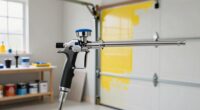
For painting doors fast, I’d start with the Graco Magnum X5: its stand-mounted airless setup suits repeated jobs better than small cup-fed sprayers. The Graco TrueCoat 360 is a more portable choice for a few doors, while the InoKraft MaXpray M1 offers a lower-flow option for buyers who value control. The main tradeoff is speed versus setup and cleanup: larger airless units can cover more area quickly, but small jobs may not justify priming and flushing the system. Cordless and HVLP models can be easier to handle, though they may call for more refills or slower coverage. Read on for the full breakdown and guidance on matching a sprayer to your door count, paint, and workspace.

Get business pricing on tools and workshop supplies
- Business-only prices and quantity discounts
- Tax-exempt purchasing
- Multiple users, one account, clear invoices
Complete the kit



Key Takeaways
- The Graco Magnum X5 is the strongest fit for repeat door projects because its stand-mounted format is aimed at larger painting jobs, not just a single door.
- The TrueCoat 360 trades capacity for portability, making it a more natural option when the job is limited to a few doors and moving around matters.
- Higher flow is not automatically better for doors: faster paint delivery can demand more control to avoid runs, especially around panels and edges.
- Battery-powered models prioritize cord-free handling, but cup capacity and battery runtime can add interruptions during a multi-door job.
- HVLP and multi-nozzle handheld sprayers are distinct alternatives: they may suit detail work or occasional projects, but they are not direct substitutes for stand-style airless coverage.
| X9 Airless Paint Sprayer, 650W, 3000 PSI, 0.39 GPM |  | Best for Fast, Adjustable Door Coats | Power: 650W | Maximum pressure: 3000 PSI | Flow rate: 0.39 GPM | VIEW ON AMAZON | See Our Full Breakdown |
| Cordless Paint Sprayer with 2×4.0Ah Batteries and 650W Motor |  | Best Cordless Option for Isolated Doors | Motor power: 650W | Batteries: 2 × 4000mAh | Runtime per battery: Up to 25 minutes | VIEW ON AMAZON | See Our Full Breakdown |
| Graco Magnum Project Painter Plus Paint Sprayer |  | Best for Bucket-Fed Door Batches | Brand and model: Graco 257025 | Tank volume: 5 gallons | Item weight: 15 pounds | VIEW ON AMAZON | See Our Full Breakdown |
| WORKPRO 700W Airless Paint Sprayer with 12-Inch Extension Rod |  | Best for Reach Beyond the Door | Model: W125410AE | Power: 700W | Maximum pressure: 2900 PSI | VIEW ON AMAZON | See Our Full Breakdown |
| InoKraft MaXpray M1 Airless Paint Sprayer, 3000 PSI, 0.31 GPM |  | Best for Beginner-Friendly Cleanup | Model: MaXpray M1 | Maximum pressure: 3000 PSI | Maximum paint output: 0.31 GPM | VIEW ON AMAZON | See Our Full Breakdown |
| AEROPRO AP8628 Airless Paint Sprayer, 950W, 0.52 GPM, 3300 PSI |  | Best for Fast Multi-Door Projects | Power: 950 W | Flow rate: 0.52 GPM (2.0 LPM) | Maximum pressure: 3300 PSI | VIEW ON AMAZON | See Our Full Breakdown |
| HomeRight Super Finish Max HVLP Paint and Stain Sprayer with 3 Brass Tips |  | Best for Door Detail and Finish Control | Type: HVLP paint and stain sprayer | Power: 450 watts | Container capacity: 39 ounces | VIEW ON AMAZON | See Our Full Breakdown |
| Graco TrueCoat 360 Single-Speed Airless Paint Sprayer |  | Best Handheld Airless Pick | Type: Single-speed handheld airless paint sprayer | Project capacity: Up to 2 gallons | Included paint tips: 2 | VIEW ON AMAZON | See Our Full Breakdown |
| Paint Sprayer for House Painting with 4 Nozzles and 3 Spray Patterns |  | Best for Pattern Options on a Budget Setup | Nozzle sizes: 1 mm, 1.5 mm, 2 mm, and 3 mm | Spray patterns: Horizontal, vertical, and circular | Included accessories: Paint filter, viscosity cup, cleaning brush, nozzle cleaning needle, dust blowing joint, clean connector, pot lid, and user manual | VIEW ON AMAZON | See Our Full Breakdown |
| VKE Battery Powered Airless Paint Sprayer, 3×1300ml Cups, 2 Nozzles, 6 Speed |  | Best for Cordless Door Touch-Ups | Paint capacity: 3 × 1300 ml cups | Nozzles: 2 | Speed settings: 6 | VIEW ON AMAZON | See Our Full Breakdown |
| DOWILIN Airless Paint Sprayer with Low Overspray |  | Best for Spraying Thick Door Coatings | VIEW ON AMAZON | See Our Full Breakdown | |||
| Paint Sprayer with 38000 RPM Motor, Adjustable Flow, and Multiple Nozzles |  | Best for Adjustable Door and Trim Work | VIEW ON AMAZON | See Our Full Breakdown | |||
| VEVOR 750W Stand Airless Paint Sprayer, 3000 PSI |  | Best for Multiple Doors and Larger Jobs | VIEW ON AMAZON | See Our Full Breakdown | |||
| Graco Magnum X5 Airless Paint Sprayer, Interior & Exterior |  | Best for Reliable, Flexible Multi-Door Jobs | VIEW ON AMAZON | See Our Full Breakdown | |||
| Cordless Paint Sprayer with Dual 4000mAh Batteries and 6 Nozzles |  | Best Cordless Option for a Single Door | VIEW ON AMAZON | See Our Full Breakdown |
More Details on Our Top Picks
X9 Airless Paint Sprayer, 650W, 3000 PSI, 0.39 GPM
For someone coating several doors, the X9 pairs a 0.39 GPM flow rate with adjustable pressure and motor speed, giving more control over coverage than a basic fixed-setting approach. Its stated overspray reduction can also help limit paint drifting onto nearby trim, though masking and careful technique still matter. Compared with the Graco Magnum Project Painter Plus, the X9 offers a higher listed flow rate, while Graco has a clearer bucket-fed setup and support for a longer hose. The X9’s 25-foot hose and 11.8-inch extension add reach, but the extension is less useful on a door than when spraying higher or lower surfaces. Setup may take patience, and the unit should not be left running idle. I’d choose it for a batch of doors when adjustable output and pace matter more than the simplest setup.
Pros:- 0.39 GPM flow rate supports quicker coverage across multiple door faces.
- Adjustable pressure and motor speed let users tune the spray for the coating and work pace.
- Stated overspray reduction may reduce paint drifting onto nearby trim when paired with careful masking.
- Includes a 25-foot hose and 11.8-inch extension for added reach.
Cons:- Setup can be challenging for some users, so allow time to follow the manual closely.
- Not intended to run idle, which can interrupt a stop-and-start door-painting workflow.
- The extension rod offers less benefit on doors than on overhead or low surfaces.
Best for: DIYers spraying several interior or exterior doors who want adjustable output and a long hose for moving around a work area.
Not ideal for: First-time users who want the simplest setup, or anyone who needs a sprayer that can run unattended between coats.
- Power:650W
- Maximum pressure:3000 PSI
- Flow rate:0.39 GPM
- Hose length:25 feet
- Extension rod length:11.8 inches
- Recommended annual usage:200 gallons
Our verdict“Choose the X9 for several doors when adjustable, relatively high-output spraying matters more than beginner-friendly setup.”
Cordless Paint Sprayer with 2×4.0Ah Batteries and 650W Motor
The main advantage here is freedom from a power cord and hose: that can make a single detached door, gate, or door in a tight area easier to reach. The two 4.0Ah batteries are listed for up to 25 minutes each, so swapping batteries extends the work window, but this is not the pick I’d choose for a long run of doors. Unlike the X9 Airless Paint Sprayer, this model’s supplied description emphasizes a container-fed, cordless setup rather than airless pressure and flow specifications; buyers should verify coating compatibility and spray performance for their paint before relying on it for a fast finish. Its 1400ml container reduces refill breaks, while the loaded weight and limited battery runtime work against long sessions. The multiple patterns and nozzles offer flexibility, but they do not remove the need for masking and test spraying.
Pros:- Cordless design makes it easier to move around a door without managing a power cord.
- Two 4.0Ah batteries provide a spare for swapping during a short project.
- A 1400ml container means fewer refills than a smaller cup.
- Six brass nozzles and four spray patterns offer choices for different application needs.
Cons:- Runtime is limited to up to 25 minutes per battery, which may not suit a larger door batch.
- The sprayer can feel heavy when the container is full.
- The provided product data does not specify airless pressure or flow rate, making speed comparisons less certain.
Best for: DIYers painting one or two doors away from convenient outlets, especially where cord and hose management would get in the way.
Not ideal for: Anyone spraying many doors in one session or seeking a specified airless flow rate for rapid, repeatable coverage.
- Motor power:650W
- Batteries:2 × 4000mAh
- Runtime per battery:Up to 25 minutes
- Container capacity:1400ml
- Nozzles:6 brass nozzles
- Spray patterns:4: horizontal, vertical, circular, diagonal
Our verdict“Pick this cordless model for a small, outlet-awkward door job, not for a long production-style run.”
Graco Magnum Project Painter Plus Paint Sprayer
When speed means avoiding repeated refills, the Project Painter Plus has a practical advantage: its suction tube draws from a 1- or 5-gallon bucket, so a door batch can keep moving without a small onboard cup. Adjustable pressure supports spraying unthinned paint or stain, and the included 25-foot DuraFlex hose gives room to position the sprayer away from the work. Compared with the X9, Graco lists a lower flow rate in the supplied information only by not providing a flow figure at all, so I can’t rank their door-coating speed from output numbers. Its stated project limit—up to 5 gallons—also makes it less suited to extended production work than a larger-capacity system. At 15 pounds, it remains portable enough for DIY use, but cleaning and setup still take time between door sessions.
Pros:- Draws directly from 1- or 5-gallon buckets, reducing refill interruptions.
- Adjustable pressure supports paint and stain applications.
- Included 25-foot hose, with support for hoses up to 50 feet.
- Includes an SG2 metal spray gun, TrueAirless 515 tip, and PowerFlush adapter.
Cons:- Designed for projects up to 5 gallons, limiting its fit for larger ongoing workloads.
- The product data supplied here does not state a flow rate for direct speed comparison.
- A bucket-fed airless setup still requires preparation and cleanup after spraying.
Best for: Homeowners spraying several doors with the same coating who value bucket-fed operation and adjustable pressure over cordless convenience.
Not ideal for: Users planning projects beyond the stated 5-gallon scale or buyers who need a published flow rate to compare door-spraying speed.
- Brand and model:Graco 257025
- Tank volume:5 gallons
- Item weight:15 pounds
- Included hose:1/4 in × 25 ft DuraFlex hose
- Maximum hose length:50 feet
- Included spray tip:TrueAirless 515
- Warranty:1-year limited warranty
- Country of manufacture:USA
Our verdict“Choose the Project Painter Plus for a multi-door DIY job where bucket-fed spraying matters more than cordless portability or a published flow figure.”
WORKPRO 700W Airless Paint Sprayer with 12-Inch Extension Rod
The WORKPRO’s appeal for door projects is a balance of useful reach and measured output: its 0.317 GPM flow rate is below the X9’s listed 0.39 GPM, so I’d favor the X9 when the priority is covering a larger batch quickly. WORKPRO counters with a 12-inch extension rod, which is more useful for frames, high panels, and nearby surfaces than for the center of a standard door. Its adjustable pressure and stated ability to spray without thinning paint suit users who want to move between doors and trim without changing equipment, subject to paint and tip compatibility. The 25-foot hose helps keep the unit out of the immediate work zone. This is a corded AC model, and cleanup remains part of the job; its included cleaning kit helps, but does not make maintenance optional.
Pros:- 700W motor and adjustable pressure support changes for different surfaces and project needs.
- Listed to spray paint without thinning, subject to coating and tip guidance.
- 25-foot hose and 12-inch extension improve reach around frames and elevated areas.
- Includes safety goggles, wrench set, and cleaning kit.
Cons:- Its 0.317 GPM flow rate is lower than the X9’s listed 0.39 GPM for buyers prioritizing throughput.
- AC power means a cord must be managed around doors and the work area.
- Requires post-use cleaning and ongoing maintenance.
Best for: DIYers painting doors alongside frames, trim, or hard-to-reach areas who want an extension and included cleanup tools.
Not ideal for: Buyers focused on the fastest coverage of many doors, since its listed flow rate is lower than the X9’s.
- Model:W125410AE
- Power:700W
- Maximum pressure:2900 PSI
- Flow rate:0.317 GPM
- Hose length:25 feet
- Extension rod:12 inches
- Power source:AC
Our verdict“Choose WORKPRO when door frames and reach matter as much as door-face speed, but favor the X9 for higher listed flow.”
InoKraft MaXpray M1 Airless Paint Sprayer, 3000 PSI, 0.31 GPM
The MaXpray M1 makes a strong case for a homeowner who wants airless application without making cleanup an afterthought. Its Flush-Ease valve, cleaning kit, quick-start guide, and video tutorials can make the first project less opaque than the X9, whose product information flags setup as a potential hurdle. For door speed, though, its 0.31 GPM output is lower than both the X9’s 0.39 GPM and WORKPRO’s 0.317 GPM, so I’d place it behind those options for a large batch. It sprays compatible latex and acrylic paints without thinning and includes a reversible 515 tip, hose, and extension. The stated 10-gallon project capacity fits home jobs rather than sustained high-volume work, and buyers need to check coating and tip guidance with the paint manufacturer.
Pros:- Flush-Ease valve and cleaning kit support a more guided cleanup process.
- Quick-start guide and video tutorials can help newcomers prepare the sprayer.
- Sprays compatible latex and acrylic paint without thinning.
- Includes a 25-foot hose, 12-inch extension, and reversible 515 tip.
Cons:- At 0.31 GPM, its listed output is lower than the X9 and WORKPRO options in this group.
- Maximum project capacity is limited to 10 gallons.
- Paint and tip compatibility must be checked with the coating manufacturer.
Best for: Homeowners new to airless spraying who want guided setup and cleanup for a modest number of doors and other household surfaces.
Not ideal for: Painters prioritizing the highest listed flow for a large door batch or planning projects beyond the 10-gallon capacity.
- Model:MaXpray M1
- Maximum pressure:3000 PSI
- Maximum paint output:0.31 GPM
- Maximum project capacity:Up to 10 gallons
- Hose length:25 feet
- Tip extension:12 inches
- Item weight:10.23 kg
- Warranty:1 year, extendable to 2 years per instructions
Our verdict“Pick the MaXpray M1 for a manageable home door project when guided setup and cleanup matter more than maximum spray throughput.”
AEROPRO AP8628 Airless Paint Sprayer, 950W, 0.52 GPM, 3300 PSI
For a batch of interior doors or a larger repaint, the AEROPRO AP8628 has the strongest stated flow rate in this group: 0.52 GPM. That capacity can reduce time spent spraying compared with the handheld Graco TrueCoat 360, which is intended for projects up to two gallons. Its five reversible tip sizes give you options for adjusting the spray to different surfaces, while the reversible tip can help clear a clog without stopping to dismantle the gun. The included 18-inch extension is more useful on walls and fences than on door faces, but can help with high or awkward areas. The tradeoff is a corded, less portable setup, and the stated annual use recommendation of 200 gallons makes this a poor fit for continuous high-volume work.
Pros:- Highest stated flow rate among these five options at 0.52 GPM
- Five reversible tip sizes support different coatings and spray needs
- Reversible tip can help clear clogs during a job
- Includes an 18-inch extension, five filters, and two wrenches
Cons:- Requires an AC power source, limiting use away from outlets
- The stated annual use recommendation is limited to 200 gallons
- Its extension and larger-surface capacity may be excessive for a single-door job
Best for: Homeowners painting several doors alongside walls, fences, or other surfaces who want a high stated flow rate and multiple tip options.
Not ideal for: People painting just one door who want a compact handheld tool, or frequent high-volume users who may exceed the stated 200-gallon annual use recommendation.
- Power:950 W
- Flow rate:0.52 GPM (2.0 LPM)
- Maximum pressure:3300 PSI
- Hose length:15 meters
- Included tips:311, 313, 415, 517, and 619 reversible tip sets
- Included extension:18 inches
- Included filters:5
- Power source:AC
Our verdict“Choose the AEROPRO AP8628 for multiple doors and broader projects where its higher stated flow rate matters more than portability.”
HomeRight Super Finish Max HVLP Paint and Stain Sprayer with 3 Brass Tips
The HomeRight Super Finish Max is the detail-oriented alternative to the airless models here. Its adjustable paint flow, three tip sizes, and wide or fine spray patterns give a door painter more control over application than the high-flow AEROPRO AP8628, though the HVLP format is not the choice I’d make when speed across many doors is the main goal. The 39-ounce container suits a small set of doors, but it means refilling can interrupt longer sessions. It works with oil- and water-based paints, stains, and sealers, and its turbine runs without an air compressor. Some coatings may still need thinning, so allow time for material preparation and cleanup. This makes more sense for a careful furniture-and-door painter than for someone trying to spray a whole house quickly.
Pros:- Adjustable paint flow and three tips support controlled application
- Wide and fine spray patterns provide different coverage options
- Handles oil- and water-based paints, stains, and sealers
- Turbine motor operates without a separate air compressor
Cons:- HVLP is a less suitable choice than airless models for spraying many doors quickly
- Some materials may require thinning before spraying
- The 39-ounce container can require refills during larger jobs
Best for: DIYers painting a few doors, cabinets, or furniture who value adjustable flow and spray-pattern control over maximum coverage speed.
Not ideal for: Painters tackling many doors in one session who want airless speed, minimal refills, and less material preparation.
- Type:HVLP paint and stain sprayer
- Power:450 watts
- Container capacity:39 ounces
- Included spray tips:1.5 mm, 2.0 mm, and 4.0 mm
- Spray patterns:Wide and fine
- Compatible materials:Oil- and water-based paints, stains, and sealers
Our verdict“Pick the HomeRight when precise flow and pattern adjustments matter more than airless speed across a large run of doors.”
Graco TrueCoat 360 Single-Speed Airless Paint Sprayer
For a small door job, the Graco TrueCoat 360 offers a useful balance of airless application and handheld convenience. It sprays unthinned coatings in any direction, including upside down, which can help when working around door edges or awkward angles. Its FlexLiner system and included funnel make filling and handling paint more contained than the larger AEROPRO AP8628 setup. The limit is scale: Graco specifies projects up to two gallons, so it is better suited to a few doors than a whole-house repaint. It is also single-speed, offering less adjustment than the HomeRight’s variable flow and pattern controls. For buyers who want to avoid a larger rig and can stay within the project limit, its compact format is the point.
Pros:- Sprays paint or stain without thinning
- Can spray in any direction, including upside down
- Handheld format suits small door and trim projects
- Includes two tips and four FlexLiner bags
Cons:- Intended for projects up to two gallons, limiting larger door batches
- Single-speed operation provides less adjustment than variable-flow options
- A smaller project format may be inefficient for repeated refilling on larger jobs
Best for: DIYers spraying one or a few doors who want a handheld airless tool and the flexibility to spray at different angles.
Not ideal for: Anyone painting many doors or working beyond a two-gallon project, where the AEROPRO AP8628 offers a higher stated flow rate and broader capacity.
- Type:Single-speed handheld airless paint sprayer
- Project capacity:Up to 2 gallons
- Included paint tips:2
- FlexLiner bags:4
- Spray direction:Any direction, including upside down
- Warranty:One year against manufacturer defects
Our verdict“Choose the TrueCoat 360 for a small, contained door project where handheld airless convenience matters more than high-volume speed.”
Paint Sprayer for House Painting with 4 Nozzles and 3 Spray Patterns
This sprayer’s appeal is its menu of four nozzle sizes and three patterns, including horizontal, vertical, and circular settings. Those choices may help a beginner adapt the spray to door panels, edges, and nearby surfaces, while the filter and cleaning tools give the kit a practical starting point. It is a much less substantiated speed pick than the AEROPRO AP8628: the supplied product data gives no motor power, pressure, or spray rate, so I can’t judge how quickly it will cover a door or whether it will handle a particular coating. Compared with the Graco TrueCoat 360, it also lacks a stated airless format and project capacity. I’d treat it as a cautious entry-level option for small tasks, not a dependable choice for a deadline-driven run of doors.
Pros:- Four nozzle sizes offer several application options
- Horizontal, vertical, and circular spray patterns are included
- Comes with a paint filter, viscosity cup, and cleaning tools
- Dust-blowing accessories are included
Cons:- No stated motor power, pressure, or spray rate to gauge door-painting speed
- Product data does not identify it as an airless sprayer
- Limited performance information makes it hard to match with specific coatings or larger jobs
Best for: Beginners handling a small household painting task who want several nozzle and pattern options and can accept limited performance information.
Not ideal for: Buyers who need a known airless system, verified coverage speed, or a predictable choice for painting multiple doors quickly.
- Nozzle sizes:1 mm, 1.5 mm, 2 mm, and 3 mm
- Spray patterns:Horizontal, vertical, and circular
- Included accessories:Paint filter, viscosity cup, cleaning brush, nozzle cleaning needle, dust blowing joint, clean connector, pot lid, and user manual
- Motor power:Not specified
- Spray rate:Not specified
- Maximum pressure:Not specified
Our verdict“Consider this sprayer for small, flexible household tasks, but choose a specified airless model if fast door coverage is the priority.”
VKE Battery Powered Airless Paint Sprayer, 3×1300ml Cups, 2 Nozzles, 6 Speed
The VKE cordless sprayer is the portability pick for doors in a garage, outbuilding, or outdoor workspace without a convenient outlet. Its six speed settings offer flow adjustment, and three 1300 ml cups provide more container capacity than the Graco TrueCoat 360’s explicitly small-project setup. But the stated 30-minute battery runtime makes this a better fit for a few doors or short sessions than a long production run; cups still need manual refilling as paint runs out. The description calls it airless and suitable for high-viscosity paint, but gives no pressure figure, and weight is unspecified. I’d choose the AEROPRO AP8628 instead when sustained, corded output and documented pressure matter more than freedom from a power cord.
Pros:- Cordless format suits work away from outlets
- Six speed settings provide flow adjustment
- Three 1300 ml cups offer multiple paint containers
- Description states suitability for high-viscosity paints
Cons:- About 30 minutes of stated battery runtime may interrupt longer jobs
- No pressure figure is provided to compare airless performance
- Manual refilling remains necessary, and weight is unspecified
Best for: DIYers spraying a few doors in a location without easy access to an outlet who value cordless operation and adjustable flow.
Not ideal for: People planning an extended multi-door session who need longer runtime, documented pressure, or a clear path to sustained high-volume spraying.
- Paint capacity:3 × 1300 ml cups
- Nozzles:2
- Speed settings:6
- Flow rate:1000 ml/min
- Battery runtime:About 30 minutes
- Weight:Not specified
Our verdict“Choose the VKE for short, outlet-free door jobs, but opt for the corded AEROPRO AP8628 for longer sessions with a stated pressure and flow rate.”
DOWILIN Airless Paint Sprayer with Low Overspray
The DOWILIN stands out for buyers who want to spray undiluted, high-viscosity coatings rather than adapt paint to a smaller sprayer. Its included 515 tip and 25-foot hose suit coating multiple doors or nearby trim without moving the machine after every pass; the 12-inch extension can also help reach awkward edges. Compared with the Graco Magnum X5, it supplies less documented flexibility for long hose runs, but its listed kit includes cleaning accessories and quick-connect parts aimed at easier cleanup. The product claims reduced overspray and coating waste, though those claims are not quantified in the supplied details. The 10-gallon tank-volume listing is also unclear for a sprayer of this size, so I would verify the actual paint supply setup before buying.
Pros:- Designed to spray undiluted, high-viscosity coatings
- Includes a 25-foot hose and 12-inch tip extension
- Quick-connect parts and cleaning accessories support cleanup
- 515 spray tip is included for broader coverage
Cons:- The listed 10-gallon tank volume is ambiguous for this setup
- Reduced-overspray and material-saving claims are not quantified
- The supplied product data truncates the hose-length wording
Best for: DIYers spraying several doors with thicker coatings who want a long hose, a 515 tip, and an extension in the box.
Not ideal for: Buyers who need clearly documented tank capacity, verified material-saving performance, or established hose compatibility for a larger project.
Our verdict“Choose the DOWILIN for multiple doors and thicker coatings if you value its included hose and extension more than clearly documented capacity.”
Paint Sprayer with 38000 RPM Motor, Adjustable Flow, and Multiple Nozzles
Among these five, this sprayer offers the widest stated nozzle range, from 0.5 mm to 2.5 mm, plus horizontal, vertical, and circular patterns. That flexibility can help a DIYer tune coverage for door faces and narrower areas, while the 1400 ml container means fewer pauses to refill than a small cup. Its adjustable flow is useful for controlling paint delivery, but the supplied details do not identify it as an airless system, unlike the Graco Magnum X5 or VEVOR 750W stand sprayer. For painting doors fast, that distinction matters: I would not treat its 38000 RPM motor as proof of airless performance or assume it will match a pump sprayer’s pace on several doors. It also needs thorough cleaning to prevent clogs.
Pros:- Six nozzle sizes span 0.5 mm to 2.5 mm
- Three spray patterns support different work areas
- 1400 ml container reduces refill interruptions
- Adjustable flow gives users control over paint delivery
Cons:- The supplied product details do not confirm airless operation
- Thorough cleaning is needed to help prevent nozzle clogs
- May be heavy for extended handheld sessions
Best for: DIYers painting one or two doors who want nozzle and pattern options for changing between broad faces and narrower sections.
Not ideal for: Buyers specifically seeking an airless sprayer for several doors or a large, continuous painting task.
Our verdict“Pick this for adjustable nozzle and pattern control on a small door project, but choose a confirmed airless model for faster multi-door coverage.”
VEVOR 750W Stand Airless Paint Sprayer, 3000 PSI
The VEVOR is the stronger fit when “painting doors fast” means handling several doors alongside larger surfaces. Its 750 W motor, 3000 PSI maximum pressure, and 1.2 LPM flow rate are aimed at sustained coverage, while adjustable speed offers some control when changing materials or tasks. Compared with the compact DOWILIN, it is better equipped on paper for a broader workload, and its 7.6-meter hose gives more reach than the listed 25-foot hose on the Graco Magnum X5. A detachable pump and cleaning brush help with maintenance, but airless equipment still takes preparation and cleanup that can outweigh the speed benefit for a single door. I would also verify the listed 200-gallon tank volume, which is ambiguous beside this stand-style design.
Pros:- 750 W power and up to 3000 PSI suit broader coverage
- Maximum flow rate is listed at 1.2 LPM
- 7.6-meter hose provides useful working reach
- Detachable pump and included cleaning brush aid maintenance
Cons:- A single-door job may not justify its setup and cleanup
- The listed 200-gallon tank volume needs verification
- Its stand-style format is less compact than handheld sprayers
Best for: Homeowners spraying several doors as part of a medium-to-large interior or exterior project who can use the sprayer beyond a single small task.
Not ideal for: People painting one door, or buyers unwilling to verify the unclear tank-volume specification before purchase.
Our verdict“Choose the VEVOR when door painting is part of a larger project and its high-output setup will see repeated use.”
Graco Magnum X5 Airless Paint Sprayer, Interior & Exterior
The Magnum X5 earns its place for buyers who want an airless setup that can move from doors to wider interior or exterior work. Adjustable pressure control helps adapt paint delivery, while the flexible suction tube draws directly from a 1- or 5-gallon bucket, avoiding repeated small-container refills. Its included 25-foot Duraflex hose is shorter than the stated maximum supported run of 75 feet, but that extra compatibility can help when the work area is spread out. Compared with the VEVOR, the X5’s supplied details make bucket feeding and hose expansion clearer; the VEVOR instead lists higher maximum pressure and flow. The X5 weighs 15 pounds and has several setup components, so it is less appealing for a quick one-door refresh than a simpler compact option.
Pros:- Adjustable pressure suits paints and stains
- Flexible suction tube draws from 1- or 5-gallon buckets
- Includes a 25-foot hose and supports runs up to 75 feet
- Suitable for interior and exterior projects
Cons:- 15-pound unit can be cumbersome to transport
- Multiple components can make setup harder for beginners
- The included hose is 25 feet; longer reach requires a compatible extension
Best for: Homeowners planning to spray several doors along with walls, siding, or other surfaces and who want bucket-fed operation.
Not ideal for: First-time users seeking a minimal setup for one door, or anyone who prioritizes the lightest, simplest machine to move.
Our verdict“Choose the Magnum X5 for a multi-door project that may expand to other surfaces, especially if bucket feeding and future hose reach matter.”
Cordless Paint Sprayer with Dual 4000mAh Batteries and 6 Nozzles
This cordless model makes the most sense when outlets and cords would slow work around a single door, rather than when maximum continuous output is the priority. Its two 4000mAh batteries provide about 25 minutes of working time per battery, and the 1400 ml tank reduces refill stops during that window. Six brass nozzles, three spray patterns, and an LED light add flexibility for door faces, edges, and dim work areas. Unlike the Graco Magnum X5, it does not use a bucket-fed airless setup, so it is less suited to a run of doors or a larger project. The stated viscosity limit of 100 DIN also narrows material choice, and battery changes plus cleanup interrupt the pace. I would choose it for portability, not for sustained airless production.
Pros:- Cordless design allows movement without managing a power cord
- Two 4000mAh batteries are included
- 1400 ml tank limits refill breaks
- Six brass nozzles, three patterns, and LED lighting add versatility
Cons:- Working time is about 25 minutes per battery
- Battery-powered format is better suited to small and medium tasks
- Cleaning after use can take time
Best for: DIYers painting one door or a small set of doors in a location where cord-free movement and built-in lighting are useful.
Not ideal for: Users seeking a confirmed airless sprayer for continuous multi-door work or coatings outside the stated 100 DIN viscosity limit.
Our verdict“Pick this for a small, cord-free door project, but choose the Magnum X5 or VEVOR for sustained airless coverage across several doors.”

How We Picked
I ranked these options around the specific job of coating doors quickly, weighing coverage pace, control, and practical setup rather than treating maximum pressure or motor power as a guarantee of better results. I also looked at format and stated capacity: stand-mounted units are more suited to repeated spraying, while handheld, cup-fed, and cordless models can be easier to position for a small batch of doors.
Cleanup, refill interruptions, and learning curve shaped the order as much as raw output. A sprayer that can move paint quickly still needs to handle door panels without making overspray, drips, or cleanup burdens unreasonable. The Graco Magnum X5 ranks ahead for sustained work; portable options follow for smaller jobs, and HVLP or compact multi-nozzle picks rank lower for buyers whose main goal is fast airless coverage. Product names and listed specifications inform these distinctions, but the right choice also depends on paint compatibility and the maker’s setup guidance.
Factors to Consider When Choosing Airless Paint Sprayer For Painting Doors Fast
Door painting has a different rhythm from spraying a broad wall: panels, edges, and hardware cutouts make control matter, while setup and cleanup can outweigh spray time on a one-door job. I’d choose around the number of doors, how they can be positioned, and how much masking the room allows—not simply the biggest pressure figure.
Match the Sprayer Format to the Number of Doors
For several doors in one session, a stand-style sprayer can reduce refill stops and keep the hose and gun separate from the paint supply. For one or two doors, a handheld unit may save time overall because it is easier to move and may take less setup. A common mistake is buying for the biggest possible project when the actual job is a short batch; priming and cleaning a larger system can erase its coverage advantage. Count both sides of every door and any frames you plan to coat. If you expect to repeat the job across a home, capacity and sustained operation deserve more weight than compact storage.
Prioritize Control Around Panels and Edges
Raised or recessed panels create corners where paint can build up, so a high-output sprayer is not automatically the fastest route to a clean finish. Look for a setup that lets you manage material flow and use a suitable tip for the paint and finish. Keep the gun moving and use consistent passes; lingering near panel joints is a common source of runs. Test the pattern on scrap material before spraying a finished door. When you cannot practice or adjust the setup, a lower-output or more controllable format may be a better match than choosing by pressure alone.
Check Paint and Tip Compatibility Before Buying
Not every sprayer handles every coating the same way, and a product’s general paint-spraying label does not confirm that a particular door paint will work unchanged. Check the manufacturer’s approved material range, thinning guidance, and tip requirements before starting. A mismatch can cause poor atomization, clogging, or a finish that needs extra sanding and recoating. Avoid thinning paint by guesswork; follow the coating and sprayer instructions. If your project uses a thicker enamel or primer, compatibility should outweigh an attractive motor or pressure specification.
Budget Time for Masking, Positioning, and Cleanup
Spray time is only part of the job: masking the room, removing or protecting hardware, and setting doors in a position that allows access to their edges all take time. Overspray can travel beyond the door, so a quick spray pass is no shortcut if the surrounding area is not protected. Cup-fed and cordless models may be easy to carry but can need more frequent refills; larger systems usually need thorough flushing after use. Plan for the cleanup method and materials before opening the paint. For a single door, a brush or roller may still be faster once preparation and washing are counted.
Decide Whether Cordless Freedom Is Worth the Stops
Battery-powered sprayers remove the cord from your path and can be handy when doors are spread across rooms or an outlet is awkward to reach. That freedom comes with limits: runtime, charging gaps, and smaller paint containers can interrupt a batch. Published battery capacity alone does not tell you how long a unit will spray with your chosen coating and setting. If you have many doors, compare the availability of spare batteries and the practical refill process, not just the number of batteries included. A corded or stand-style model can be the more efficient choice when the work area is fixed.
Treat HVLP as a Different Tradeoff, Not an Airless Equivalent
HVLP and airless sprayers use different delivery approaches, so they should not be compared on pressure figures or assumed to produce the same pace. An HVLP option may appeal for detailed work or smaller finish projects, while an airless system is more aligned with covering larger surfaces quickly. Buyers sometimes choose a multi-nozzle handheld sprayer expecting it to behave like a stand-mounted airless unit; the operating format and output can differ substantially. Think about the finish you need, paint compatibility, and how many doors you will coat. If speed across repeated doors is the priority, favor a true airless model suited to that workload.
Frequently Asked Questions
Is an airless sprayer faster than a brush or roller for just one door?
Not always, because spray time is only one part of the job. Masking the room, removing hardware, setting up the sprayer, and flushing it afterward can take longer than brushing or rolling a single door. Spraying becomes more compelling when you have several doors ready at once or need to coat detailed profiles evenly. If the room is occupied or hard to mask, the prep burden can outweigh the speed advantage. Decide based on the whole batch, not the time spent pulling the trigger.
Should I choose a higher-flow sprayer to finish doors faster?
Higher flow can move more paint, but it also leaves less margin for slow or uneven passes on door panels. Runs and heavy edges can cost more time in sanding and recoating than a slower, controlled application. Check that the sprayer and tip are suitable for your coating, then practice on scrap before working on the door. A high-output model makes more sense when you can maintain consistent technique and have enough doors to benefit from its pace. For occasional work, control and manageable cleanup may matter more than maximum flow.
Can I spray doors while they are still hanging?
You can spray a hanging door, but access to the edges and the risk of paint reaching nearby walls or floors make preparation harder. Removing the door and placing it securely can give you better access to both faces and reduce the chance of spray settling on adjacent surfaces. The best choice depends on whether you can support the door safely and allow the coating to dry without contact. Plan how you will handle both sides before beginning, especially if the product instructions specify a particular orientation. Do not let convenience lead to spraying near unprotected hardware, hinges, or a finished floor.
Do I need a separate sprayer for primer and finish paint?
Usually, one compatible sprayer can apply both, but the coating, tip, and cleanup requirements must match the manufacturer’s directions. Primer may be thicker or have different handling needs than the finish coat, so check compatibility rather than assuming the same setup works unchanged. Flush the system between materials and follow the coating maker’s recoat instructions. If you are switching products, keep track of what remains in the hose or cup to avoid contaminating the finish. A second sprayer is rarely the first thing to buy; careful cleaning and correct setup matter more.
When does a cordless sprayer make more sense than a stand model?
A cordless unit can be useful when you need to move between rooms, work away from outlets, or coat a small number of doors without dragging a hose. Its convenience may be offset by battery limits and more frequent paint refills, which can interrupt a larger project. A stand model is generally a stronger fit when the doors are gathered in one work area and you want to spray continuously. Compare realistic runtime and cup capacity with the number of doors you plan to finish in a session. For a one-off small batch, portability can outweigh capacity; for repeated work, fewer interruptions usually matter more.
Conclusion
For the best overall fit for repeated door painting, choose the Graco Magnum X5; its stand-style format is better aligned with sustained work than the compact options. The best value direction is the InoKraft MaXpray M1 for buyers who want a lower-flow airless setup and do not need the X5’s larger-job orientation. For a premium, higher-output alternative, the AEROPRO AP8628 is the pick for buyers prioritizing stated flow and pressure, provided they are ready to manage the added control demands. Beginners with a small project may prefer the Graco TrueCoat 360 for its portable format, while buyers who need cordless handling should compare the battery models and accept likely refill or runtime limits. If your job is only one door, or cleanup and masking would be extensive, consider whether a brush or roller is the quicker choice overall.
Halloween Picks
halloween
As an affiliate, we earn on qualifying purchases.