For most cabinet projects, I’d start with the Fuji Spray 2202 Semi-PRO 2: its HVLP setup is suited to controlled, fine-finish work, though it asks for more setup and cleanup than a handheld unit. The HomeRight Super Finish Max is a more approachable option for small projects, while the Graco Magnum Project Painter Plus makes more sense when the job extends beyond cabinets to larger surfaces. The main choice is between HVLP control and airless speed, balanced against overspray, thinning, setup, and maintenance. Compact sprayers can simplify smaller jobs but may require more refills, while larger systems bring added reach and cleanup. Read on for how all 12 options compare and which tradeoffs fit your project.

Get business pricing on tools and workshop supplies
- Business-only prices and quantity discounts
- Tax-exempt purchasing
- Multiple users, one account, clear invoices
Complete the kit



Key Takeaways
- HVLP is the clearest fit for cabinet finish control: The Fuji Spray 2202 and Graco EVO Plus are the more specialized system-style choices, while handheld HVLP models favor convenience.
- Airless capacity comes with a cabinet-specific compromise: The Graco Magnum Project Painter Plus and X5 suit larger, mixed-surface jobs, but their speed and reach can mean more overspray management on doors and frames.
- Compact sprayers trade capacity for easier handling: The Graco TrueCoat models and handheld options are easier to stage for small jobs, but container size and refill frequency matter across a full kitchen.
- Adjustable patterns and flow are useful only when matched to the work: Multiple settings on the LESONJOY, VONFORN, and 1000W HVLP units offer flexibility, but users still need to practice distance and trigger control.
- Buy for the whole project, not just the spray pass: Cleaning access, masking time, paint compatibility, and the number of cabinet doors can matter as much as motor power.


| paint sprayers for cabinet | Model | Type | Spray patterns |
|---|---|---|---|
| Graco Magnum Project Painter P | 257025 | Airless paint sprayer | — |
| Fuji Spray 2202 Semi-PRO 2 HVL | 2202 Semi-PRO 2 | — | — |
| Wagner Spraytech FLEXiO 595 Ha | FLEXiO 595 | Handheld HVLP paint and stain sprayer | — |
| Tilswall Dreamer400 Ultra-Ligh | — | HVLP paint sprayer | 3 |
| Graco TrueCoat One Electric Ai | TrueCoat One | Electric airless paint sprayer | — |
| Graco TrueCoat 360 Drill-Power | TrueCoat 360 Cordless Connect Drill Sprayer | — | — |
| Graco EVO Plus HVLP Paint and | EVO Plus | Electric HVLP sprayer | Horizontal, vertical, and circular |
| LESONJOY 1000W HVLP Paint Spra | CN-6000 | — | Horizontal, vertical, and circular |
| VONFORN 700W Paint Sprayer wit | VF803-Y | — | Horizontal, vertical, and circular |
| 1000W HVLP Electric Paint Spra | CN-6000 | — | Horizontal, vertical, and circular |
| HomeRight Super Finish Max HVL | — | HVLP paint and stain sprayer | Wide and fine |
| Graco Magnum X5 Airless Paint | — | Stand airless paint sprayer | — |
More Details on Our Top Picks
Graco Magnum Project Painter Plus Airless Paint Sprayer
The Project Painter Plus is the strongest fit here when cabinet refinishing is part of a broader household paint job. Its adjustable pressure and ability to draw directly from a bucket let you spray unthinned paint or stain without repeatedly filling a small cup. Compared with the Graco TrueCoat One, it supports projects up to 5 gallons rather than 3, making it a better match for multiple rooms of cabinetry or cabinets plus other surfaces. That scale comes with a cabinet-specific tradeoff: an airless setup can be less forgiving for detailed doors and trim than the Fuji Spray Semi-PRO 2 HVLP system. The included hose is 25 feet, although the sprayer supports up to 50 feet with a compatible hose. I’d choose it for large, mixed projects, not a one-off vanity or a workspace where fine overspray control is the priority.
Pros:- Adjustable pressure supports spraying paint or stain without thinning.
- Draws directly from 1- or 5-gallon buckets, reducing cup refills on larger jobs.
- Supports hose lengths up to 50 feet for reaching distant or elevated work.
- Includes a metal spray gun, 25-foot hose, and setup and storage accessories.
Cons:- The airless setup may be harder to control on detailed cabinet doors than an HVLP system.
- The included hose is 25 feet; reaching the 50-foot maximum requires a longer compatible hose.
- Its project capacity and equipment are more than needed for a small cabinet-only refresh.
Best for: DIYers refinishing several cabinets or combining cabinet work with larger household painting projects.
Not ideal for: Anyone spraying only a small set of cabinet doors who prioritizes fine finish control and minimal overspray over bucket-fed capacity.
- Type:Airless paint sprayer
- Model:257025
- Pressure control:Fully adjustable
- Project capacity:Up to 5 gallons
- Included hose:1/4 in x 25 ft DuraFlex
- Maximum hose length:50 feet
- Weight:15 pounds
- Included spray gun and tip:SG2 metal spray gun and TrueAirless 515 spray tip
Our verdict“Choose this for cabinet work bundled with larger paint jobs, but favor an HVLP model for a small, detail-heavy cabinet project.”
Fuji Spray 2202 Semi-PRO 2 HVLP Spray System
For cabinet doors and drawer fronts, I’d put the Fuji Spray 2202 Semi-PRO 2 ahead of the larger airless Graco models when finish control matters more than covering broad areas quickly. Its adjustable fan pattern lets you narrow the spray for rails and edges or widen it for flat panels, while the non-bleed gun avoids continuous airflow when you’re not spraying. A 1-quart cup is much smaller than the bucket-fed capacity of the Graco Magnum Project Painter Plus, so this system asks for more refills and suits cabinet batches rather than whole-house work. The metal turbine case and 25-foot hose support a dedicated stationary setup, but its 25-pound weight makes it less convenient to move around than the handheld Wagner FLEXiO 595. I’d pick it for a careful cabinet shop or garage workflow, provided the user has compatible North American 120V power.
Pros:- Adjustable fan pattern can be narrowed for cabinet details or widened for flat panels.
- Non-bleed M-Model gun stops airflow when not spraying.
- A 25-foot hose allows the turbine to stay away from the immediate work area.
- Metal turbine case includes a holder for the spray gun.
Cons:- The 1-quart cup needs frequent refilling compared with the bucket-fed Graco Magnum Project Painter Plus.
- At 25 pounds, the system is less portable than the Wagner FLEXiO 595 handheld sprayer.
- Designed for North American 120V power; 220V use requires contacting the manufacturer.
Best for: Cabinet refinishers who want adjustable spray patterns for doors, frames, and trim and can work from a stationary turbine.
Not ideal for: Painters seeking a lightweight handheld tool, bucket-sized capacity, or a system for use outside North American 120V power.
- System type:HVLP spray system
- Model:2202 Semi-PRO 2
- Motor:1400-watt, two-stage bypass
- Spray gun:M-Model, non-bleed
- Air cap:1.3 mm
- Cup capacity and type:1 quart, bottom-feed
- Hose length:25 feet
- Power compatibility:North American 120V
- Weight:25 pounds
Our verdict“Choose the Fuji for controlled cabinet finishing in a fixed workspace, and skip it if portability or large-volume spraying matters more.”
Wagner Spraytech FLEXiO 595 Handheld HVLP Paint and Stain Sprayer
The Wagner FLEXiO 595 is the most approachable pick here for a cabinet DIYer who wants one handheld tool for both broad surfaces and smaller pieces. Its Detail Finish nozzle gives it a cabinet-focused option that the included broad-surface iSpray nozzle does not, and the adjustable flow, width, and pattern settings help adapt the spray to doors, frames, and furniture. The Fuji Semi-PRO 2 offers a more dedicated turbine-and-gun setup for controlled finishing, but it weighs 25 pounds and takes up more space; Wagner keeps the turbine in the handheld unit and includes a storage case. That convenience does not remove the need for practice or cleanup: the nozzles and detachable parts still need rinsing, and switching between nozzle types adds a step when moving between cabinet panels and detail work. I’d choose it for occasional refinishing, not a production workflow.
Pros:- Includes separate iSpray and Detail Finish nozzles for different work sizes.
- Variable flow, spray width, pattern, and nine power settings provide adjustment options.
- Designed to handle unthinned paints and stains, including paints and primers.
- Quick-connect turbine, cup liners, and storage case support setup and storage.
Cons:- Switching nozzles adds a step when moving between broad panels and fine cabinet details.
- Detachable parts still require rinsing after use.
- A handheld motor unit is less separated from the work area than the Fuji Semi-PRO 2 turbine setup.
Best for: First-time cabinet DIYers who want a handheld sprayer with a dedicated detail nozzle for doors, trim, and furniture.
Not ideal for: Frequent cabinet painters seeking a stationary turbine setup, or users who want to avoid nozzle changes and post-project cleanup.
- Type:Handheld HVLP paint and stain sprayer
- Model:FLEXiO 595
- Power settings:9
- Included nozzles:iSpray and Detail Finish
- Spray adjustments:Variable flow, adjustable width and pattern, horizontal or vertical
- Compatible materials:Unthinned paints and stains, including paints and primers, solid stains, and sealers
- Cleanup:Detachable parts rinse clean; cup liners included
- Storage:Durable storage case
- Warranty:1 year
Our verdict“Choose the FLEXiO 595 for an accessible cabinet-and-furniture tool with a detail nozzle, especially for occasional DIY projects.”
Tilswall Dreamer400 Ultra-Light HVLP Paint and Stain Sprayer
At 1.5 pounds, the Tilswall Dreamer400 is the easiest option in this group to hold through a small cabinet refresh, particularly when spraying doors, trim, or furniture requires frequent repositioning. Its two nozzle adapters and three spray patterns offer basic flexibility, while the 600 ml tank keeps the tool compact. Compared with the Wagner FLEXiO 595, it is lighter and simpler on paper, but Wagner includes separate nozzles for broad and detail work and supports a wider set of adjustment controls. The Tilswall’s 450 ml/min maximum flow rate and small tank make it better suited to short sessions than a large kitchen, and paints other than Tilswall’s ready-to-spray formula may need 5–15% thinning. I’d select it for light, limited cabinet work; the instruction to clean within 15 minutes also makes prompt cleanup part of the routine.
Pros:- At 1.5 pounds, it is lighter than the other listed handheld options.
- Three spray patterns and adjustable flow offer basic control for cabinet surfaces.
- Includes 1.5 mm and 2.0 mm nozzle adapters, a strainer, viscosity cup, and cleaning kit.
- Can spray paint, stain, and sealers on a range of household surfaces.
Cons:- The 600 ml tank needs refilling during larger cabinet jobs.
- Paints other than Tilswall ready-to-spray paint may require 5–15% thinning.
- The sprayer should be cleaned within 15 minutes after use.
Best for: DIYers with a small cabinet, furniture, or trim project who value low hand fatigue and a compact handheld sprayer.
Not ideal for: People spraying a large kitchen in one run, or anyone unwilling to thin some paints and clean the sprayer promptly.
- Type:HVLP paint sprayer
- Power:500 W
- Power source:Corded electric
- Weight:1.5 pounds
- Maximum flow rate:450 ml/min
- Tank volume:600 ml
- Nozzle adapters:1.5 mm and 2.0 mm
- Spray patterns:3
- Warranty:2 years
Our verdict“Choose the Dreamer400 for small cabinet jobs where low weight matters more than large capacity or broad paint compatibility without thinning.”
Graco TrueCoat One Electric Airless Paint Sprayer
The Graco TrueCoat One suits cabinet owners who want airless convenience without stepping up to the larger Project Painter Plus. It sprays unthinned paint, stain, and sealer from a standard container, and adjustable speed gives the user room to slow down for doors or work faster on larger surfaces. Its 25-foot hose and included wide TrueCoat tip make it more self-contained for a limited batch than the bucket-fed Graco Magnum Project Painter Plus, but capacity is capped at 3 gallons rather than 5. That makes this a practical middle ground for a small kitchen or several furniture pieces, not a clear choice for intricate finish work: the Fuji Semi-PRO 2 offers an adjustable fan pattern better suited to dialing in a narrow spray. Cleanup remains part of the job, though the included PowerFlush adapter helps with that step.
Pros:- Sprays unthinned paint, stain, and sealers directly from a standard container.
- Adjustable speed supports slower detail work or faster coverage on larger surfaces.
- Includes a 25-foot hose, TC spray gun, and wide TrueCoat paint tip.
- PowerFlush adapter supports cleanup after spraying.
Cons:- Designed for projects up to 3 gallons, below the Project Painter Plus capacity.
- Airless spraying offers less fan-pattern adjustment than the Fuji Semi-PRO 2 HVLP system.
- Requires cleanup after use even with the included PowerFlush adapter.
Best for: Cabinet DIYers spraying a small kitchen or a few cabinet sections who want unthinned material handling and adjustable speed.
Not ideal for: Large, multi-room jobs that exceed 3 gallons, or detail-focused painters who prefer HVLP fan-pattern control.
- Type:Electric airless paint sprayer
- Model:TrueCoat One
- Model number:26DTC1
- Project capacity:Up to 3 gallons
- Hose length:25 feet
- Spray materials:Unthinned paint, stain, and sealers
- Speed control:Adjustable
- Included spray equipment:TC spray gun and wide TrueCoat paint tip
- Cleanup accessory:PowerFlush adapter
Our verdict“Choose the TrueCoat One for a smaller cabinet batch when you want airless spraying without the larger capacity of the Project Painter Plus.”
Graco TrueCoat 360 Drill-Powered Paint Sprayer
The Graco TrueCoat 360 makes most sense for cabinet projects when you already own a compatible drill or driver and want to avoid buying a separate motorized sprayer. Its no-thinning operation and VacuValve design, which supports spraying in any direction, can help when coating cabinet sides, undersides, and other awkward angles. Unlike the corded Graco EVO Plus, this model depends on a separate drill for power, so it is less convenient if you want a ready-to-use kit. Its two-gallon project limit also places it firmly in DIY territory, not a choice for repeated or large-scale cabinet work. The included FlexLiner bags simplify paint handling, but the small included bags mean refilling during a larger job. I’d choose it for a focused cabinet refresh, not an ongoing workshop setup.
Pros:- Works with many major drill, driver, and impact-driver brands
- Vac uValve design supports spraying in different directions, including upside down
- Sprays paint and stain without thinning
- Includes FlexLiner bags, a spray tip, funnel, and strainer
Cons:- Requires a compatible drill or driver, which is not listed as included
- Intended for projects up to two gallons, limiting its usefulness for larger jobs
- Included FlexLiner bags hold 32 oz each, so larger tasks require refills
Best for: DIYers who already own a compatible drill and want a sprayer for a small cabinet repaint or other projects up to two gallons.
Not ideal for: Buyers without a compatible drill, or anyone spraying a large kitchen or frequent cabinet projects who needs a more self-contained setup.
- Brand:Graco
- Model:TrueCoat 360 Cordless Connect Drill Sprayer
- Model number:26D360
- Power source:Battery powered; compatible drill or driver required
- Maximum pressure:2000 psi
- Tank volume:Up to 2 gallons
- Dimensions:5.25 in W x 9.75 in H
- Included components:Two 32 oz FlexLiner paint bags, wide paint and stain tip, funnel, strainer, paint inlet filter, and seal lube
- Warranty:1-year limited warranty
Our verdict“Choose the TrueCoat 360 if you already have a compatible drill and want a compact sprayer for a limited cabinet project.”
Graco EVO Plus HVLP Paint and Stain Sprayer
For a first cabinet-spraying project, the Graco EVO Plus offers a useful balance of straightforward controls and material-specific options. Its four brass nozzles include two for paint and two for stain, while adjustable flow and three spray patterns give a beginner ways to tailor the output to cabinet doors and frames. Compared with the drill-powered Graco TrueCoat 360, the EVO Plus is a self-contained electric HVLP tool; it does not require a separate drill, though the available product details do not state its cup capacity. The PowerFlush adapter is a practical inclusion for cleanup, but small household projects are its intended scale, not a full-time production workload. I’d favor it over a basic sprayer when nozzle choice and cleanup support matter, but skip it if you need documented high-volume capacity.
Pros:- Four solid brass nozzles include separate options for paint and stain
- Adjustable material flow helps tailor output to cabinet parts
- Horizontal, vertical, and circular spray patterns provide application flexibility
- Includes an HVLP PowerFlush adapter and cleaning kit
Cons:- Designed for small household projects rather than larger-scale work
- The product details do not specify cup capacity, making refill planning difficult
- Four nozzles add setup choices that beginners must match to the material
Best for: First-time DIYers painting a modest set of cabinet doors who want dedicated paint and stain nozzles, adjustable flow, and an included cleanup adapter.
Not ideal for: Cabinet refinishers tackling large kitchens or frequent jobs who need a specified high-capacity reservoir or a sprayer suited to sustained work.
- Brand:Graco
- Model:EVO Plus
- Model number:27F401
- Type:Electric HVLP sprayer
- Included nozzles:Four solid brass nozzles: two for stain and two for paint
- Nozzle sizes:1 mm, 2 mm, and 3 mm (as listed)
- Spray patterns:Horizontal, vertical, and circular
- Material thinning:Not required
- Warranty:12 months
Our verdict“Pick the EVO Plus for a small first cabinet project where nozzle options and cleanup support matter more than high-volume capacity.”
LESONJOY 1000W HVLP Paint Sprayer with 1400 ml Container, 4 Copper Nozzles and 3 Spray Patterns
The LESONJOY CN-6000 earns its place for cabinet jobs where fewer pauses to refill are a priority: its 1400 ml container is larger than the 1200 ml tank listed for the VONFORN VF803-Y. Adjustable flow and horizontal, vertical, or circular patterns also help adapt the spray to broad panels and narrower cabinet components. Its four copper nozzles give buyers options, but the supplied details do not identify the sizes, so selecting a precise setup is less transparent than with VONFORN’s listed nozzle sizes. The 1.8-meter hose can also restrict movement around a cabinet workspace, and its plastic construction may be less robust than a metal-bodied system such as the Fuji Spray 2202. I’d shortlist it for occasional home refinishing where tank capacity matters more than extended reach or heavy-duty construction.
Pros:- 1400 ml container can reduce refill interruptions compared with the VONFORN VF803-Y
- Adjustable flow helps tailor output for cabinet panels and smaller parts
- Three spray patterns and four included nozzles offer setup flexibility
- Includes filters, a viscosity cup, and nozzle-cleaning tools
Cons:- Plastic construction may be less durable than metal-bodied alternatives
- The 1.8-meter hose may limit reach around a larger workspace
- The product details do not specify the four nozzle sizes
Best for: Home DIYers painting several cabinet doors or furniture pieces in one session who value a 1400 ml container and adjustable spray settings.
Not ideal for: Users who need a longer hose for moving around a large work area, want metal construction, or need nozzle sizes clearly identified before setup.
- Brand:LESONJOY
- Model:CN-6000
- Power:1000W
- Power source:AC
- Tank volume:1400 ml
- Nozzles:Four copper nozzles
- Spray patterns:Horizontal, vertical, and circular
- Maximum pressure:20 psi
- Hose length:1.8 meters
Our verdict“Choose this LESONJOY model for home cabinet work where its 1400 ml container matters more than hose reach or a sturdier body.”
VONFORN 700W Paint Sprayer with 4 Nozzles and 3 Spray Patterns
The VONFORN VF803-Y is a useful fit for cabinet painters who want nozzle sizes spelled out before choosing a setup. Its four options—1.0, 1.5, 2.0, and 3.0 mm—make the configuration clearer than the LESONJOY CN-6000, whose nozzle sizes are not listed in the supplied details. Three spray patterns and adjustable flow add control for broad door faces and narrower components, while tool-free assembly keeps setup approachable. The tradeoff is its 1200 ml tank, which is smaller than LESONJOY’s 1400 ml container and may mean more refills across a larger set of cabinets. It also calls for careful cleaning after each use; its included cleaning connector and tools help, but do not remove that task. I’d choose it for a DIYer who values known nozzle options over a larger reservoir.
Pros:- Four listed nozzle sizes make setup options clear
- Horizontal, vertical, and circular patterns suit different cabinet surfaces
- Adjustable flow helps control paint output
- Includes paint filters, a cleaning connector, and nozzle-cleaning tools
Cons:- The 1200 ml tank is smaller than the 1400 ml LESONJOY CN-6000 container
- Nozzle size selection adds a setup decision for each material and task
- Paint residue must be cleaned from the sprayer after use
Best for: DIY cabinet painters who want clearly identified nozzle sizes and adjustable patterns for switching between doors, frames, and furniture.
Not ideal for: People spraying a large run of cabinets who would rather refill less often, or anyone seeking a sprayer that avoids hands-on cleanup.
- Brand:VONFORN
- Model:VF803-Y
- Power:700W
- Nozzle sizes:1.0 mm, 1.5 mm, 2.0 mm, and 3.0 mm
- Spray patterns:Horizontal, vertical, and circular
- Flow control:Adjustable
- Tank volume:1200 ml
- Included components:Four nozzles, five paint filters, viscosity cup, cleaning needle and brush, dust-blowing joint, cleaning connector, and pot lid
Our verdict“Choose the VF803-Y if clearly labeled nozzle choices matter more to you than a larger tank for longer cabinet-painting sessions.”
1000W HVLP Electric Paint Sprayer with 1400 ml Container, 4 Copper Nozzles, 3 Spray Patterns, and Adjustable Flow Control
This 1000W HVLP sprayer offers the same listed CN-6000 model, 1400 ml capacity, 20 psi maximum pressure, and 1.8-meter hose as the blue LESONJOY version, but its description puts particular emphasis on adjustable flow control and removable parts for cleanup. For cabinet work, that flow adjustment can help manage paint output across wide door faces and narrower trim, though it does not replace choosing a suitable nozzle or practicing on a test surface. Compared with the VONFORN VF803-Y, it has a larger stated container, while VONFORN provides specific nozzle sizes that are not given here. The plastic construction and short hose remain meaningful limitations, and the listed pressure is modest. I’d pick this version when capacity and flow adjustment lead your checklist; choose VONFORN if precise nozzle-size information is a higher priority.
Pros:- 1400 ml container offers more capacity than the VONFORN VF803-Y’s listed 1200 ml tank
- Adjustable flow helps tailor output to different cabinet parts
- Three spray patterns support different surface orientations
- Includes a cleaning brush, unclogging needle, filters, and viscosity cup
Cons:- Plastic construction may be less durable than metal alternatives
- The 1.8-meter hose may restrict movement around the workspace
- Nozzle sizes are not specified in the product details
Best for: DIYers painting cabinet doors and furniture who want a 1400 ml container, adjustable flow, and included cleaning tools in an AC-powered sprayer.
Not ideal for: Buyers who need a long reach, metal construction, or clearly specified nozzle sizes for selecting a particular cabinet-paint setup.
- Brand:LESONJOY
- Model:CN-6000
- Motor power:1000W
- Container capacity:1400 ml
- Nozzles:Four copper nozzles
- Spray patterns:Horizontal, vertical, and circular
- Maximum pressure:20 psi
- Hose length:1.8 meters
- Power source:AC
Our verdict“Pick this sprayer if a larger container and adjustable flow suit your cabinet project better than specified nozzle sizes or extended reach.”
HomeRight Super Finish Max HVLP Paint and Stain Sprayer with 3 Brass Tips
For cabinet doors, drawer fronts, and trim, I’d favor the HomeRight Super Finish Max over the Graco Magnum X5’s airless setup: its HVLP format and wide or fine spray patterns offer more control for smaller surfaces. The turbine runs without an air compressor, while three tip sizes let you match the setup to coatings ranging from stain and sealer to latex paint. Its 39-ounce container also means fewer refills than many compact handheld options. The tradeoff is that this is not a no-prep solution: some coatings may still need thinning, and the included tips cover only three of the six available sizes. For a cabinet project, it makes more sense than the X5 if finish control matters more than spraying large areas quickly.
Pros:- Turbine motor works without a separate air compressor.
- Three tip sizes and two air-cap patterns offer useful setup choices for cabinet surfaces.
- 39-ounce container reduces refill interruptions during small and medium projects.
- Supports a broad range of oil- and water-based coatings.
Cons:- Some coatings may still need thinning before spraying.
- Only three tip sizes are included, despite six sizes being available.
- Smaller capacity and HVLP pace are less suited to large-area jobs than an airless sprayer.
Best for: DIYers spraying cabinet doors, drawer fronts, and smaller built-ins who want adjustable patterns and compatibility with several coating types.
Not ideal for: People painting large rooms or extensive cabinetry in one session, or anyone who wants a sprayer that never requires coating adjustments or thinning.
- Type:HVLP paint and stain sprayer
- Power:450 watts
- Container capacity:39 ounces
- Included spray tips:1.5 mm, 2.0 mm, and 4.0 mm
- Spray patterns:Wide and fine
- Compatible materials:Chalk paint, milk paint, latex paint, enamels, primers, clear sealer, polyurethane, stain, and varnish
- Air compressor required:No
Our verdict“Choose this HVLP model for controlled spraying on cabinet parts and trim; choose the Graco Magnum X5 when covering larger areas matters more.”
Graco Magnum X5 Airless Paint Sprayer for Interior and Exterior Use
The Graco Magnum X5 is the scale-up choice in this pair: it draws paint from a 1- or 5-gallon bucket and offers adjustable pressure, so a homeowner can move from cabinet work to walls or exterior projects without repeatedly filling a small cup. Compared with the HomeRight Super Finish Max, it favors coverage and project capacity over the finer pattern control that can suit cabinet doors. The airless system supports spraying paints or stains without thinning, but it still takes setup and cleanup, and its included hose is only 25 feet; reaching the stated 75-foot maximum requires a longer hose. With a recommended project size of up to 10 gallons, this is a practical DIY-scale machine, not a choice for prolonged, high-volume work.
Pros:- Draws directly from 1- or 5-gallon buckets, avoiding frequent cup refills.
- Adjustable pressure suits a range of paints and stains without thinning.
- Can support up to 75 feet of hose for reaching elevated or distant areas.
- Includes a metal spray gun, spray tip, 25-foot hose, and PowerFlush adapter.
Cons:- The included hose is 25 feet; longer reach requires a separate longer hose.
- Recommended for projects up to 10 gallons, limiting its fit for larger-scale work.
- Airless coverage is less tailored to fine cabinet-surface control than the HomeRight HVLP sprayer.
Best for: Homeowners or remodelers painting multiple cabinet sections alongside walls, rooms, or exterior surfaces who want bucket-fed capacity and adjustable pressure.
Not ideal for: Someone spraying only a few cabinet doors and prioritizing fine control, compact storage, or minimal cleanup; the HomeRight HVLP model is better matched to that narrower job.
- Type:Stand airless paint sprayer
- Maximum pressure:3,000 PSI
- Recommended project size:Up to 10 gallons
- Hose reach:Up to 75 feet
- Included hose length:25 feet
- Paint supply:Draws from 1- or 5-gallon buckets
- Item weight:15 pounds
- Dimensions:12.4 inches W x 17.9 inches H
- Included components:SG2 metal spray gun, RAC IV 515 SwitchTip, 25-foot Duraflex paint hose, Pump Armor storage fluid, and PowerFlush adapter
Our verdict“Pick the X5 when cabinet spraying is part of a broader, larger DIY paint project and bucket-fed capacity outweighs fine-detail control.”
How We Picked
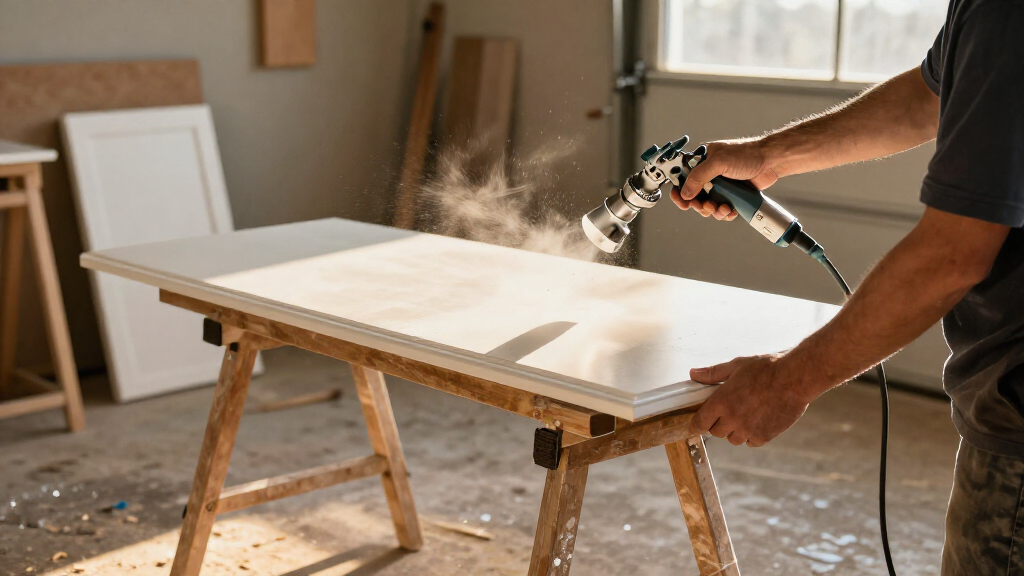
I ranked these sprayers around the demands of cabinet work: controlled application on doors and face frames, practical handling for repeated passes, and a finish process that a homeowner can manage. I weighed spray-system type, adjustability, container capacity, portability, paint compatibility information, and the likely burden of setup and cleanup. A cabinet-friendly tool should offer enough control to reduce runs and heavy edges, but it should also suit the scale of the job.
The order reflects fit, not a claim that one technology suits every project. HVLP systems rank higher for buyers focused on furniture-like finish control; airless models rank higher when cabinet work is part of a broader painting job. Compact handheld models can be easier to start with, while their capacity and consistency may be less appealing for many doors. I also distinguished established system formats from feature-rich budget-style sprayers, where the buyer should verify support, compatible coatings, and replacement parts before committing.
Factors to Consider When Choosing Paint Sprayers For Cabinets
Cabinet spraying is a sequence of preparation, application, and cleanup—not just choosing a machine. I’d match the sprayer to the number of doors, the coating, the workspace, and how much finishing practice you’re willing to do.
Choose the spray system around the finish and project size
HVLP systems generally give the operator more control over a smaller spray pattern, which can help on cabinet doors, rails, and stiles. Airless systems are designed to move paint quickly, a benefit when the job includes walls, fences, or other large surfaces as well as cabinets. Neither label guarantees a smooth result; the coating, tip or nozzle, pressure, and technique all matter. A common mistake is buying an airless unit for a small cabinet-only job without planning for overspray and masking. Another is choosing a small handheld sprayer for a large kitchen and underestimating refill and break time. Decide whether the cabinets are the whole project or one part of a larger repaint before prioritizing speed or control.
Check coating compatibility before choosing a sprayer
Cabinet coatings can vary in thickness and formulation, so confirm that the sprayer supports the specific primer and topcoat you plan to use. Some coatings may need straining, thinning, or a different nozzle setup, but follow the coating and sprayer instructions rather than assuming one recipe works for all products. Over-thinning can affect coverage and film build, while spraying material that is too thick can produce poor atomization or strain the unit. Ask whether the manufacturer specifies viscosity limits, compatible materials, or recommended accessories. Budgeting only for the sprayer can leave you without the right tips, filters, or cleaning tools. A compatible setup is more useful than a high wattage claim on its own.
Estimate capacity by counting doors and work sessions
Container size affects how often work stops, but a large reservoir is not automatically better for every cabinet project. A full kitchen may involve multiple doors, drawer fronts, and frames, so frequent refills can interrupt a consistent workflow. Smaller cups are lighter and easier to maneuver overhead or around narrow cabinet interiors, but they can slow a larger job. Consider whether you can spray doors in batches and refill between coats without losing track of which pieces are ready. Think about the weight of the complete sprayer when full, not just the empty tool. For a few doors, portability may matter more than capacity; for many doors, fewer interruptions can be worth a heavier setup.
Plan for masking, ventilation, and overspray
Cabinet spraying can put a fine coating mist on nearby floors, appliances, walls, and hardware, so the work area needs more protection than a brush-and-roller job. Remove doors and drawers when possible, label their positions, and create a stable spray area with room to move around each piece. Ventilation and suitable respiratory and eye protection should follow the coating label and local safety guidance. Airless equipment may cover large areas quickly, but that does not remove the need to control overspray around detailed cabinet parts. A tight workspace can make a smaller, more controllable setup easier to manage even if it takes longer. Include masking and drying space in the project plan before choosing based on spray speed alone.
Compare cleanup and serviceability, not just setup time
Leftover coating can dry in passages, nozzles, tips, and filters, so cleanup is part of each spraying session. Before buying, check how the paint-contact parts come apart and whether the manufacturer provides clear cleaning steps and replacement components. A system that is quick to assemble may still require careful flushing or brushing after use. If you plan to spray more than one color, factor in the time needed to clean between materials and avoid contamination. For infrequent use, simple access to the nozzle and a manageable cleanup routine may matter more than a long list of settings. Choosing equipment you can maintain properly can protect both the tool and the quality of later coats.
Spend more only when the added control or capacity will be used
A higher-end system can make sense when you have many cabinet parts, repeat projects, or a strong preference for controlled finish work. It is harder to justify extra equipment complexity for a one-time project with only a few doors, especially if setup and cleanup will be unfamiliar. At the same time, a low-cost sprayer can become frustrating if coating compatibility, replacement parts, or support are unclear. Compare the complete setup, including hoses, tips, filters, and any required accessories, rather than the main unit alone. Beginners may benefit more from a manageable tool and practice panels than from advanced controls they have not learned to use. Match spending to the number of projects and the finish demands, not to the largest specification.
Frequently Asked Questions
Is HVLP or airless better for painting kitchen cabinets?
I’d lean toward HVLP when the main goal is careful control on doors and cabinet frames, particularly in a smaller workspace. Airless is a stronger fit when cabinet painting is part of a much larger job and fast coverage matters. The final result still depends on using a compatible coating, choosing the right setup, and practicing your technique. Airless users should plan carefully for masking because overspray can reach nearby surfaces. If you are unsure, weigh your workspace and total surface area before choosing by speed alone.
Can I spray cabinet paint without thinning it?
That depends on the coating and the sprayer, so check both manufacturers’ instructions before loading the cup or reservoir. Some materials may spray as supplied, while others may need thinning or a specific nozzle arrangement. Do not thin by guesswork: too much can change coverage and the finished film, and too little can cause poor atomization. Test the full setup on a scrap panel before spraying a cabinet door. A test also helps you adjust distance and movement without risking visible parts.
Do I need to remove cabinet doors before spraying?
Removing doors and drawer fronts usually makes it easier to reach edges and spray each face consistently. It also lets you work horizontally on a stable surface, which can help reduce runs when your technique is still developing. Label each piece and keep its hardware together so reassembly is less confusing. Fixed cabinet frames still need careful masking and access planning. If removal is not practical, protect nearby surfaces thoroughly and test your reach and spray angle before coating exposed cabinetry.
How much should cleanup influence my choice?
Cleanup should carry substantial weight if you plan to spray only occasionally or switch between colors and coatings. Residue left in the nozzle, hose, filter, or paint passages can interfere with the next session, so a sprayer that is difficult to clean may become a poor fit even if it applies paint quickly. Check the disassembly and cleaning instructions before purchase, including whether the parts that contact paint are accessible. Also consider where you can safely flush or clean the equipment. A simple maintenance routine can matter more over a full project than an extra spray setting.
Which kind of sprayer makes sense for only a few cabinet doors?
For a small repair or a few doors, a compact handheld sprayer may be easier to stage than a larger system, provided it supports your coating and offers adequate control. A larger airless unit can add setup, masking, and cleanup that outweigh its speed on a small task. Still, a small container may require refills, so compare the number and size of pieces rather than assuming compact always means convenient. Practice on scrap material first and reserve enough coating for consistent passes. If the project could expand to walls or other large surfaces, a more versatile system may earn its extra setup.
Conclusion
For a cabinet-focused project where finish control leads, I’d choose the Fuji Spray 2202 Semi-PRO 2 as the best overall, with its system-style HVLP approach; buyers should accept more setup and cleanup than with a handheld option. For best value among practical homeowner choices, the HomeRight Super Finish Max is worth a look if its capacity and coating compatibility match the job. The Fuji is also my best premium direction for buyers prioritizing a dedicated HVLP system, while the Wagner FLEXiO 595 is a more approachable beginner pick for those who favor a handheld format. Choose the Graco Magnum Project Painter Plus or X5 for larger, mixed-surface projects where airless speed has real value, not just for a small set of cabinet doors. Before choosing any model, confirm coating compatibility, practice on a test panel, and account for masking and cleanup.